
Chemical Clock Reactions
- Circa 1987

These captions and transcript were generated by a computer and may contain errors. If there are significant errors that should be corrected, please let us know by emailing digital@sciencehistory.org.
Transcript
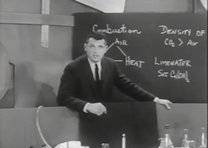
00:00:00 Hello, I am Harry Sello. It is my pleasure to introduce Tempest in a Test Tube, a television
00:00:13 show which made its debut August 24, 1955 on KQED Channel 9, the educational station
00:00:21 for the San Francisco Bay Area. Tempest was a series of 53 half-hour shows pioneering
00:00:29 a new approach in which I, as lecture demonstrator, gave live, unrehearsed presentations of a
00:00:37 series of chemical experiments. These were designed to illustrate basic, simple chemical
00:00:43 principles. The purpose was to stimulate an interest in chemistry by teenage students
00:00:50 and by adults. The talks and experiments had to be entertaining, educational, and simple.
00:00:59 Spontaneity and liveliness were key to the approach. All the experiments used in the
00:01:04 shows were designed and constructed by members of the California section of the American
00:01:09 Chemical Society. The participants were employed by the Shell Development Company, Emeryville,
00:01:16 and by Chevron Research, Richmond. A grant of $52,000 from the Ford Foundation and National
00:01:24 Educational Television permitted the filming of the first 24 shows of the series. The management
00:01:31 for the ACS consisted of Alan Nixon, section chair, Fred Stross, TV committee chair, myself
00:01:39 as first emcee, and Aubrey McClellan, second emcee. We four constitute the core of the
00:01:47 present committee. The series was extremely popular then with KQED viewers of all ages.
00:01:57 The senior chemist committee of the California section today is determined to revive Tempest
00:02:04 for the benefit of elementary schools, high schools, adult education classes, ACS local
00:02:11 collections, historical archives, TV stations, and similar organizations. We believe in chemistry
00:02:19 as a second language. While basic principles have not changed, practices have. Forty-five
00:02:28 years ago, such simple chemical demonstrations were not treated with the degree of safety
00:02:34 considerations that they are today. Today, even such simple demonstrations would be carried
00:02:41 out with the proper regard for safety glasses, shields, protective gloves, laboratory coats,
00:02:49 and visible fire extinguishers. The principle of safety first would be explicitly present
00:02:56 as part and parcel of a modern Tempest in a Test Tube.
00:03:41 Tempest in a Test Tube, a series of experiments designed to explain the mysteries of chemistry
00:03:56 and the laws that govern it. Produced by KQED San Francisco, in cooperation with the California
00:04:11 section of the American Chemical Society, for the Educational Television and Radio Center.
00:04:24 And now let's go to our laboratory and meet Dr. Harry Sello.
00:04:29 So, most of the reactions that a chemist will study are very similar to the one I'm
00:04:36 about to do. Pour a little bit of one chemical, and then let's stir in the next one. This
00:04:56 is a very common type of reaction. The reaction occurs immediately as soon as the chemicals
00:05:04 are mixed. There are many such reactions that the chemist studies. This particular one was
00:05:09 the reaction between silver nitrate and hydrochloric acid. The product, the white solid, is silver
00:05:16 chloride. Of course, the nitric acid that's formed stays in solution. But the reaction
00:05:21 occurs immediately. In this talk, we will concern ourselves with another kind of chemical
00:05:28 reaction, one which is not so common, the delayed chemical reaction, or what we sometimes
00:05:34 fondly call chemical clock reactions. Let's look at an example of a delayed chemical reaction.
00:05:42 Here's a little bit of one reagent. Now, add next. Well, nothing yet. There it goes.
00:06:06 Now the white precipitate forms. Notice that the reaction did not occur immediately
00:06:12 upon mixing the two solutions. At least nothing that we could see occurred immediately. There
00:06:18 was some delay. These two reagents are sodium thiosulfate, our old friend, hypo, and hydrochloric
00:06:28 acid. The two react together. Sulfur is one of the products of the reaction, but the sulfur
00:06:35 is not formed immediately. It is formed only after some preceding reactions occur. What
00:06:43 I mean is this, simply. This is a complicated situation. It's not just a simple reaction.
00:06:49 There's not just one. There are several. The main visible reaction is preceded by one or
00:06:56 two others, so that not until the first ones are out of the way does the main reaction
00:07:01 occur. In this case, sulfur is formed early, but you can't see it. It's just too small
00:07:08 a particle to be visible. The sulfur particles grow, become bigger grains until they become
00:07:13 visible and white, and now as they get bigger and bigger, really heavy in concentration,
00:07:20 they even have a yellow cast to them, and this particular one smells strongly of sulfur.
00:07:28 But however, there is a delay in the main reaction. This, then, is the first example
00:07:34 of what we'll call in this talk chemical clock reactions. Now when the chemist runs across
00:07:42 a situation like this, he proceeds to study what factors, just what things, will influence
00:07:49 the delay of a chemical reaction. Will it always occur? Are there other reactions like
00:07:53 this? How can I adjust this delay so we can study it at various intervals? Let's go on
00:08:01 and look at just such a situation of examining the factors which affect a chemical reaction.
00:08:11 Let me pour a little bit of this solution into the beaker. Water clear solution. Here
00:08:23 is a beaker, the same size, rather, that's been standing on ice for a while. It's chilled.
00:08:30 And here is some more of the same solution, which has been standing here for a few minutes,
00:08:35 also being chilled. I'll pour that in here. Now, let's see, put them like this, there.
00:08:59 Get them a little closer together so I can pour these both at the same time. The same
00:09:07 reagent, I'll pour these in simultaneously. Vigorous reaction. But look at the second
00:09:22 one. Phew! There's been some reaction. It's black, but notice the difference. Two things
00:09:34 that are different. One, it was delayed in starting, this was black while this was clear,
00:09:38 and then turned black, but not nearly as vigorous as the first one. Well, the reagents were,
00:09:45 in both cases, the sugar solution, a concentrated solution of sugar, cane sugar actually, sucrose,
00:09:52 plus concentrated sulfuric acid. One of the products formed is carbon. Also some gaseous
00:10:00 fumes, which seem to be affecting the lecture for some reason. Very pungent. Carbon is formed
00:10:07 in both cases. However, because of the low temperature, this chilled reaction was slower.
00:10:14 It took a longer time to get started. So now we must write our first factor, which we found
00:10:19 affects chemical reactions. Here is the table we'll start. We'll edit factors which influence
00:10:26 rate. By rate, I mean rate of chemical reaction, that is the speed with which things occur,
00:10:32 with which the visible result occurs. This first factor then is the temperature. In this case,
00:10:45 the result was the obvious one. The lower temperature caused the rate of reaction to
00:10:50 be slower. Lowering the temperature decreases the rate. Let's put it down that way. Lower
00:10:58 T decreases rate. You can look at that in the following way. Chemical reaction depends upon
00:11:16 various molecules getting together to react. The temperature of the solution is a measure
00:11:24 of how fast the molecules are moving around. That is, the higher the temperature, the faster
00:11:28 they're moving around. The more often they will bump into each other. If this rate of
00:11:33 bumping can be slowed down, naturally the rate with which the reaction occurs will be
00:11:38 slowed down. This is exactly what happened. Sulfuric acid needs to come in contact with
00:11:43 the cane sugar, with the sucrose. If you slow down the rate with which these come together,
00:11:48 at the same time decrease the number of collisions which occur, then you slow down the rate.
00:11:53 This is exactly what happened. Now, in the next series of experiments, we'll have a quantitative
00:12:01 way of estimating this. Let's actually time this delay in reaction that we've been talking
00:12:07 about. Let's use a timer to measure more accurately the amount of delay in the chemical reaction.
00:12:14 Mix these two solutions, stir, and start the timer.
00:12:28 Fifteen seconds have gone by. There it goes. Just about 20 seconds. Let's reset this to
00:12:56 zero. So at room temperature, these two reagents take about 20 seconds to react. Let's just
00:13:13 write this number down and keep it here for reference. Off on the side here, 20 seconds
00:13:18 is the base time for room temperature reactions. Now all we have to do is compare several others
00:13:27 to something like this to tell whether we have a factor which makes the reaction go
00:13:33 slower or faster. Here are the same solutions as the previous, except that in two of these,
00:13:41 I've started them off with some water, just plain distilled water, different amounts.
00:13:46 That is, in the first pair, we have exactly the same situation, or that is very close
00:13:51 to it. The next pair have the same reagents, but here is 50 milliliters of water added
00:13:58 to begin with, and in this one, 100 milliliters of water added to begin with. So that here
00:14:04 we'll have a concentrated case, let's say, here a more dilute case, and here even a more
00:14:10 dilute example. Let's time each one in turn and see what happens. Here's the first, which
00:14:16 should be roughly the same as the previous one if everything works right. These never
00:14:21 come out exactly because the volumes aren't exactly the same. Let's mix these two and
00:14:28 quickly start the timer again. About 18 seconds for the first one. Well, that's fairly close.
00:14:53 We had 20 here. For the same one, the second try, 18 seconds. Actually, there were different
00:14:59 volumes used in this particular one than that one. Equal volumes, here 100 milliliters each,
00:15:04 here 50 milliliters each, so the time wasn't too far off. Now let's then do the one with
00:15:11 the first bit of water added for dilution. Start the timer at zero again. Make sure things
00:15:30 are mixed here separately first. Now, see if you can guess whether this should be longer
00:15:47 or shorter. There's coming up the 18 seconds of the first one already. We're past that
00:16:01 point. There it goes, 33 seconds. 33 seconds for the 50 milliliters of water. This is,
00:16:25 we had a column here, water, H2O, zero. We got 18 seconds for 50 of water. We get 33 seconds.
00:16:35 Zero, 50, 18, and 33. Okay, now the next one. Reset the timer. Just have to take time to do
00:16:49 this. So, there's a, you can tell a little trace of reaction starting before the main reaction
00:17:01 occurs. That's because the indicator which is being used is not completely soluble in the
00:17:06 solution. There are little particles of it floating around. So you get a sort of a little
00:17:13 tiny bit of advance warning, but the main reaction occurs quite quickly. Now here's the one with the
00:17:17 100 milliliters of water. Mix that. Start the timer. Of course, you can already guess that
00:17:29 we'll have to do a little bit of waiting on this one. Patience is a virtue which every chemist
00:17:35 should have. 20 seconds. Get this out of the way and get it over here to where I can see this
00:17:53 thing. There. 35 seconds. We're past the second one already. 40. Not a trace of reaction yet.
00:18:10 There it goes. Just about 50 seconds. So with 100 milliliters of water added to both chemicals,
00:18:23 we had 50 seconds for reaction. Now, the principle illustrated here is that when the reactants,
00:18:33 or reagents, are diluted, spread apart, the reaction is slower. This fits from the molecular
00:18:41 notion because the molecules then have to travel longer distances to shoulder their
00:18:46 way through intervening water molecules in order to react. So we must now write down
00:18:51 our second factor for those which affect the rate or influence the rate, and that is concentration.
00:18:57 Lower the concentration decreases rate. By concentration, I don't mean the concentration
00:19:19 that the audience gives, nor that of the lecturer. I mean the concentration of the molecules in the
00:19:25 solutions. Let's go on then and look at the next factor. Need a timer again. We'll start it at zero
00:19:34 once more. Now, we already had an advanced look at this particular factor, temperature, when we
00:19:43 looked at the sulfuric acid and the sugar. But here is the same reaction that we've just studied,
00:19:49 only temperature now is the factor, more quantitative than the sugar reaction was.
00:19:53 Here's the first one. These jars now have been standing on the hot plate for some time. They're
00:20:00 quite warm. They're so warm that the labels are just about falling off. Stick on labels. Now,
00:20:09 I must be sure that we put the indicator in this one just before starting so we can tell
00:20:15 when the reaction occurs. I'll explain about this indicator in just a moment. Here's the one. Stir
00:20:26 it up well. Now, I have to try to operate quickly on this one. Get over here to hit this as soon
00:20:35 as we mix the two together. They're quite warm. Mix, start. Well, that maybe took one second.
00:20:43 Actually, the reaction practically went as soon as we mixed. So, let's continue our column here.
00:20:51 One second or less. Let's say zero to one second for hot. Kind of getting off the edge of the board
00:21:03 here. Zero to one second for hot reaction mixtures. Here is the comparison, the standard so-called at
00:21:12 room temperature. We have to be sure that we do that one so we can have something to refer to.
00:21:16 Let's see. Come around from this side. It works better. There we go. Again, indicator. What I was
00:21:26 going to say about the indicator is this is a reaction involving a base, hydroxyl ion. This
00:21:33 indicator is thymolphthalein, a jawbreaker, thymolphthalein. It turns dark in the presence
00:21:40 of base. The reaction completion is signified when the base is formed so the thymolphthalein
00:21:45 turns dark. Here is the reaction at room temperature by way of comparison. We already
00:21:51 have done this twice. Let's just repeat it for comparison. Oh, you have to have about three
00:21:57 arms to do this, maybe even two heads. We should come close to the time we observed before,
00:22:08 the 20 or the 18 seconds. It says here. There we go, 20 seconds. Very good, even if I say so
00:22:21 myself. Room temperature, 820 seconds. That was what we observed in the first case. Now,
00:22:32 the final bit is the one using the lower than room temperature, the chilled solutions. Get
00:22:43 these out here where we can see them. Indicator. Mix these. Good mixing is always a factor.
00:23:07 Now mix the two together, start the reaction, and let's observe this last time for this
00:23:16 reaction. This is now lower than room temperature. There is 20 seconds coming up. Now 20 seconds,
00:23:31 so we're already past the time for the room temperature reaction. 35, 50,
00:24:01 coming up. Any time now, we're ready for it. 65, coming up. A little trace of reaction appearing
00:24:17 at the top around where the indicator is concentrated. 70. Let's go, there we go. 75
00:24:29 seconds, or about 77 seconds. Well, this clearly illustrates then that cooling slows down the
00:24:34 reaction. Let's just write this last number down. 77 seconds at lower than room, less than room
00:24:42 temperature. The sign means less than. Well, so we've illustrated then with respect to this
00:24:51 quantitative nature that is accurately shown, as good as we could with the timer, that these
00:24:57 factors truly affect chemical reactions. We've shown temperature and concentration. In the next
00:25:03 experiment, there will be shown a slightly different factor which affects chemical reactions,
00:25:10 but also a different chemical reaction. We have shown two materials which reacted together in a
00:25:16 solution, that is, everything was mixed throughout. By the way, these two materials were, on the one
00:25:21 case, formaldehyde solution, on the other case, a mixture of sodium sulfite, sodium bisulfite.
00:25:27 That pair reacted with formaldehyde in this delayed manner, and the indicator,
00:25:32 thymophthalein, showed the change. Here is a setup where we're using an induction coil to
00:25:39 throw a spark. Now, I have here placed between the electrodes a piece of aluminum. I'll place
00:25:47 it right in there again, right between the two electrodes. If I make contact,
00:25:51 I can cause a spark to flow across the electrodes and right through the aluminum.
00:26:02 There has been no visible effect on the aluminum. Nothing has happened. The spark just flowed right
00:26:15 through. It's a conductor, so it's not surprising that this happened. But let's do this reaction
00:26:21 with aluminum in a slightly different form. Here's my aluminum in a slightly different form,
00:26:25 in the form of a powder. I'll put this powder in this flask. A goodly amount in there,
00:26:37 even a little bit more will do. Lower the electrodes down into the powder,
00:26:44 or close to it, and put in a device for blowing a little jet of air.
00:26:52 See if I can just get this placed right here. So this will go right down into the powdered aluminum.
00:27:02 Come on, behave. I'll just turn this around. We want to make sure that the little air blower
00:27:14 goes right down into the middle of the powder, right near the spot. There we go. Now,
00:27:19 better put my safety glasses on for this one, and for Mars. I'll throw the spark,
00:27:31 cause the spark to go. There it is, right down in the flask, and then watch what happens when
00:27:36 I start squeezing the bulb. A rather rapid reaction. That was also aluminum. The aluminum
00:27:48 reacted in its powdered form somewhat quicker than it reacted, if at all, in the solid form.
00:27:56 The only difference in these two experiments was the fact that in the one case we used solid
00:28:02 aluminum, and the other powdered aluminum. So the only difference was the state of subdivision. How
00:28:07 small the particles of aluminum were. Here, the oxygen of the air can only get at the aluminum
00:28:13 on two surfaces. Maybe a little bit along the edge, that's tiny. In the case of the powder,
00:28:19 all the tiny little particles of aluminum can be surrounded by oxygen. So that when the spark is
00:28:24 thrown, the reaction starts, aluminum reacts with oxygen, and you get a very vigorous flash.
00:28:29 Aluminum oxide is formed. So we must then write a third factor which affects chemical reactions.
00:28:35 Call it the state of subdivision. Subdivision. I don't mean any particular real estate or anything
00:28:57 like that, but the fine particles react more quickly. So let's say fine particles faster.
00:29:10 Well, let's summarize all this mumbo-jumbo. What have we seen in this talk? We examined
00:29:22 the factors which influence the rate of a reaction. The reason we could talk about this
00:29:27 is that there are two kinds of reactions, roughly, in this sense. Reactions which occur so fast that
00:29:34 there is no delay. Instantaneous reactions. That was illustrated by the reaction between
00:29:39 silver nitrate and hydrochloric acid. We then showed an example of a reaction which occurred
00:29:49 with a delay. The reaction between sodium thiosulfate and hydrochloric acid. In this case,
00:29:55 sulfur particles were formed, sulfur dioxide was given off, and you could smell the sulfur
00:30:01 dioxide. A smell which a lot of people associate with sulfur. Actually, the sulfur doesn't have
00:30:08 an odor of its own, but the sulfur dioxide which is present usually gives the pungency. Well,
00:30:13 we went on then to show that temperature affects reactions. That was the first factor. The lower
00:30:19 the temperature, the lower the rate. The slower the reaction proceeded. This was illustrated very
00:30:24 graphically by the timed reactions in which when we chilled the reactants, that is started out with
00:30:36 room temperature and less than room temperature, we found that the reaction took longer and longer
00:30:42 to proceed. This was easy to explain in terms of molecules reacting in that the lower the
00:30:50 temperature, the slower the molecules moved around. The less often they collided so that
00:30:54 the less often they could react. Conversely, if we increased the temperature, we would increase
00:31:00 the rate. Then we could see by adding some water, different amounts that we could also lower the
00:31:07 rate. That is, diluting the reaction decreased the rate. So the lower the concentration, the
00:31:14 lower the rate. Also explainable in terms of the molecules in that the fewer of them there are,
00:31:20 the less will be the amount of reaction or the slower will be the reaction. Not the less will
00:31:25 be the amount of reaction. That's not quite right. The slower will be the reaction. Finally,
00:31:29 by choosing a dust explosion type of reaction, we showed that aluminum in a finely divided state
00:31:34 would really react explosively, whereas ordinary aluminum does not react with oxygen very quickly.
00:31:40 In fact, this dust explosion is typical of what you might see in the papers from time to time,
00:31:45 dust explosions in grain elevators, coal mines, and so forth. Chemical clock reactions. Thank you.
00:32:34 This is national educational television.
“Chemical Clock Reactions" is one of fifty-three short educational films originally produced in 1955 for KQED San Francisco as part of the series Tempest in a Test Tube. This series of half-hour episodes illustrates basic chemistry concepts for high school students through live experiments and demonstrations by presenter Dr. Harry Sello. The experiments used in the show were designed by the American Chemical Society’s California chapter and reflect the safety standards of the time. This episode, “Chemical Clock Reactions,” teaches viewers how and why some chemical changes are delayed, and shows how different factors, like temperature, affect how fast reactions happen.
| Property | Value |
|---|---|
| Creator of work | |
| Place of creation | |
| Format | |
| Genre | |
| Medium | |
| Extent |
|
| Language | |
| Subject | |
| Rights | In Copyright - Rights-holder(s) Unlocatable or Unidentifiable |
| Credit line |
|
Institutional location
| Department | |
|---|---|
| Collection |
Related Items
Cite as
American Chemical Society, and KQED-TV (Television station : San Francisco, Calif.). “Chemical Clock Reactions.” Vhs, circa 1987. Tempest in a Test Tube Videocassette Collection. Science History Institute. Philadelphia. https://digital.sciencehistory.org/works/gw5i8m1.
This citation is automatically generated and may contain errors.