
Oxygen
- Circa 1987

These captions and transcript were generated by a computer and may contain errors. If there are significant errors that should be corrected, please let us know by emailing digital@sciencehistory.org.
Transcript
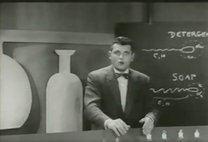
00:00:00 Hello, I am Harry Sello. It is my pleasure to introduce Tempest in a Test Tube, a television show which made its debut August 24th, 1955, on KQED Channel 9, the educational station for the San Francisco Bay Area.
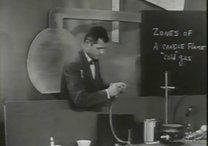
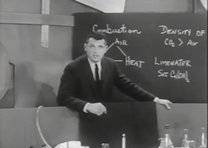
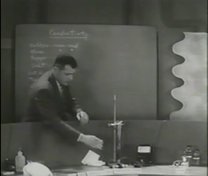
00:00:22 Tempest was a series of 53 half-hour shows pioneering a new approach in which I, as lecture demonstrator, gave live, unrehearsed presentations of a series of chemical experiments.
00:00:37 These were designed to illustrate basic, simple chemical principles. The purpose was to stimulate an interest in chemistry by teenage students and by adults.
00:00:50 The talks and experiments had to be entertaining, educational, and simple. Spontaneity and liveliness were key to the approach.
00:01:00 All the experiments used in the shows were designed and constructed by members of the California section of the American Chemical Society.
00:01:09 The participants were employed by the Shell Development Company, Emeryville, and by Chevron Research, Richmond.
00:01:16 A grant of $52,000 from the Ford Foundation and National Educational Television permitted the filming of the first 24 shows of the series.
00:01:27 The management for the ACS consisted of Alan Nixon, section chair, Fred Strauss, TV committee chair, myself as first emcee, and Aubrey McClellan, second emcee.
00:01:41 We four constitute the core of the present committee. The series was extremely popular then with KQED viewers of all ages.
00:01:54 The senior chemist committee of the California section today is determined to revive Tempest for the benefit of elementary schools, high schools, adult education classes,
00:02:08 ACS local sections, historical archives, TV stations, and similar organizations. We believe in chemistry as a second language.
00:02:20 While basic principles have not changed, practices have.
00:02:25 45 years ago, such simple chemical demonstrations were not treated with the degree of safety considerations that they are today.
00:02:34 Today, even such simple demonstrations would be carried out with the proper regard for safety glasses, shields, protective gloves, laboratory coats, and visible fire extinguishers.
00:02:49 The principle of safety first would be explicitly present as part and parcel of a modern Tempest in a Test Tube.
00:03:04 This is a test tube.
00:03:11 This is a test tube.
00:03:19 This is a test tube.
00:03:29 This is a test tube.
00:03:49 Tempest in a Test Tube, a series of experiments designed to explain the mysteries of chemistry and the laws that govern it.
00:03:59 Produced by KQED San Francisco,
00:04:08 in cooperation with the California section of the American Chemical Society,
00:04:17 for the Educational Television and Radio Center.
00:04:23 And now let's go to our laboratory and meet Dr. Harry Sello.
00:04:30 Hello. In this talk I would like to demonstrate the properties of a material which is vital to the life of all of us, oxygen.
00:04:41 Before describing some of the experiments, I would like to start one which will take a little time to develop.
00:04:48 And we can come back and refer to it at a later period in the talk.
00:04:53 Here is a dish containing colored water on which are placed two test tubes full of the same water.
00:05:02 These test tubes have in them two little electrodes, electrical leads that is, which are connected to four dry cells in series.
00:05:12 This nest of dry cells acts as one big battery.
00:05:17 I'll make the final connection and start the experiment.
00:05:27 There, we've connected on that one.
00:05:31 Immediately, bubbles can be seen rising in both test tubes.
00:05:38 And upon looking closely and knowing what to look for, in this test tube, the bubbles seem to be rising much faster than they are in this one.
00:05:47 That is, there are more of them than there are in this one.
00:05:51 Well, let's go on and come back and look at this later in the talk.
00:05:59 About 180 years ago, the following experiment was performed.
00:06:06 A little bit of an orange powder was placed in a test tube.
00:06:19 Perhaps a little more neatly than this, but in the same way.
00:06:36 Just shake that down a little.
00:06:49 Light the burner.
00:07:01 Now let's get this just to the right level.
00:07:11 This bright orange powder is turning darker around the edges where the burner is hitting directly.
00:07:20 Let's let that heat for a moment and describe the experiment a little bit more.
00:07:26 As I say, 180 years ago, this observation was made.
00:07:30 A gentleman by the name of Joseph Priestley, a chemist then,
00:07:36 well, some people called him an alchemist, one of these old-time chemists,
00:07:41 was observing the effect of heat on this orange powder and he made these same observations.
00:07:46 It turned black while heating.
00:07:49 It seemed to liberate some sort of what he called air.
00:07:54 Those days, most all gases were called air.
00:08:00 While this material turned black where it was being heated,
00:08:04 it also started to deposit a light grayish film on the side of the test tube.
00:08:11 And this grayish film is now beginning to be deposited right here.
00:08:14 There's a sharp line of it.
00:08:17 He then, Mr. Priestley did, took a glowing splint, a piece of wood,
00:08:28 got it to just glowing, and put it down over this material.
00:08:32 And about the same thing happened.
00:08:36 The glowing splint burst into flame.
00:08:50 There, again.
00:08:52 This evidence to Mr. Priestley was the discovery of this vital material, oxygen.
00:08:59 He didn't know it was oxygen, unfortunately.
00:09:01 He knew its properties.
00:09:03 He knew what it could do, that it could support combustion,
00:09:05 that mice could live in it for a certain period of time
00:09:08 and would die after the oxygen disappeared.
00:09:10 But he did not call it oxygen.
00:09:13 He called it one of his peculiar kind of airs or gases that he had been studying at the time.
00:09:20 He even went so far as to breathe it.
00:09:23 Well, I don't think we should repeat that part of the experiment.
00:09:26 In those days, they took a little more chances than we do now, mostly because of ignorance.
00:09:31 It remained for another chemist, about the same period, who was acquainted with Mr. Priestley,
00:09:37 to be impressed by this experiment and to go on and study this air a little further,
00:09:43 and this other chemist gave it the name of oxygen.
00:09:46 Let's write these chemists' name on the board.
00:09:57 Priestley, the gentleman who discovered oxygen.
00:10:06 Lavoisier, the man who studied it and gave it its name.
00:10:10 Lavoisier called it oxygen, meaning acid former,
00:10:14 because he knew that oxygen was present in most acids,
00:10:19 so he felt that this element should be called acid former or oxygen.
00:10:24 The material which both Mr. Priestley and Mr. Lavoisier heated at that time was mercuric oxide,
00:10:31 a material composed of mercury and oxygen,
00:10:35 which, when heated, liberates oxygen,
00:10:38 which gives the test that I showed, causes a glowing splint to burst in the flame.
00:10:43 Now, upon cooling, it is turning back to its former color,
00:10:48 the same as it was in the jar, sort of orange, light colored.
00:10:52 Around the cooler portions of the test tube, the gray film is mercury.
00:10:58 Well, the lives of these gentlemen were very interesting,
00:11:01 and the work that they did was extremely entertaining,
00:11:03 and it's certainly worthwhile the time of anyone who is interested to read about their lives,
00:11:08 and I think one book that I would like to recommend is the following,
00:11:13 a book written by Jaffe,
00:11:18 entitled Crucibles,
00:11:26 Crucibles, the Story of Chemistry.
00:11:40 This is just one of many books of chemical history on that very big topic.
00:11:46 I happen to like this one personally.
00:11:48 It's a very romanticized type of story.
00:11:51 Jaffe writes about this in an exciting way.
00:11:56 Well, as I say, Mr. Lavoisier, the chemist who gave oxygen its name, was a brilliant man indeed.
00:12:02 He unfortunately was living in a time when things were really troublesome,
00:12:07 the French Revolution, and because of some very bad mistakes,
00:12:11 Lavoisier was killed as a traitor to his country, which of course he was not.
00:12:16 A lot of accidents did happen then.
00:12:19 He was an unfortunate accident.
00:12:21 No one knows what he could have done had he remained alive.
00:12:25 We call Lavoisier the father of modern chemistry
00:12:28 because of the studies that he made on oxygen and its properties.
00:12:31 In particular, the use that he made of the analytical balance,
00:12:36 a very essential tool in proving the laws of chemistry.
00:12:41 In this next experiment, which was one of the same type that these gentlemen conducted
00:12:46 because it has to do with the properties of oxygen,
00:12:49 in this next experiment, there is here a candle
00:12:52 which is standing in a little puddle of water in a dish.
00:13:06 We've now seen that we can get oxygen by heating a particular chemical like mercuric oxide,
00:13:13 the chemical that Priestley and Lavoisier studied.
00:13:16 We also know that there is oxygen in the atmosphere around us.
00:13:20 Let's look at its effects upon a candle burning.
00:13:24 This candle will get good and started here.
00:13:30 Now, I'll carefully lower this tube over the candle.
00:13:43 And put the stopper on the top.
00:13:46 The level of the liquid is now at the bottom of the dish at the foot of the candle.
00:13:51 And there the candle just went out and see what happened.
00:13:56 The level jumped up to about here,
00:14:00 to a point where the pressure equalized on both sides.
00:14:04 Then a little air got in around the bottom of the tube
00:14:08 and the level fell back down a little ways.
00:14:11 But there it is still rising, still above the level in the dish.
00:14:14 What has happened here?
00:14:16 The candle made use of the oxygen in the atmosphere around us.
00:14:20 It consumed most of that oxygen in burning.
00:14:23 Because the oxygen was consumed,
00:14:26 the pressure inside the tube became lower than that in the atmosphere around the tube,
00:14:30 so that outside pressure forced the liquid up on the inside to equalize pressures.
00:14:35 At the time it did this,
00:14:37 I just saw a little bubble of air run in around the bottom of the tube
00:14:43 and instead of the liquid level being up here,
00:14:47 as it might have been for a moment,
00:14:49 it's actually down here.
00:14:51 The reason the candle went out was because it consumed this very vital material, oxygen.
00:14:57 This experiment demonstrates that a good portion of the air around us is oxygen.
00:15:01 It does not exactly tell us how much.
00:15:04 That has to be done by means of another more complicated experiment.
00:15:08 But we do know that we have in the air around us about 21% of oxygen
00:15:13 with the remainder nitrogen and small amounts of other gases.
00:15:18 This experiment is a demonstration of the process of oxidation.
00:15:23 That is, the process in which oxygen combines with other materials.
00:15:29 This process takes place in nature around us all the time.
00:15:33 The rusting of metals, the burning processes that we see,
00:15:37 a piece of wood or coal or oil burning,
00:15:41 is a process of oxidation.
00:15:43 Of course, in the case of the fuels like that,
00:15:46 we prefer to call it combustion,
00:15:48 which can be really called a rapid oxidation.
00:15:51 But in all of these, oxidation is the process by which some material combines with oxygen.
00:15:58 In this case, the wax of the candle combined with oxygen.
00:16:03 It's of interest to know that in our own bodies at all times,
00:16:07 this same process is taking place.
00:16:11 However, it is not as simple as it would be in the burning of a candle.
00:16:15 If it were, you'd probably say this is why we burned a candle at both ends.
00:16:19 In our everyday living, we call it respiration.
00:16:23 Respiration means the process by which we take in air,
00:16:27 soak up the oxygen into our bloodstream,
00:16:31 let the oxygen be carried around into the blood cells
00:16:35 where it's combined with the fuel that we take in, the food we eat.
00:16:39 The burning or oxidation process takes place in the cells.
00:16:42 Carbon dioxide and unused oxygen, the products of this oxidation,
00:16:47 are carried back out through the lungs and exhaled.
00:16:51 This process of respiration then is nothing more or less
00:16:55 than a sort of a complicated type of oxidation.
00:16:59 In the course of this process then, we use oxygen to combine it
00:17:03 with our fuels, the food we eat.
00:17:06 Let's look further at the properties of oxygen.
00:17:10 To do this, I should take my burning burner over with me
00:17:17 and examine some of these properties of oxygen.
00:17:23 The burner wasn't burning. I'm at the burning issue.
00:17:27 We've shown that oxygen can be obtained from a chemical
00:17:31 by heating that chemical.
00:17:34 Oxygen then can also be obtained from the air around us.
00:17:38 The process in which liquid air is made, for example, is a source of oxygen.
00:17:42 When oxygen is obtained by this kind of a process,
00:17:44 that is by liquefying air and getting the oxygen from it,
00:17:48 we get oxygen in the form of cylinders.
00:17:51 It is contained in cylinders.
00:17:53 Here is a cylinder of oxygen.
00:17:55 The cylinder comes filled with something like 2,000 pounds per square inch
00:18:00 of oxygen and is about as pure as it can be obtained.
00:18:06 The cylinder is now open. This has been used.
00:18:08 It registers something over 1,100 pounds per square inch.
00:18:14 By cranking this, you can hear the oxygen rushing down through the tube.
00:18:19 I will just fill up this little jar full of oxygen.
00:18:26 While the jar is being filled, let me light my burner.
00:18:41 I think the jar is now about filled.
00:18:45 Just adjust the flame of the burner so it can be barely seen.
00:18:48 A slight yellow flame.
00:18:50 It's not the most efficient kind of a way to use the burner,
00:18:53 but at least under these bright lights, the yellow flickering can be seen.
00:18:59 Light the splint.
00:19:03 And let's see if we can find our oxygen.
00:19:13 There it goes, bursting in the flame.
00:19:18 A glowing splint test for the presence of oxygen.
00:19:21 By doing it in this way, I've also shown one of the other properties of oxygen,
00:19:25 not immediately obvious, and that is that oxygen by itself is heavier than air.
00:19:32 Air is a mixture of nitrogen and oxygen, mostly nitrogen.
00:19:36 Pure oxygen is heavier than air, so it would tend to run out of the jar.
00:19:42 Now since I've used it up, I better fill this thing up again.
00:19:52 I can feel the oxygen running around the hand here as I wait.
00:19:59 There, I think that's full.
00:20:04 Let's take this little bit of steel wool.
00:20:09 Fine wires of iron.
00:20:12 And to do this, I really should put on my safety glasses.
00:20:16 Just in case glass wants to fly around.
00:20:20 I'll heat the steel wool. You see it gets slightly or reddish in the flame.
00:20:30 A little bit redder and hotter in the oxygen.
00:20:33 While steel wool glowed in the flame, barely glowed,
00:20:38 it burst into white hot heat and a visible flame in the oxygen.
00:20:42 Not only that, but this must be a very strong piece of glass indeed
00:20:47 because the molten piece of steel wool,
00:20:50 that is the steel wool melted in the form of a red hot bead,
00:20:53 white hot bead, and fell to the bottom of the tube
00:20:56 and as a matter of fact burned a hole right through the tube
00:20:59 because there's a scorch mark left here on the table.
00:21:04 So this process of oxidation is indeed a very striking one
00:21:08 when pure oxygen is used.
00:21:13 This glass, by the way, is made of heat-resistant glass.
00:21:16 This jar is of heat-resistant glass so that it didn't crack,
00:21:19 but a hole did burn through the bottom
00:21:22 due to the heat of the iron being oxidized to iron oxide.
00:21:27 Let's fill this up again.
00:21:30 That should be about full.
00:21:35 This time, we'll take a little bit of charcoal
00:21:39 and examine the effect of charcoal in oxygen.
00:21:46 There are some flakes of charcoal already flying off the tube.
00:21:50 Beginning to get a little red hot in spots.
00:21:55 Oxidation is now taking place in the atmosphere.
00:21:58 The carbon is being oxidized to carbon dioxide,
00:22:01 but it's a very low rate because it uses only the oxygen in the atmosphere,
00:22:05 which is dilute.
00:22:07 The carbon is being oxidized to carbon dioxide,
00:22:10 but it's a very low rate because it uses only the oxygen in the atmosphere,
00:22:14 which is dilute.
00:22:16 Let's see. Let's see what happens if we shake this into the oxygen here.
00:22:20 Bursts into more glowing sparks than it was here.
00:22:27 The illustration here, then, is that the process of oxidation
00:22:30 in the presence of almost pure oxygen, 100% oxygen,
00:22:33 is much more rapid than it is in the case of just atmospheric oxygen.
00:22:37 Let's go on to the next experiment to see a further demonstration
00:22:41 of the process of oxidation in the presence of almost pure oxygen,
00:22:45 and to see a further indication of oxidation.
00:22:48 Here is a glass tube, a burette,
00:22:52 a stopcock at the top to shut it off.
00:22:55 The bottom part of it is sealed off by being immersed in a dish of water.
00:22:59 So there's a burette full of air now open at this end
00:23:05 and sealed off by being immersed in the water at this end.
00:23:09 I have placed inside of this burette a bit of the same steel wool
00:23:14 of the type that I used here to...
00:23:16 in fact, of this same pad that I used to burn in the jar.
00:23:20 I'll just run some oxygen over this steel wool.
00:23:29 You see, oxygen is not a poisonous gas,
00:23:31 so it can be allowed to escape out into the air.
00:23:33 It just enriches the air around us a little bit.
00:23:36 It might give the speaker a little kick.
00:23:40 I'll run some of this over the...
00:23:43 There it is bubbling through the burette.
00:23:45 I'm running it over the iron, the steel wool that's in the tube.
00:23:49 It's escaping out the bottom, the excess.
00:23:52 Make sure we wash out all the air.
00:23:54 Just replace it with nothing but oxygen.
00:23:57 There, I think that's about ready now.
00:24:00 And I'll shut this off.
00:24:02 At the start, the level of the liquid is the same in the dish
00:24:08 as it is in the tube.
00:24:13 And already, the level on the inside of the tube has begun to rise,
00:24:19 and it's up about a half an inch from the surface of the liquid
00:24:23 on the outside of the tube.
00:24:25 There is an indication that the pressure on the inside of the tube
00:24:28 is being decreased.
00:24:30 Oxygen is being consumed.
00:24:33 And it is continuing to rise even as I watch it here.
00:24:38 What is this process?
00:24:39 Well, this again is oxidation, a very familiar kind of oxidation.
00:24:44 Since this is iron reacting with oxygen,
00:24:48 then this is what we normally call rusting.
00:24:52 By making this take place in an atmosphere of pure oxygen,
00:24:57 why, the rusting process goes on much faster than it would
00:25:00 if the iron were just left lying around out into the air,
00:25:03 out in the air, so that the rusting process is so fast
00:25:08 that the oxygen is being used up and water is rising to replace it.
00:25:15 In fact, some of the iron particles, I can see by looking extremely close,
00:25:21 are getting colored with a brownish covering of iron oxide or rust.
00:25:27 Again, a demonstration, a visible demonstration of the process
00:25:30 of oxidation in action.
00:25:34 Well, let's go on.
00:25:35 Let this sit here.
00:25:37 Perhaps it will rise even further.
00:25:41 Let's take a look at the experiment that we started
00:25:43 at the beginning of the talk.
00:25:46 For this, I will need my glasses and burner.
00:26:03 The action of the battery has now stopped
00:26:07 because this tube is empty.
00:26:11 This tube is about half full.
00:26:15 I'll just disconnect this to make sure that we don't run into any trouble here.
00:26:22 This first test tube now is completely full of gas.
00:26:32 Let's see if we can identify the gas that's in it.
00:26:46 I very carefully hold the test tube in the upside-down position.
00:26:57 Light the splint, and...
00:27:07 That pop you heard was the pop due to the hydrogen
00:27:11 which had filled the test tube, burning as it escaped.
00:27:14 It combined very quickly with the oxygen of the atmosphere,
00:27:18 and the presence of the burning splint exploded, actually.
00:27:22 I had to tip the test tube up to do this,
00:27:24 which proves that hydrogen, then, is lighter than air.
00:27:27 It can escape when the test tube is held upwards.
00:27:31 Let's look at the next one.
00:27:36 This time, I'll let the remaining liquid pour out.
00:27:41 Here's a glowing splint.
00:27:44 Very carefully turn this over, and there, the glowing splint
00:27:47 didn't quite burst into flame, but suddenly, certainly, glowed more brightly.
00:27:52 So the half of the test tube here was filled with oxygen.
00:27:56 Again, in this case, the test tube was filled with oxygen.
00:28:01 Again, in this case, I had to quickly turn the test tube right-side up
00:28:05 so that the oxygen would not escape, since it itself is heavier than air.
00:28:11 Let's look at a short diagram of...
00:28:14 a brief diagram of just this setup, and explain what happened.
00:28:24 Here's the jar.
00:28:27 Here's the jar.
00:28:30 In it is a level of liquid about up to here,
00:28:35 and two test tubes, which were sitting about like that,
00:28:42 on a tray.
00:28:44 I'll just sort of sketch in the fact that there was a tray.
00:28:47 Right about at the level of liquid.
00:28:49 In each test tube, there is a little square piece of platinum
00:28:52 called an electrode.
00:28:57 One piece of platinum was connected through a wire
00:29:03 to one side of the battery.
00:29:05 We'll mark that plus.
00:29:07 The other piece of platinum was connected through a wire
00:29:10 to the other side of the battery.
00:29:12 We'll just mark that minus.
00:29:14 I show these going off to different sides.
00:29:17 Actually, they came around and connected to the dry cells.
00:29:22 This side was completely full of gas.
00:29:26 This side was half full of gas.
00:29:28 Here was the hydrogen.
00:29:30 Here was the oxygen.
00:29:32 So, by the passage of an electric current through the water
00:29:37 into the water of the test tubes,
00:29:39 we separated water into its two components, hydrogen and oxygen.
00:29:44 This is called electrolysis.
00:29:48 Electrolysis.
00:29:53 Two volumes of hydrogen were obtained for one volume of oxygen.
00:29:56 This is where water gets its formula named H2O.
00:30:01 Now let's summarize.
00:30:04 Oxygen was discovered by Priestley,
00:30:07 really identified and named by Lavoisier about 180 years ago.
00:30:14 It is indeed a vital element.
00:30:16 It's important to us in our everyday life.
00:30:19 We breathe it through a process we call respiration.
00:30:23 Pure oxygen is capable of supporting combustion.
00:30:28 Things glow very brightly and even catch fire
00:30:31 when they're immersed in pure oxygen,
00:30:33 such as glowing steel wool,
00:30:35 will oxidize or undergo a process called oxidation
00:30:39 and burn very violently.
00:30:41 In our case, we saw where a piece of molten steel
00:30:44 fell to the bottom of the glass beaker
00:30:47 and burned its way right through the bottom of the beaker.
00:30:51 We then had a further indication of oxidation in the tube.
00:30:56 In fact, I can show you that the water has filled the test tube,
00:31:00 filled this tube rather, by opening it at the top
00:31:03 and dropping the level nearer to where it started.
00:31:06 It actually started at the bottom.
00:31:08 This process also was oxidation,
00:31:11 the iron combined with oxygen to form iron oxide.
00:31:15 This is the process that occurs every day in nature around us,
00:31:19 the rusting of metals, the burning of fuels with oxygen.
00:31:24 Processes which take place slowly in the atmosphere
00:31:28 take place quickly in pure oxygen.
00:31:31 Thank you.
00:31:33 ♪♪
00:31:43 ♪♪
00:31:53 ♪♪
00:32:03 ♪♪
00:32:13 ♪♪
00:32:24 This is national educational television.
“Oxygen" is one of fifty-three short educational films originally produced in 1955 for KQED San Francisco as part of the series Tempest in a Test Tube. This series of half-hour episodes illustrates basic chemistry concepts for high school students through live experiments and demonstrations by presenter Dr. Harry Sello. The experiments used in the show were designed by the American Chemical Society’s California chapter and reflect the safety standards of the time. This episode, “Oxygen,” teaches viewers how and why oxygen is essential, and shows how it is produced, identified, and used in reactions like combustion and respiration.
| Property | Value |
|---|---|
| Creator of work | |
| Place of creation | |
| Format | |
| Genre | |
| Medium | |
| Extent |
|
| Language | |
| Subject | |
| Rights | In Copyright - Rights-holder(s) Unlocatable or Unidentifiable |
| Credit line |
|
Institutional location
| Department | |
|---|---|
| Collection |
Related Items
Cite as
American Chemical Society, and KQED-TV (Television station : San Francisco, Calif.). “Oxygen.” Vhs, circa 1987. Tempest in a Test Tube Videocassette Collection. Science History Institute. Philadelphia. https://digital.sciencehistory.org/works/2loir3q.
This citation is automatically generated and may contain errors.