
may contain errors
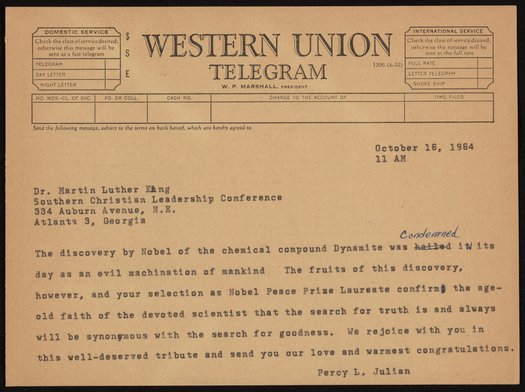
Telegram from Percy L. Julian to Martin Luther King Jr., October 16, 1964
- 1964-Oct-16
Rights
 In Copyright
Download all 2 images
PDFZIPof full-sized JPGsDownload selected image
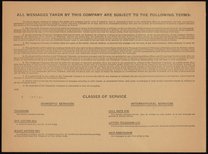
Small JPG1200 x 897px — 199 KBLarge JPG2880 x 2153px — 1.1 MBFull-sized JPG5140 x 3842px — 3.5 MBOriginal fileTIFF — 5140 x 3842px — 56.5 MBPercy Lavon Julian (1899-1975) congratulates Reverend Martin Luther King Jr. (1929-1968) for receiving the Nobel Peace Prize in 1964 for his “non-violent struggle for civil rights for the Afro-American population”.
Julian is internationally recognized for his pioneering research in the development of cortisone, sex hormones, soybean proteins, and firefighting foam. Over the course of his career, Julian received more than 130 chemical patents and in 1973, became the second African American, following David Blackwell (1919-2010), to be elected to the National Academy of Sciences.
| Property | Value |
|---|---|
| Author | |
| Addressee | |
| Place of creation | |
| Format | |
| Genre | |
| Extent |
|
| Language | |
| Subject | |
| Rights | In Copyright |
| Rights holder |
|
| Credit line |
|
Institutional location
| Department | |
|---|---|
| Collection |
Related Items
Cite as
Julian, Percy Lavon. “Telegram from Percy L. Julian to Martin Luther King Jr., October 16, 1964,” October 16, 1964. Percy Lavon Julian Papers. Science History Institute. Philadelphia. https://digital.sciencehistory.org/works/e1oh4a1.
This citation is automatically generated and may contain errors.

Rights
In Copyright