
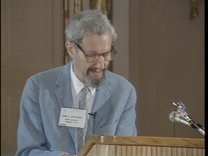
Frank Westheimer: Chemical Education Division Awards Speech (Tape 2)
- 1988-Jun-07

These captions and transcript were generated by a computer and may contain errors. If there are significant errors that should be corrected, please let us know by emailing digital@sciencehistory.org.
Transcript
00:00:00 Within those, and within science, those underpinnings are more difficult to learn on one's own
00:00:09 than the corresponding underpinnings in, say, history. But there is a lesser problem in
00:00:16 extending knowledge in a field of the humanities. In a study of literature, it doesn't matter
00:00:23 whether you take a course on Harding before or after you take one on British and Irish
00:00:28 poetry or one on the novels since World War II or one on the letter in literature. Those
00:00:36 titles are taken from the current Harvard catalog.
00:00:41 The extension of knowledge of literature is certainly an important part of education,
00:00:46 but no one is educated anyway whose education stops when he or she receives a degree from
00:00:51 college. The role of college is primarily to provide underpinnings, and these are especially
00:00:57 important for vertical learning. At a graduation ceremony at the University of Chicago some
00:01:03 years ago, Professor Roger Hildebrand spoke of his father, Joel Hildebrand, a famous chemist
00:01:10 and professor at the University of California at Berkeley, who died a few years ago at the
00:01:15 age of 102. Roger Hildebrand told how his father had attended the Chicago World's Fair
00:01:22 in 1898 and had visited the fledgling University of Chicago to consider whether he wanted to
00:01:28 attend it. He decided instead to go to the University of Pennsylvania. Roger Hildebrand
00:01:35 reported that it was just as well that his father had decided not to attend the University
00:01:39 of Chicago since his father was destined to be a great chemist, and if he had attended
00:01:44 the University of Chicago in 1898, they wouldn't even have taught him about the electronic
00:01:50 structure of matter because the electron hadn't yet been discovered. The art department
00:01:58 would not have shown him photographs of Picasso's paintings since they hadn't yet been painted,
00:02:05 and so on. Most of what we learn must be learned after we leave college. What we need in college
00:02:12 is the background and enthusiasm for learning. That background is more essential the more
00:02:18 highly vertical the subject matter to be learned. True, learning a foreign language
00:02:25 is vertical. Critics of my emphasis on the vertical nature of learning in science point
00:02:30 out that learning of Oriental languages in particular is also highly vertical and requires
00:02:37 several years in sequence, just as sciences do. But much of the cultural value of a foreign
00:02:44 language can be obtained in translation. To the extent, however, that mathematics is
00:02:51 the language of science, one has no choice but to learn that language. There are no translations.
00:03:00 No one has devised adequate translations of chemistry or physics either. Of course, America
00:03:06 needs at least a few scholars who have mastered, truly mastered, Chinese and other difficult
00:03:13 languages and ancient languages such as Sanskrit. I join with humanists in my admiration of
00:03:20 these scholars and in advocating their financial support. But the general public can get along
00:03:26 with translations from these languages while we lack translations of, say, molecular biology.
00:03:36 Perhaps this is the place to say a few more words about the vertical nature of education
00:03:41 in science. Advanced courses in science demand prerequisites. The fact becomes obvious on
00:03:49 reading any college catalogue. Physics requires calculus. Quantum mechanics requires calculus
00:03:56 and physics and chemistry. One subject is built on another in a way that is not typical
00:04:03 of the humanities. One can learn medieval history before or after English history or
00:04:09 American history or Chinese history or even ancient history. Many students are frightened
00:04:18 of science, and I feel that this fright arises in large part because they realize that they
00:04:24 are hiatuses in their knowledge and that they will need all of it to build upon. I'm convinced
00:04:33 that if we start offering tests not for grading but to find the holes in students' learning,
00:04:44 that we can repair these holes and diminish, not eliminate, but diminish the fear of science.
00:04:52 When the core curriculum was debated at Harvard, I noted the vanishingly small requirements
00:04:57 in science and ended up my impassioned plea for more with the following. For better or
00:05:06 worse, Harvard is highly regarded and widely imitated. I question whether this faculty
00:05:13 should now announce to the world that, in its opinion, science occupies a minor, perhaps
00:05:21 only a trivial place in the intellectual heritage of mankind. The product of this
00:05:28 peroration was nil. Professor Michael Walzer, a strong proponent of the core, answered as
00:05:35 follows. Westheimer's argument for more science has been heard before, and it is a good argument,
00:05:43 perhaps too good, for it is perfectly clear from what he has said that one more half-course
00:05:49 in science would not be nearly enough. I agree. Professor Walzer was correct in that
00:05:59 one more half-course in science is not nearly enough, but four more half-courses in science
00:06:04 would help. What sort of an argument did he advance? As far as I can make out, he admitted
00:06:11 that more science is needed in general education but claimed that, since much more is needed,
00:06:19 no more should be required. How is it possible that the Harvard faculty, voted by an overwhelming
00:06:28 majority to install a system that all but ignores science? Why have most major universities
00:06:35 and colleges done likewise? What explains the almost universal action of brilliant and
00:06:42 well-meaning faculties? How is it possible that almost everyone is out of step but me?
00:06:51 Of course, the number of faculty in the humanities and the social sciences exceeds the number
00:06:56 in the sciences. If everyone simply voted to enhance the importance of his or her own
00:07:04 discipline, a possible and understandable of short-sighted attitude, core curricula
00:07:11 would pass overwhelmingly. But in fact, many in the science faculty at Harvard also voted
00:07:18 for the core, and presumably other faculties support similar programs elsewhere. In conversation,
00:07:26 it was clear why. The scientists didn't really want the responsibility of teaching the unwashed.
00:07:34 The mathematicians didn't and presumably don't even want to teach the experimental scientists.
00:07:41 They wanted pure mathematicians in their classes. In justification of their unwillingness
00:07:47 to teach non-scientists, the scientists frequently stated that it isn't possible to teach anyone
00:07:55 who doesn't want to learn. That's true. But the great universities of America have a choice
00:08:02 of students and could, if they wished, select those who are willing to learn some science,
00:08:09 and quite possibly among the brilliant students now in our universities, we would find that
00:08:14 many wanted to learn science if that was what the faculty expected of them. We have here
00:08:20 one of the many examples of self-fulfilling prophecy. In effect, we tell our students
00:08:27 by our requirements that science is all but irrelevant to education, and then are surprised
00:08:34 when they don't seem very enthusiastic about learning it. In any event, if knowledge of
00:08:41 science is essential to education, we, the faculty and administration in colleges and
00:08:47 universities, must at least try to teach it. We cannot abdicate our responsibility by saying
00:08:54 that the job is too difficult. One of the clearest points of present danger concerns
00:09:00 medical schools. In a report in 1984 on the Harvard Medical School, President Derek Bok
00:09:07 suggested that, quote, the necessary scientific knowledge for pre-medical education might
00:09:14 be fitted into two year-long courses. Such compression would cut in half the time needed
00:09:22 to fulfill the prerequisites for medical school. David Fraser, the president of Swarthmore
00:09:30 College, conducted a poll of physicians and found that they felt that they had been forced
00:09:35 to take far too many courses in science. The implication is that the scientific basis of
00:09:42 medicine is not as important as had been believed in the past. Should we not pay attention to
00:09:51 practicing physicians who feel that they have spent too much time and effort in science? Aren't
00:09:57 they the best judges of what they have needed? Can't we manage a health care system where research
00:10:03 scientists learn a great deal of science and the family doctor learns only a little? Perhaps
00:10:10 doctors now send patients to specialists when their problems are difficult. Perhaps we are
00:10:19 only discussing an extension of that system. Perhaps doctors 20 and 30 years out of medical
00:10:26 school, looking back, feel that they were overqualified in science. But I wonder if
00:10:33 they would feel that way looking forward, considering the rapid pace of expansion of
00:10:39 medical knowledge. Would they want to face the future with less science? We might ask them.
00:10:47 Because of the vertical nature of learning in science, not all the science needed for
00:10:55 medicine can be taught in medical school. This is not merely a matter of saying that
00:11:00 the medical school curriculum is already crowded, which of course it is, so that teaching fundamental
00:11:07 science there would necessarily displace something else—study of infectious diseases or psychiatry or
00:11:14 pharmacology or experience in the clinic. The point is that one has to learn the sciences
00:11:22 in sequence. For good reason, biochemistry is taught in the first year of medical school.
00:11:28 Since one needs general chemistry before organic chemistry and organic chemistry before biochemistry,
00:11:35 medical schools could not teach biochemistry until the third year if they didn't demand
00:11:38 prerequisites. The learning needed to prepare for biochemistry has to be spread over a number
00:11:49 of years, and there is no way out except by utilizing the college years. The introduction
00:11:57 of science into medicine in the last three decades has been spectacular. Many critics
00:12:04 worry that modern medicine is too impersonal, too scientific, and applaud the idea of restricting
00:12:10 the amount of science that doctors must learn in and out of medical school. But Lewis Thomas,
00:12:18 in his book entitled The Youngest Science, discusses his own education in medicine and
00:12:24 comes to a different conclusion. He records how little could be done for patients in the
00:12:29 middle thirties. He described the rounds in hospitals under the tutelage of Dr. Herman
00:12:38 Blumgart when he, Thomas, was a student in medical school. Thomas wrote, so far as I know,
00:12:46 from three months of close contact with Blumgart for three hours every morning, he was never wrong,
00:12:55 not once. But I can recall only three or four patients for whom the diagnosis resulted in the
00:13:03 possibility of doing anything to change the course of the illness. Then came the explosive
00:13:09 news of sulfamidin and the start of the real revolution in medicine. Thomas, a great believer
00:13:18 in the human aspects of medicine and in the laying on of hands, went on to write, quote,
00:13:25 the mechanization of modern medicine works. It is a vastly more complicated profession. The doctor
00:13:34 seems less like a close friend and confident, less interested in the patient as a person,
00:13:40 wholly concerned with the disease. And there is no changing this, no going back. If I develop
00:13:49 signs and symptoms of malignant hypertension or cancer of the colon or subacute bacterial
00:13:57 endocarditis, I want as much comfort and friendship as I can find at hand. But mostly I want to be
00:14:06 treated quickly and effectively so as to survive, if that is possible. I believe that the problem,
00:14:15 you'll be surprised to hear me say this, I believe that the problem lies in the failure to appreciate
00:14:20 the vertical nature of education in science and medicine, as contrasted to the horizontal
00:14:25 nature of education in the humanities and law. Not long ago, learned discourse was conducted in
00:14:33 Latin. If American law schools were required to teach in Latin, pre-law requirements would
00:14:41 certainly be established in foreign language. Since, because of the sequential nature of learning in
00:14:48 science, postponing pre-medical education won't work. The prerequisites, the pre-medical requirements
00:14:56 must be retained, and perhaps even increased. The courses in science that are presented in
00:15:03 core curricula in various universities throughout America are generally special ones, designed for
00:15:10 non-scientists. Physics for Poets is a popular title. Such courses are frequently the subject
00:15:17 of ridicule. For many years I resisted the idea of such courses, but have finally become convinced
00:15:25 that they must be needed. We know, experimentally, that they are needed, because they have been
00:15:32 invented and reinvented in one university after another. The uniformity with which survey courses
00:15:40 or core courses are introduced must mean something. In my view, it does not mean that humanists cannot
00:15:47 learn science, or that humanists are less intelligent or work less hard. It merely reflects
00:15:54 the fact that the sciences are intensive, whereas the humanities are extensive. For this reason,
00:16:01 science courses require a platform of knowledge from which to begin. Or, as Dr. Moy stated,
00:16:12 you can't enter science in the middle. The need for prerequisites explains why courses in science
00:16:20 for non-scientists are so difficult to design, and frequently fail of their purpose. If scientists
00:16:27 try to teach non-scientists molecular biology without chemistry, or quantum mechanics without
00:16:33 mathematics, the result is unlikely to be favorable. Faced with minimal allowance of time,
00:16:40 and minimal effort on the part of students, their teachers try to skip the prerequisites that they
00:16:48 demand of their own students. Then the special courses for non-scientists, instead of being
00:16:54 easier than those for students of science, become really impossible. If they are carefully crafted
00:17:01 so as to be at least possible, they are almost devoid of content. If they cover only a specialized
00:17:08 field, they give no sense of the sweep of science. And if they try to cover a reasonable area with
00:17:15 proper background, they are much too difficult. It is a no-win situation. The only cure is much
00:17:23 more science, so that one can build the platform for understanding. Physics without calculus is a
00:17:31 nightmare. Physics built on calculus is quite reasonable. This is the nature of the subject,
00:17:38 and it can't be helped. Many brilliant teachers in many colleges and universities have tried
00:17:43 desperately to cope with the problem of teaching science with inadequate time and inadequate effort
00:17:49 on the part of students. It hasn't been done successfully, and presumably it can't be done.
00:17:56 Without, perhaps, voicing but still sensing the vertical structure of their disciplines,
00:18:02 scientists prefer to teach everyone the same materials. But if you're building a one-story
00:18:09 cottage, you do not get the plans for a skyscraper and then build just the first floor. The vertical
00:18:16 nature of knowledge in science means that we do have to supply special courses for those who will
00:18:23 not go far into the field, whereas the horizontal nature of knowledge in the humanities means that
00:18:30 the humanists can expect that everyone will learn the same materials, although scientists, of course,
00:18:37 will learn much less of it. This conclusion has been reached empirically over and over again
00:18:43 throughout the U.S., where scientists take regular courses in the humanities while humanists are
00:18:49 given special courses in science. Special courses in science are needed not because science is too
00:18:57 hard or because humanists have a different kind of intelligence. The special courses are needed
00:19:03 and are difficult to construct because in the sciences one idea is built on top of another.
00:19:08 The special courses may never be able to get non-scientists to the top of the skyscraper for
00:19:15 the gorgeous view of the entire landscape, the view of the world of nature and technology that
00:19:21 scientists enjoy. But if both humanists and scientists would realize that the different
00:19:27 nature of their disciplines is the essential point on which their joint efforts stumble,
00:19:32 we might be able to do better. To get to the science of 1988, one has to have a background
00:19:43 in science and mathematics. Since students in the humanities are not required to have that
00:19:48 background, we invent core courses. They are a brave attempt to do the impossible. Perhaps the
00:19:57 worst aspect of a program, such as the core curriculum at Harvard or similar programs from
00:20:03 other elite colleges and universities, is a signal that they send to the high schools,
00:20:08 don't bother with science. Where, however, are the standards to come from, if not from above?
00:20:15 If universities demanded some real science from their students, the high schools might
00:20:21 emphasize the importance of working toward better preparation in science and mathematics. The
00:20:27 result would not be instantaneous, but in a generation we would have much better education
00:20:33 and perhaps better industry as well. Some critics of more science in college admit that more science
00:20:45 is needed in education, but contend that the problem is one for the elementary and high schools,
00:20:50 not the colleges. We, the intellectual elite, should not be required to give remedial courses
00:20:57 in mathematics or to teach elementary physics, chemistry, and biology. College and university
00:21:04 faculties implement this vision of our own grandeur by failing to teach elementary materials.
00:21:13 Of course, we need to improve and increase the teaching of science to students before
00:21:18 they reach college. The subjects are vertical, and we must build from the bottom.
00:21:22 My whole point, however, is that science is a vertical structure. If and when little has been
00:21:35 done for students when they reach college, we still have to try to help them and build the
00:21:41 structure as best we can. One of the great physicists of our time, I. I. Rabi of Columbia
00:21:48 University, was interviewed in 1985, and after he died, the interview was broadcast on the McNeil-Lehrer
00:21:57 report in January of this year. Rabi said that, quote, in this century, at this time, the basic
00:22:04 knowledge and patterns of thought come from science. The center of culture is science, and
00:22:12 in the education of young people, science and its values should be central. Close quote. The
00:22:18 elevation of science that Rabi sought flies in the face of a humanistic tradition that is thousands
00:22:23 of years old. His reform will be slow in coming, if it comes at all. At least in America, humanists control
| Property | Value |
|---|---|
| Creator of work | |
| Format | |
| Genre | |
| Medium | |
| Extent |
|
| Language | |
| Subject | |
| Rights | In Copyright |
| Rights holder |
|
| Credit line |
|
Institutional location
| Department | |
|---|---|
| Collection |
Related Items
Cite as
American Chemical Society. “Frank Westheimer: Chemical Education Division Awards Speech (Tape 2).” U-matic (tm), June 7, 1988. American Chemical Society Audiovisual Collection. Science History Institute. Philadelphia. https://digital.sciencehistory.org/works/b5jfm2o.
This citation is automatically generated and may contain errors.