
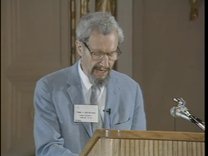
Frank Westheimer: Chemical Education Division Awards Speech (Tape 3)
- 1988-Jun-07

These captions and transcript were generated by a computer and may contain errors. If there are significant errors that should be corrected, please let us know by emailing digital@sciencehistory.org.
Transcript
00:00:00 The generation of Americans in science is under siege.
00:00:06 The general education of non-scientists in college is grossly inadequate,
00:00:11 based, as it usually is, on a small number of special courses
00:00:16 that cannot possibly achieve their goal.
00:00:19 The time has come for some leadership in American education to put it on a forward track.
00:00:25 We, as scientists, cannot teach enough science in two half-courses to make sense.
00:00:31 One more half-course, as Professor Walser pointed out, will not help much.
00:00:38 But MIT and Caltech demand that their science students
00:00:43 take 20 to 25 percent of their courses in the humanities.
00:00:47 If the humanists would invest 20 to 25 percent of their effort in science,
00:00:52 we could lead them up a gentle slope to a considerable level of learning.
00:00:58 Thank you.
00:01:16 Thank you, Professor Westheimer.
00:01:18 We are left with many thoughts,
00:01:22 and as chemical educators, I think he has challenged us.
00:01:28 We have a few moments, and Dr. Westheimer will be gracious enough to field a couple of questions.
00:01:34 So if there are any questions.
00:01:42 Yes.
00:01:44 Dr. Westheimer, it seems to me that one of the problems we face in our college
00:01:50 is that science and mathematics are in the same basket.
00:01:56 And the experimental scientist needs mathematics as a language,
00:02:01 but mathematics simply cannot replace the experimental science requirement or need.
00:02:11 And I don't know how you convince college faculty
00:02:16 of the need for mathematics and science in college.
00:02:20 Could you all hear that question?
00:02:23 The question was whether it is appropriate to lump mathematics and science together,
00:02:33 since the needs for the two are really quite different,
00:02:40 and in particular, the sciences depend upon laboratory, which mathematics does not.
00:02:49 Since mathematics is really needed in much of science,
00:02:55 I think it's appropriate to teach them together.
00:03:00 I would think that among the appropriate core courses
00:03:06 in a curriculum that had much more science in it
00:03:10 would be a combined calculus and physics course,
00:03:14 where one would, I think, give life to the calculus by showing what it's used for
00:03:23 and make the physics much easier by teaching the needed mathematics along with it.
00:03:32 The only way in which we are going to be able to solve
00:03:37 the problem that was brought up by this question
00:03:40 is to have much more science teaching for non-scientists in college
00:03:46 so that we can do such things as teach physics and calculus as a combined course,
00:03:58 nowhere near the rigor in the calculus that one would get in a pure mathematics course,
00:04:04 not anywhere near as much physics as one would get in a pure physics course.
00:04:10 But I think we could show students the connection between calculus and physics
00:04:19 to the great benefit of both subjects.
00:04:27 Professor Westheimer, you have in your list of elite colleges and universities,
00:04:34 isn't there a bias there?
00:04:36 It might be those are the worst places to look for the real experimentation that's
00:04:41 going on in this country.
00:04:43 Perhaps it's going on in many of the public universities that are not so elite
00:04:47 and in many of the private schools.
00:04:49 And maybe it's the other way around, that the elite universities will
00:04:53 get their ideas from there.
00:04:58 Was that heard throughout the?
00:05:00 No.
00:05:01 No?
00:05:02 The question was whether my choice of a few elite universities
00:05:07 was not a very bad choice, and whether the leadership in American education
00:05:12 may not really come from some of the less prestigious institutions in America.
00:05:27 I would certainly hope so.
00:05:30 What I said here was that it is time for some leadership.
00:05:35 I know where that leadership is not coming from.
00:05:39 And if it could come as a groundswell from the public institutions,
00:05:46 we in America would be enormously benefited.
00:05:52 Perhaps one more, if there is one more.
00:05:55 Yes, sir.
00:05:58 If it's true that learning science is a vertical process,
00:06:02 and since students learn at different rates,
00:06:05 aren't we making a mistake by throwing any collection of students into one class
00:06:10 and expecting them all to learn at the same rate?
00:06:12 Wouldn't something like a more self-paced approach be reasonable?
00:06:17 The question was whether self-paced learning might not be much better
00:06:23 in the sciences just because of the vertical nature of science.
00:06:32 My answer is, I think so.
00:06:35 I think that self-paced learning has a great place in science.
00:06:41 It's difficult to go completely over to self-paced learning
00:06:50 when you have laboratories to teach
00:06:54 because you want students to be at a certain level
00:06:57 when they take the laboratory,
00:06:59 and it's hard to have a self-paced laboratory.
00:07:01 You have to, for economy,
00:07:04 you really have to run the whole class doing one thing at the same time.
00:07:08 But I'm quite sure that there is a great place
00:07:15 for self-paced learning in science.
00:07:18 And I also suspect that there's going to be a great place
00:07:23 for really reactive computer-assisted instruction in science
00:07:29 for the same reason,
00:07:31 that it will allow a lot more self-paced instruction.
00:07:41 Thank you again, Professor Westheimer,
00:07:44 for a very stimulating address.
00:07:47 The awards symposium will continue at 1.50 this afternoon.
00:07:52 We will hear from Dr. Marjorie Gardner, Dr. Leo Yaffe.
| Property | Value |
|---|---|
| Creator of work | |
| Format | |
| Genre | |
| Medium | |
| Extent |
|
| Language | |
| Subject | |
| Rights | In Copyright |
| Rights holder |
|
| Credit line |
|
Institutional location
| Department | |
|---|---|
| Collection |
Related Items
Cite as
American Chemical Society. “Frank Westheimer: Chemical Education Division Awards Speech (Tape 3).” U-matic (tm), June 7, 1988. American Chemical Society Audiovisual Collection. Science History Institute. Philadelphia. https://digital.sciencehistory.org/works/7q0l4gz.
This citation is automatically generated and may contain errors.