
Freezing, Melting, and Boiling
- Circa 1987

These captions and transcript were generated by a computer and may contain errors. If there are significant errors that should be corrected, please let us know by emailing digital@sciencehistory.org.
Transcript
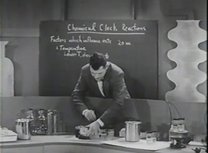
00:00:00 Hello, I am Harry Sello. It is my pleasure to introduce Tempest in a Test Tube, a
00:00:07 television show which made its debut August 24th, 1955 on KQED Channel 9, the
00:00:15 educational station for the San Francisco Bay Area. Tempest was a series
00:00:21 of 53 half-hour shows pioneering a new approach in which I as lecture
00:00:27 demonstrator gave live, unrehearsed presentations of a series of chemical
00:00:32 experiments. These were designed to illustrate basic simple chemical
00:00:38 principles. The purpose was to stimulate an interest in chemistry by teenage
00:00:44 students and by adults. The talks and experiments had to be entertaining,
00:00:50 educational, and simple. Spontaneity and liveliness were key to the approach.
00:00:57 All the experiments used in the shows were designed and constructed by
00:01:01 members of the California section of the American Chemical Society. The
00:01:06 participants were employed by the Shell Development Company, Emeryville, and by
00:01:11 Chevron Research, Richmond. A grant of $52,000 from the Ford Foundation and
00:01:18 National Educational Television permitted the filming of the first 24
00:01:23 shows of the series. The management for the ACS consisted of Alan Nixon, section
00:01:29 chair, Fred Strauss, TV committee chair, myself as first MC, and Aubrey McClellan,
00:01:36 second MC. We four constitute the core of the present committee. The series was
00:01:46 extremely popular then with KQED viewers of all ages. The senior chemist
00:01:53 committee of the California section today is determined to revive Tempest
00:01:59 for the benefit of elementary schools, high schools, adult education classes, ACS
00:02:06 local sections, historical archives, TV stations, and similar organizations. We
00:02:12 believe in chemistry as a second language. While basic principles have
00:02:19 not changed, practices have. Forty-five years ago, such simple chemical
00:02:25 demonstrations were not treated with the degree of safety considerations that
00:02:30 they are today. Today, even such simple demonstrations would be carried out with
00:02:36 the proper regard for safety glasses, shields, protective gloves, laboratory
00:02:43 coats, and visible fire extinguishers. The principle of safety first would be
00:02:49 explicitly present as part and parcel of a modern Tempest in a test tube.
00:03:37 Tempest in a test tube, a series of experiments designed to explain the
00:03:50 mysteries of chemistry and the laws that govern it. Produced by KQED San
00:03:57 Francisco, in cooperation with the California section of the American
00:04:07 Chemical Society, for the Educational Television and Radio Center. And now let's
00:04:19 go to our laboratory and meet Dr. Harry Sello. Hello. The topic of this talk is
00:04:28 freezing, melting, and boiling. To talk about these three physical processes, we
00:04:35 will use a very common compound, water, to the chemist H2O. Before starting the
00:04:43 experiments, for demonstration purposes, I would like to make a couple of
00:04:48 preparations here, which will take a little time to develop, so that we can
00:04:52 set them aside. The first is here. I have here a piece of iron pipe filled with
00:05:01 water and capped at both ends. Fairly thick iron pipe. It's been in this beaker
00:05:08 of dry ice for some time chilling. Well, I'd like to put it back in and set it
00:05:12 aside. Cover it up with dry ice. Cover the bomb and the table, of course, and put it
00:05:26 out of the way here on the side, where we can come back to it later. I said that we
00:05:36 were going to use water as the example to illustrate freezing, melting, and
00:05:40 boiling, and what they mean. One source of water is as a product of combustion.
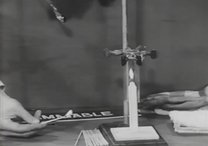
00:05:55 This can be illustrated simply by the experiment in which this beaker is
00:05:59 placed over the candle, so, and the beaker fogs, develops a fog over its
00:06:10 surface, a fog of water vapor. The water vapor comes from the combustion of the
00:06:17 fuel in the candle. Well, this is one form of water, water vapor, or water as a gas.
00:06:26 Let us proceed on a little further and consider some other properties of water.
00:06:43 Light my burner here, and I'll have to hold it against this dark background of
00:06:50 the stand to see where the flame is set properly. There. I could make this flame
00:07:01 yellow and visible, but that wouldn't be a very efficient flame. Perhaps if I put
00:07:11 this black background behind it, it might even be seen more easily.
00:07:29 This apparatus, which is shown here, is an apparatus which will perform, as soon as
00:07:37 the water gets hot, in which we will perform a distillation. It consists of
00:07:42 essentially three parts, a flask filled with dark liquid, which is water dyed to
00:07:48 make it visible, a condenser, or some engineers call it a heat exchanger, and a
00:07:56 receiver. In the flask is placed a thermometer through the stopper. Now, as
00:08:04 soon as this gets hot enough to show the action, we'll be able to illustrate
00:08:09 the various parts of this experiment.
00:08:21 Already some water vapor is developing on top of the flask. Well, this may take a
00:08:26 few minutes to come to a boil. I think we should proceed on to this next small
00:08:31 little demonstration here and illustrate the third form of water, that is the
00:08:38 third of three forms, the first being water vapor, the second being water
00:08:42 liquid, which is in the flask, and here water solid or ice. Now, this wasn't a
00:08:53 very complicated experiment, admittedly. It consisted in dropping a cube of ice
00:08:58 into a beaker of water. The simple principle being illustrated here is that
00:09:04 the ice floats on the water. This is a very important property. It means, first
00:09:10 of all, that ice is less dense than water, otherwise the ice would sink, and
00:09:16 indeed, you and I should be very glad for the fact that ice is less dense than
00:09:21 water, because if it weren't, we probably would not be able to live in the, in most
00:09:26 of the United States for most of the year as we do now. What I mean is this. We
00:09:33 live in the temperate climates, that is, the climates in which the large part of
00:09:36 the country gets some cold temperature during the winter. Water freezes. We hit
00:09:42 freezing temperature very readily during winter. Well, it is fortunate that when
00:09:46 water freezes, the ice floats so that a river or a pond or a stream of some sort
00:09:52 will freeze from the top down. That is, a layer of ice will develop, and pretty
00:09:56 soon that ice will go a little deeper, and perhaps a river, a deep river, may
00:10:00 never really freeze completely. Just think of the reverse situation. Supposing ice
00:10:04 were not less dense than water, so that the ice would freeze from the bottom up.
00:10:10 That would mean that during a cold winter, all the fish would be destroyed
00:10:15 in any given river or any lake, since they would not have any place to escape
00:10:19 to. All the water would get frozen from the bottom up. Rivers would stop flowing.
00:10:24 We would lose hydroelectric power. Well, all sorts of trouble like that, so that
00:10:30 we could not live very comfortably in the real cold parts of the country, even
00:10:33 though they may be nice during the rest of the year. And probably a river that
00:10:37 was frozen through because it froze from the bottom up never would get thawed out
00:10:40 during a long summer, even, because it would just be too much ice to freeze, too
00:10:45 thawed out, rather. It would be too much there to begin with. So we are indeed
00:10:49 happy and lucky that Mother Nature has provided it for us that water freezes to
00:10:54 ice, which is less dense than the original water, and floats on top. Now, in
00:10:58 this distillation here, I already hear some perking occurring, and lots of
00:11:05 droplets are developing around the neck of the flask. The thermometer still hasn't
00:11:14 risen. Well, no, I should take that back. Here it is. It's just past the 82, 84
00:11:19 mark and rising sharply, 88, 89. Now somebody may buy if they're in the stock
00:11:26 market, I suppose, but the temperature hasn't gotten up to the right point yet.
00:11:30 Now the water is clearly boiling very easily, perking along rather merrily.
00:11:37 Vapors are rising here. They're pretty well collected around the stopper. And the
00:11:41 first bits of vapor have appeared in our condenser. And the distillation is
00:11:47 now working. There's water, warm water droplets coming over here. This process
00:11:53 is distillation. To distill means to make use, to separate liquids while making use
00:12:05 of their boiling. I've sort of simplified the definition, but it's good enough for
00:12:10 our purposes here. This is a very common apparatus. It has many practical uses.
00:12:15 Already, here is one. Water is dyed in this flask. Supposing you wanted to get
00:12:20 pure water from something that you couldn't drink. Well, by boiling it, making
00:12:24 steam, letting the steam condense in the condenser, collecting the water which
00:12:30 results, we now have clear water, non-dyed water. We have separated the pure
00:12:34 water from the dye, and the dye will remain back here. This process will
00:12:39 continue until the water has mostly all boiled over. As I say, this is a very
00:12:45 common practice in industrial uses. One of the most common is to separate
00:12:51 alcohol from its fermentation product, to purify drinking alcohol from water. It
00:12:58 can be done by distillation. Another is still the separation of many petroleum
00:13:04 products. Petroleum products can be separated into their liquid fractions by
00:13:12 water, also by distilling such as we do in water. I was caught up here because I
00:13:18 wanted to point out that a distillation operation is usually concerned with a
00:13:21 lot of heat, hence water comes about from all sorts of sources. So the process
00:13:30 of distillation then illustrates the fact that water can be separated
00:13:34 from impurities. Muddy water could be so separated, you see, you could leave the
00:13:39 mud behind and distill the water over. Three states of water, liquid, gas, and
00:13:44 over here in this other one, solid. These are the three forms in which water will
00:13:51 exist. Let's look further into this matter of water expanding when it
00:13:58 freezes. First I better turn this off.
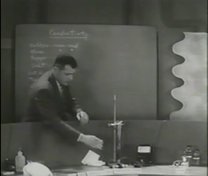
00:14:06 Stop our distillation. Proceed over here to the next experiment. Here we have a
00:14:16 flask containing water again, only dyed blue to me. It looks dark to the camera
00:14:26 I'm sure so it can be seen. Flask is completely full right up to the top and
00:14:31 in this flask has been jammed a cork stopper containing this long hollow tube
00:14:39 so that the squeezing of the cork stopper into the liquid forced the
00:14:43 liquid right up into the tube. It looks very much like an oversized kind of
00:14:47 thermometer, water thermometer, with a very great big bulb and with a cork in
00:14:52 the middle of it. Ah, there goes our bomb. Let's go over and take a look at it.
00:15:03 Bring it over here where we can see it.
00:15:22 Kind of cold to hold. Let's get a glove here. There, there is a crack the length
00:15:36 of the bomb extending from cap to cap through which can be seen the ice.
00:15:42 There's a little piece of scotch tape with a label pasted on so as to mark the
00:15:48 bomb that it was full before I started. That scotch tape isn't holding anything
00:15:52 anyway. The crack extends from all the way the length of the bomb. Now this is a
00:15:56 very strong piece of pipe. It takes several thousands of pounds to break a
00:16:03 piece of pipe like this so the force of the expanding ice or expanding water and
00:16:08 coming to ice or freezing to ice is just tremendous. I have over here some samples
00:16:14 other bombs that I broke at another time just to test out this experiment. These
00:16:28 now have been thawed out you see and they were emptied so we can look into
00:16:32 them a little more closely. Here's one which developed quite a crack, even a
00:16:37 bigger one than this first one we did here. In fact this crack was so big that
00:16:42 it just split the cap right off. Just broke the cap. Here's another. Did the
00:16:49 same thing, split the length of the bomb and this was the cap that was on it
00:16:52 before. It was a slightly different kind of cap. It had a plug in it and there was a
00:16:55 hole in the top. This shows that it's very difficult to keep water from
00:17:01 freezing when the temperature is right. When it's at freezing at zero degrees C
00:17:06 or centigrade rather, water just wants to freeze and it's very hard to prevent it
00:17:10 from doing so. As a matter of fact in order to prevent the freezing of water
00:17:15 you can apply a lot of pressure. You see if the water expands while it freezes
00:17:21 then keeping it from expanding would keep it from freezing. This can be done
00:17:27 if enough pressure is applied, if this pipe were strong enough for example, but
00:17:33 this would have to be a tremendous pressure. To change the freezing point of
00:17:36 water by one degree would take something like, oh, 1,500 pounds per square inch of
00:17:44 pressure. A hundred atmospheres, 1,500 pounds per square inch or more correctly
00:17:49 let's say about 1,470 pounds per square inch of pressure to keep water from
00:17:55 freezing. That is to keep it from freezing at zero degrees to make it
00:17:59 freeze one degree lower. So the power of expanding water is indeed tremendous and
00:18:04 those of you who have lived in the parts of the country where winter gets
00:18:08 kind of cold, you may recall that you lost water supply during the winter
00:18:12 because of the splitting of water pipes. Very difficult to stop this. Let's go
00:18:17 back and look at our little experiment here that was interrupted.
00:18:27 Now I would like to mark, ah, I see something. Before I was wondering where
00:18:31 this heat came from, this reminded me. Before we start, I'd like to take this
00:18:35 can and put it on the hot plate here. That hot plate has been sitting here
00:18:40 kind of hot, so any sizzling noise you may hear during the course of the
00:18:45 discussion is due to the can. They're starting to sizzle now, there's water in it.
00:18:51 Now I'd like to mark this point at which the level of the liquid is in the tube
00:18:57 right now. There's a little grease pencil mark. And in the beaker, I'll put a little
00:19:09 bit of, not dry ice this time, but regular ice or sometimes called wet ice.
00:19:19 By the way, those of you who are fond of picking up a chunk of ice and tossing it
00:19:31 in your mouth and like the pleasure of melting ice, I would suggest that it's
00:19:36 not a very good idea to do this in the laboratory at all. I mention that because
00:19:40 I just had the urge to do so myself, also being kind of warm. This is not a very
00:19:45 good practice and should be strongly discouraged because you never know what
00:19:49 got into the ice. To this ice, I will add a little bit of salt.
00:20:02 The purpose of the salt in ice is to give a mixture which will give a lower
00:20:08 temperature than just the ice alone. If you've ever been in a large city during
00:20:13 the winter, the streets sometimes glaze over with a layer of ice. So not even
00:20:18 sometimes. I recall in Chicago this happened quite often. Well, this makes for
00:20:24 very tricky driving. So what happens is that the Department of Streets will send
00:20:30 out a truck with a lot of salt on it and they'll just go around shoveling the salt
00:20:33 on the glaze and soon you'll find that the ice has melted. You see, ice or water
00:20:39 with salt in it will freeze at a lower temperature than pure water. So adding
00:20:43 salt to ice makes it go down to a lower temperature. Now that's enough for a
00:20:50 starter. Lower this right down into the freezing mixture, firm, and pack in a
00:21:02 little bit more around the other side.
00:21:10 By the way, if you've ever made ice cream at home, your your home ice cream freezer
00:21:15 uses an ice salt mixture. Pack a little more salt in it.
00:21:28 It has a tendency to cake a little bit here.
00:21:39 And we'll just put a little more in for good measure. Right around the top.
00:21:52 Now, see what happened out here. Ah! Something is already visible. The level
00:22:00 of liquid has already dropped about a half an inch below the previous mark.
00:22:06 This is the important point. We started up here. It has dropped. Upon putting it
00:22:13 into ice salt mixture, upon chilling, this means that the water in the flask
00:22:18 has contracted, gone to a smaller volume. Well, while this is going on, this
00:22:26 contraction, let's go on to this next little experiment here and then come
00:22:31 back and take a look at the first one. The next experiment is one in which
00:22:40 we're concerned with the physical process in which gaseous water, or steam,
00:22:47 changes back into liquid water. This process is called condensation, to
00:22:54 condense. Condensation is a description for just that, steam changing back
00:23:02 into liquid water. Or, not necessarily steam, any gaseous vapor, like gasoline
00:23:08 vapor, changing back into liquid gasoline. It's the reverse of boiling or
00:23:13 vaporization. Condensation, the changing of the vapor back to the liquid. Now, in
00:23:20 here, in this steel can, is a, about an inch of water in the bottom, which has
00:23:28 been sizzling here for some time. Now, I don't know, it's probably been boiling
00:23:36 long enough now. I can see down into it. Yes, it is boiling. Let's try and try the
00:23:43 experiment and see what happens.
00:23:50 The can is kind of hot. Take it off the heat, put it on the pan here. Now, the important
00:23:57 part of this experiment, if you should ever repeat it, is take it off the heat
00:24:01 before putting on the lid. Do not put the lid on the can when the can is on the
00:24:06 hot plate, which reminds me that I'll just turn this thing off, it's generating an
00:24:10 awful lot of heat. I now cap the can and take my sponge, which has been soaked
00:24:28 with a little bit of water, squeeze it out on the can. The can is beginning to
00:24:37 make noises like it doesn't like this process. It's certainly beginning to
00:24:48 collapse, and it's caving in on this front end there. Add a little bit more of
00:24:59 water, make sure it gets good and chilled. Back. Oh, it's pretty well caved in on the
00:25:12 front of it. Let's just see if we can do any more to it. Oh, it's about as cool as
00:25:20 it wants to get. It looks like somebody has grabbed it right in its middle and
00:25:26 given it a great big squeeze and crushed it. The following has happened.
00:25:31 The water inside has boiled, the steam risen out, washed out all the air ahead
00:25:38 of it, so that nothing was left in the can but just steam and liquid water. When
00:25:43 I capped it and poured cold water onto the outside, I condensed the steam, the
00:25:49 process of condensation. I condensed the steam, it now then left a vacuum in the
00:25:55 can so that the air pressure on the outside of the can proceeded to collapse
00:25:59 it. If I had boiled this just a little bit longer, maybe perhaps five or ten
00:26:03 minutes, and really gotten up a good head of steam, then, and made sure I washed
00:26:08 out all the air from the inside, then crushing it would have even crumpled it
00:26:11 up more. The more vacuum there is on the inside, the more this will crush. This
00:26:16 illustrates a point which will be discussed at another talk a
00:26:20 little more deeply, namely that the atmosphere exerts a pressure on the can.
00:26:25 Something like almost 15 pounds for every square inch. So there, if you
00:26:32 figured out the dimensions of the can, there's a hundred square inches on
00:26:35 this side, and another hundred here is 200, and perhaps another hundred all
00:26:38 told, 300 square inches times 15 pounds would be 4,500 pounds on this can. Well,
00:26:46 that's well better than two tons, and no wonder the can wants to crush.
00:26:53 Concerning this matter of atmospheric pressure, I would like to leave you with
00:26:58 a small problem. See if you can't, from your surface area of your body, the amount
00:27:06 of area exposed to the atmosphere, figure out how much pressure, or better still,
00:27:11 how much force must be exerted on the area of a human body. When you come up
00:27:17 with an answer, it had better be large. Let's go on, well, then further ask
00:27:23 yourself, why is it I am not mashed to a pulp by this tremendous force? Let's go
00:27:28 on and see what's happened in our previous experiment. The water in the
00:27:33 column has now dropped almost a full inch below the previous mark. Recall that
00:27:41 at the previous mark, the water was at room temperature. It has been chilled, not
00:27:46 quite to freezing, and it has contracted until it has dropped almost an inch
00:27:51 below the previous mark. Let's just put a mark here to show how far down it has
00:27:56 gone. This shows that water reaches its maximum density at just before it freezes.
00:28:04 Just about four degrees above zero, water reaches its maximum density. It
00:28:10 shrinks to its smallest volume, and then the next thing that happens after it
00:28:14 cools down to freezing is that the water freezes and then expands. We have shown
00:28:19 this first contraction. Let's now see if we can go a little further with this
00:28:25 experiment and hasten this freezing process a little bit. Instead of using
00:28:31 just the ice salt that I used before, which is still left in here, I'll throw a
00:28:35 little carbon dioxide or dry ice right on top of it, just to make it a little
00:28:39 faster. Keep your eye on the column of liquid. You don't want any of these big
00:28:49 chunks.
00:28:59 A little bit more.
00:29:09 And finally just a little bit more than that even. Now it's pretty well covered
00:29:15 with dry ice. Remember this is the mark at which it reached. It's pretty close to
00:29:25 us, contracted pretty much as much as it wanted to. I see some of this dry ice is
00:29:30 falling out of here now. Big chunks in there now on top. Now this device which
00:29:38 measures the contraction and expansion, or another word for expansion would be
00:29:45 the dilation of water, is called a dilatometer or dilatometer, if you will,
00:29:52 something which measures dilation. It's a very common device in certain phases of
00:29:59 chemistry which makes use of this property of expansion to measure what
00:30:05 goes on. Now as this freezes, I already see that there is a tiny amount of
00:30:12 increase in height. It has now begun to go back up again, but let's leave that
00:30:18 and summarize, picking this up at the very end of our summary. We have shown
00:30:23 three processes, freezing, melting, and boiling. Freezing and melting being just
00:30:30 the opposite. The boiling we demonstrated, we used to demonstrate a distillation
00:30:35 apparatus which separated pure water from dyed water. In fact I was dying to show
00:30:42 you that experiment. This is a common industrial process. We went on further to
00:30:49 show that water changed still into another form, ice, solid form, caused
00:30:54 expansion when it did happen, and this expansion was strong enough to split
00:30:59 iron pipes, one of which we showed here. Then the condensation of water was
00:31:06 demonstrated by cooling the steam in a can, which resulted in the can being
00:31:11 crushed by atmospheric pressure. And finally we saw that upon cooling, the
00:31:18 water, which started at the top mark, contracted, went down as far as the
00:31:22 bottom mark, where then it began to freeze, and began to rise due to the
00:31:26 expansion, and went up to as high as the original mark, and now even higher, and it
00:31:31 will continue to rise as it continues to freezes. To freeze rather. Thank you.
00:31:48 ♪♪♪
00:31:58 ♪♪♪
00:32:20 This is National Educational Television.
“Freezing, Melting, and Boiling” is one of fifty-three short educational films originally produced in 1955 for KQED San Francisco as part of the series Tempest in a Test Tube. This series of half-hour episodes illustrates basic chemistry concepts for high school students through live experiments and demonstrations by presenter Dr. Harry Sello. The experiments used in the show were designed by the American Chemical Society’s California chapter and reflect the safety standards of the time. This episode, “Freezing, Melting, and Boiling,” teaches viewers how matter changes between solid, liquid, and gas, and shows how temperature affects these changes.
| Property | Value |
|---|---|
| Creator of work | |
| Place of creation | |
| Format | |
| Genre | |
| Medium | |
| Extent |
|
| Language | |
| Subject | |
| Rights | In Copyright - Rights-holder(s) Unlocatable or Unidentifiable |
| Credit line |
|
Institutional location
| Department | |
|---|---|
| Collection |
Related Items
Cite as
American Chemical Society, and KQED-TV (Television station : San Francisco, Calif.). “Freezing, Melting, and Boiling.” Vhs, circa 1987. Tempest in a Test Tube Videocassette Collection. Science History Institute. Philadelphia. https://digital.sciencehistory.org/works/ruq2pqu.
This citation is automatically generated and may contain errors.