
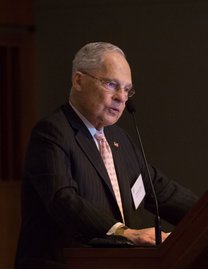
Oral history interview with Frederick Frank
- 2011-May-25
- 2011-Sep-14
- 2013-Aug-16
Oral history interview with Frederick Frank
- 2011-May-25
- 2011-Sep-14
- 2013-Aug-16

Frederick Frank was born in Salt Lake City, Utah, in 1932. According to Frank, his family was a “true western family.” After an unexpected accident that injured his teeth, causing him to stutter for a while, as an elementary school student, he avoided speaking and gravitated toward school subjects like mathematics that did not require him to speak. An avid athlete, Frank was not interested in taking over his father’s retail clothing business, so he petitioned his parents to attend an Eastern prep school. He attended The Hotchkiss School in Lakeville, Connecticut. The school had an academically rigorous environment that Frank believed prepared him for college at Yale University where he studied philosophy and American studies. When Frank graduated from Yale, he was drafted and sent to Fort Ord in California for training. Due to some lucky breaks, he ended up getting assigned to the Supreme Headquarters Allied Powers Europe (SHAPE) and spent a year in Paris, France. When he got out of the Army and came back to the States, he enrolled in the Stanford School of Business with the GI Bill and took a job at Smith, Barney and Company upon graduation.
At Smith Barney, Frank started working for William R. “Bill” Grant, who let Frank become the first specialized drug analyst. As Frank spent time learning the industry, he learned science by osmosis. He got involved in the biotechnology industry in the late seventies when Alejandro “Alex” Zaffaroni introduced him to Cetus. Frank later took Cetus public shortly after Genentech went public. In the interview, he talks about significant deals he contributed to in the biotech industry, including the Genentech-Roche deal, and his interactions with the leaders of Genentech and Roche. He also discusses Chiron’s acquisition of Cetus and the importance of scientists in leadership at biotech companies. Additionally, he mentions his involvement in the Human Genome Sciences Inc. deal, working with First Boston to sell off the Swiss operation of Biogen, and creating the convertible exchangeable preferred stock for Biogen. It was around this time that Frank met his wife, Mary Tanner, whom he considered a valued business colleague as well. By the eighties, most of Frank’s work was focused on biotechnology although he occasionally worked with other companies like Eastman Kodak Company. He talks about the
establishment of life science specialties at major banks, some of his failures, particularly in Ag bio, and thoughts on the industry and clinical research companies. He reflects on the changes in the biotech industry, including an increase in acquisitions, and mentions the people with whom he particularly liked working. In addition to mentioning the Laguna meeting, Frank also talks about highlights from his career, such as the 440-million-dollar Chrysler offering. He concludes the first session of the interview by expressing his gratitude for his career and discussing a few additional deals.
In the second two sessions of Frank’s interviews, he reiterates many of the stories he shared in the first session, occasionally in greater detail. Some of the new material he shares includes an entertaining anecdote about him receiving an award at the Laguna meeting, the changes in the role of analyst, his suggestion of a tax credit to encourage passion investing, and what he identifies as the three periods of the biotech industry—prior to 1976, 1976 to 2000, and 2000 to present. He concludes the final interview session talking about the Bristol-Myers Squibb deal.
| Property | Value |
|---|---|
| Interviewer | |
| Interviewee | |
| Place of interview | |
| Format | |
| Genre | |
| Extent |
|
| Language | |
| Subject | |
| Rights | In Copyright |
| Rights holder |
|
| Credit line |
|
About the Interviewer
Mark Jones holds a PhD in history, philosophy, and social studies of science from the University of California, San Diego. He is the former director of research at the Life Sciences Foundation and executive editor of LSF Magazine. He has served in numerous academic posts, and is completing the definitive account of the origins of the biotechnology industry, entitled Translating Life, for Harvard University Press.
Institutional location
| Department | |
|---|---|
| Collection | |
| Oral history number | 1005 |
Related Items


Interviewee biographical information
| Born |
|
|---|---|
| Died |
|
Education
| Year | Institution | Degree | Discipline |
|---|---|---|---|
| 1954 | Yale University | BA | Philosophy and American Studies |
| 1958 | Stanford University. Graduate School of Business | MBA |
Professional Experience
Smith, Barney and Company
- 1958 to 1969 Partner
Lehman Brothers (1993-2008)
- 1969 to 1973 Partner
- 1973 to 2008 Vice Chairman
Barclays Capital
- 2008 to 2009 Vice Chair
Peter J. Solomon Company
- 2009 to 2013 Vice Chairman
Burrill & Company
- 2013 to 2014
EVOLUTION Life Sciences Partners, LLC.
- 2014 to 2021 Founder & Chairman
Honors
| Year(s) | Award |
|---|---|
| 1997 | Hall of Fame Award, The Biotech Meeting in Laguna Niguel, California |
| 1998 | Outstanding Contributions in the Field of Immunology, Irvington Institute for Immunological Research |
| 2004 | Albert Einstein Award, Weizmann Institute of Science |
| 2005 | Top 100 Living Contributors to Biotechnology, Reed Elsevier |
| 2006 | Gilda’s Club of New York City Visionary Award |
| 2019 | Richard J. Bolte Sr. Award |
| 2021 | Biotechnology Heritage Award, Biotechnology Innovation Organization |
Cite as
See our FAQ page to learn how to cite an oral history.
JONES: We’re collecting biographies, so maybe we should start at the beginning. You were born in Salt Lake City, [Utah].
FRANK: Nineteen thirty-two.
JONES: Okay. And can you tell me about your early years, your family, and . . . .
FRANK: My father was born in Salt Lake, and my mother was born in Portland, Oregon, so it’s a real western family. And my grandmother was born in San Francisco, [California], so it goes back a long ways in the west.
JONES: How did they get to the west?
FRANK: My grandfather on my father’s side came from Russia, from Kiev, just after the turn of the century. At the time, they had three children, and then my father was the first one born here. He was born in Murray, Utah, actually, which is a suburb of Salt Lake. Then they had another daughter.
My grandparents on my mother’s side came also a little bit before the turn of the century to Portland, Oregon [from Germany]. It’s very interesting. Take my father’s family. How does a Russian Jewish family end up in Salt Lake City? In those days, it was probably 90 percent Mormon. I don’t have real knowledge of it. My assumption was they ran out of money on the way to the West Coast and just stayed there.
JONES: So they went to the East Coast first and traveled across the country?
FRANK: Yes. My grandfather was quite an entrepreneur, actually. He started the streetcar system in Salt Lake. And as I said, he was in the men’s retail clothing [. . .] business. I’m a [true] western family. And I went away to school at a fairly early age, and my family think . . . . I’m the only deserter in the family. The rest of my family are still in Salt Lake.
JONES: I see. And your father, his business was—
FRANK: He was in the men’s retail clothing business. [The store was called Arthur Frank.]
JONES: In Salt Lake City?
FRANK: In Salt Lake. Right.
JONES: And growing up, were you involved in the business? Did you—
FRANK: No.
JONES: No?
FRANK: Well, except when I was a little older, when I was a teenager, I did work there at Christmastime. And that was it.
JONES: Right. How were your early years at school? Were you a good student?
FRANK: Yes. I was a good student, although I had a very strange accident when I was about nine years old, I think. We used to spend our summers in Portland with my grandmother, and I was at that age when boys don’t like to be kissed by their relatives. So my aunt and my grandmother picked us up at the train station one summer, and it was late at night, probably 10:30 at night. And we got to my grandmother’s house, and my Aunt Jane said, “Well, darling, give me a kiss. It’s so nice to see you.” I said, “Well, Aunt Jane, I can only give you a kiss if you can beat me in a foot race,” knowing of course that none of my relatives could. So she challenged me. So we were running up the path to my grandmother’s house, and I tripped, and I fell down on these concrete steps, right on my face. And I knocked my front teeth—they thought I’d knocked them out—but as it turned out, I knocked them up in my gums. Very painful. And the next day I was swollen like this, so they took me to the doctor and they x-rayed it, and they realized what had happened. But the consequence of that was for a long time I stuttered, and that’s a fairly traumatic experience for a kid.
JONES: Yes.
FRANK: Because other children make fun of you.
JONES: Yes.
FRANK: And so when you’re in class and the teacher asks you to read something and you stutter, it’s very painful. But fortunately, I got over it [by taking speech lessons]. One thing that’s interesting about it. I was good at math, and in math, you don’t speak. You know, you do problems.
JONES: Right.
FRANK: So obviously, I think it accelerated my interest in math at the time. But anyway, I had a very normal youth. Salt Lake City was a very safe place, so you’d come home from school, and your parents would let you go out and play. And I was a very good athlete, so I loved being outdoors.
JONES: What sports did you play?
FRANK: I played football, baseball, track, skiing, golf. I did pretty much . . . in those days, unlike today, where if a child has a reasonable talent in one thing, they focus everything on that 00:05:00 one. Same thing in college today when they pick kids for college unlike when I went to college they wanted well-rounded kids. They don’t want the well-rounded kids anymore. They all like what I call “spike heads.” Somebody who’s really [outstanding] at something like the world’s leading . . . . Yale [University] has—where I’m very close—stilt walker, right? Well, who gives a damn? But the concept is you have people who are great at something, and the whole class will be balanced. I don’t happen to subscribe to that.
JONES: Right.
FRANK: But that’s the way it is. So I was a very well-rounded kid. I was a good student. I was a good athlete. [. . .]
JONES: Did you have any career ambitions at all growing up? Did you foresee—
FRANK: No.
JONES: . . . you know, a future?
FRANK: No.
JONES: What about your family? Did they have expectations for you?
FRANK: I don’t think so. They wanted me to do whatever I wanted to do. As I grew up, though, I knew I didn’t want to be in my father’s business.
JONES: Why not?
FRANK: Which was the men’s retail clothing business. I thought it just wasn’t very intellectual, wasn’t very stimulating, was rather dull. My father was in it because he was the youngest son, and my grandfather came down with diabetes when my father was at the University of California at Berkeley, and so he made my father come back to take over the store because diabetes in those days was very, very serious.
JONES: Yes. This would be before insulin, right?
FRANK: No insulin like today. My father never really liked his business. He retired at a very young age, and so he sold the business to Hart Schaffner & Marx [in Chicago, Illinois]. He liked golf, so he played golf. But he never liked his business. And that’s not encouraging to a young man who here’s his father talking about he doesn’t his business, right?
JONES: And did that maybe color your ideas of business generally, that some—
FRANK: I don’t think so. I didn’t grow up really knowing what I wanted to do. But one of the catalysts of my life was my father because of being in the retail clothing business, the leading men’s fashion magazine in those days was Fortune. It was a totally different magazine than it is today. It was ten times better than it is today. So my father subscribed to Fortune magazine, and he kept them. So we had them from the twenties all the way up. He never threw any of them away. As a kid, I loved going through these old magazines.
And the 1932 September edition had an article on the great Eastern prep schools. I’d never heard of a prep school. I’d never been ten yards east of Salt Lake. I’d only gone west. So at dinner, I asked my parents if I could go away to school. And they said, “Well, what are you talking about?” So I cited this article. So my father said, “Well, I’ve never heard of these schools, but when I go back on a buying trip, I’ll go visit some of them,” having read the article himself.
So he visited, I think, about five of the schools. He didn’t take me. That was far too expensive. And he came back, and he said, “These are really phenomenal schools. I’d never known about these schools. And if you want to apply, you can apply. However, I doubt if you can get in.” [Well, I was a straight A student.] And I did get in.
JONES: And why do you think you got in, or do . . . how did you feel about it? Did you think that maybe—
FRANK: I had no idea if I’d get in or not get in.
JONES: [Right].
FRANK: So anyway, the first one I heard from was The Hotchkiss School in Lakeville, Connecticut, who accepted me. Was I going to wait around to hear from the others? I didn’t know one from another, [and] they gave me a short time frame to accept, so I accepted. So my parents put me on a train by myself from Salt Lake City to Lakeville, Connecticut. Today parents would not do that.
JONES: No. No.
FRANK: And so I went away to school.
JONES: Well, I’m interested. You read the article. What really appealed to you about the idea of prep school?
FRANK: Well, I was a straight A student, and I realized from reading that article that they [provided] a much more rigorous education that would probably be very beneficial once I got into university, which turned out to be true. And so that’s why I asked my parents, and I loved the program. It was an all-boys school. Prep schools were basically all-boys schools, or they had some all-girls schools. They weren’t co-ed. I loved the sports programs they talked about, and it seemed something that I would really like and be challenged academically, which turned out to be very true. And so I went away to school. [Thanksgiving] was quite lonely because everybody went home because in those days it was principally an eastern [school] 00:10:00 so they could go home. I couldn’t go home. There were very few of us left on campus so that was kind of lonely.
But I went home at Christmas. As you would expect, my friends were very curious. You know, “Well, what’s it like, Fred? Do you like it?” “I really do like it.” Because fortunately, having been a good athlete, I was on the football team from the beginning, and that really got you accepted very early on. And I was on the basketball team, etc.
So my friends asked, you know, “Do you really . . .” I said, “I really like it. It’s really terrific.” But after five minutes, they had their lives. I had nothing in common with them anymore. I was very happy to go back. I was never lonely again. It was very simple. And it was clearly the transforming thing in my life because then I went to Yale [University].
JONES: And going to the school, had you been prepared? Did you have to catch up when you got to—
FRANK: Oh, I was totally unprepared. Totally unprepared. My first semester, my grades were abysmal. I mean, I was so embarrassed that my parents were going to get these terrible grades, having generally gotten straight As. But the comments from the teachers were very favorable. And I said, “Well, I’d like to do well and then see what they had to say.”
JONES: So they could tell that you were talented, and—
FRANK: Well, I have to go back one step . . . . I didn’t go as a freshman. I went as what they call an “upper-middle” junior. So my classmates were already two years ahead of me.
JONES: I see.
FRANK: So it was very challenging, but I caught up. And fortunately, I got into Yale, which is a phenomenal school. And it was also an all-boys school at the time.
JONES: Did you develop any particular interests intellectually?
FRANK: No.
JONES: Academically while you were at Hotchkiss?
FRANK: Well, at Hotchkiss you didn’t have much choice. I mean, it was a fairly routine, [rigorous] curriculum. At Yale, I had no idea what I wanted to do when I got out. So I said to myself, “Well, I’m going to be here four years. I’m probably going to work for thirty years or so.” I’m in my fifty-second year, so that wasn’t exactly right. So what is the best thing that Yale has to offer me?
And I talked with my advisor. I talked with some of the other students whom I knew from Hotchkiss in prior years. And it was very clear at the time that Yale had the world’s leading philosophy department. So I said, “I’ll take philosophy.” I had no idea what it was. And that’s what I did. So I took philosophy and American studies. And I loved it.
JONES: Who were some of the names? Do you recall? The faculty members?
FRANK: Well, the leading faculty member was [. . .] a Canadian. [Charles William] Hendel. It was Dr. Hendel. I just loved my classes because they were extremely small because most people would rather not take those kind of classes. But I really enjoyed it, and, as I said, I had no idea what I wanted to do. When I was at Yale—this was during Korea— I joined the ROTC [Reserve Officers’ Training Corps], and that was the way you got deferred from the Army. And my junior year, summer camp, I got thrown out of ROTC because I failed the eye test. We were being trained as forward observers in the artillery—FOs—and in Korea the life expectancy of an FO was two weeks. [laughter]
JONES: Really?
FRANK: Anyway, I got thrown out. As a consequence of that, when I graduated, I got drafted, and I went to Fort Ord in California, which is a base of, at the time, about forty-five thousand men—mostly a training base. You wonder, “What is the catalyst to change your life?” Normally, you can’t really relate . . . you don’t really know what [the catalyst is] going to be. But when I was at Ford Ord in basic training, and then I was stationed [there] after basic training, I was stationed in a special unit, and I was elected Soldier of the Month at Ford Ord. Now what does that get you? You get to have lunch with the officers. You get a weekend pass. You get your name and picture in the newspaper. And you get a one-dollar Zippo lighter with your name, rank, and serial number on it.
But on this lighter they made a mistake. They made me a PFC [Private First Class], and I was a lower form of amoeba than that—two ranks below that actually. So I said to the colonel 00:15:00 who ran this program, I said, “Sir, this is a great honor, but unfortunately, they made a mistake on this lighter. I’m not a PFC. I’m only an E2 [Private 2nd Class].” So he calls over to this captain, and he says, “Captain, promote this man. Any soldier good enough to be soldier of the month should certainly be at least a PFC. Promote him.” And the captain said, “Sir, I’d be more than pleased to do that, but you obviously don’t remember, that rank is frozen.” And colonels being smarter than captains, said, “Back date his orders. Look up when they froze rank and back date his orders,” which they did. So I was promoted two ranks. I’d been in the [United States] Army about six weeks. [laughter]
JONES: And did you before or after have any contact with the colonel? Did you work for him?
FRANK: Not that colonel. So anyway, so I was in this unit. So I was soldier of the month. The important part of that was I was promoted.
JONES: Right.
FRANK: So I’ll explain to you why that was. So after basic training, I was sent to this specialty unit, which had a colonel, a major, a captain, a master sergeant, and myself. This is a very special unit. The master sergeant was a fraudulent enlistee in World War II by lying about his age.
JONES: So he was young?
FRANK: He was fifteen [when he enlisted], and he said he was sixteen or seventeen. I’ve forgot what it was. Not very well-educated. So basically, I did his work for him. Typical of the Army, the colonel was assigned a car, a Jeep, but no driver, staff car. So low man on the totem pole, I drove the colonel. So I got to know him well because he had very bad arthritis—like I have at the moment—and I would take him two or three times a week for treatments to the hospital. So I got to know him pretty well. Because of my past training at ROTC, the colonel, learning about this, said, “Well, they made a mistake. You should have been let in the Army as a corporal because of your three years of ROTC.” So he wrote to the Pentagon to try to do that, and they wrote back and said, “Well, yes, we made a mistake, but we can’t correct that mistake.” Typical of the Army. Which was fortunate, because if I’d had prior rank when I was in basic training, everybody in my unit who had prior rank was sent to Fort Huachuca [Sierra Vista, Arizona]. I’m glad I didn’t go to Fort Huachuca.
JONES: Where is Fort Huachuca? I don’t—
FRANK: [In] Arizona. So what happens? I drive the colonel. I had a top-secret security clearance, which means I picked up the mail. One day I picked up the mail, and there’s a direct assignment to SHAPE Headquarters in Paris. You now know that as NATO [North Atlantic Treaty Organization]. SHAPE stands for Supreme Headquarters Allied Powers Europe. There were only four people on this base who qualified for this assignment, which I was one because they screwed up on this lighter. If I hadn’t been a PFC, I could not have gotten that assignment. I had the right—it was called MOS—military occupational specialty. It was called clerk-typist in my case. But you had to be a PFC or corporal. So that lighter changed my life because I asked the colonel . . . well, I would normally take the mail and give it to the captain, but I put these orders directly in my pocket. When I got back to the base, I went to see the colonel, and I explained this [assignment opportunity] to him. And he said, “Well . . .” In the Army, you’re always called by your last name. So he said, “Frank, we have very high hopes for you in the Army. We expect you to . . .” [and] so forth and so on. I said, “Sir, well, thank you very much, but I’m not a career soldier. I’m doing my military service. I’m pleased to do it. But I’m not a career soldier.”
JONES: And you had decided that prior to going in, or—
FRANK: Oh, yes.
JONES: You—
FRANK: I had no idea of being in the military.
JONES: Yes.
FRANK: So he was nice enough to let me go. So I went to SHAPE Headquarters [just outside of Paris, France], where I served for a year, and that was a very fortunate thing.
JONES: Yes. What was going on there?
FRANK: Well, nothing. I mean, it was during [the Korean War], but SHAPE was obviously all the nations of NATO together. So I worked basically for a large cadre of generals, and I would order these generals around because of the role I had, which is pretty amusing. But the funny part was when I first got there, the protocol is you salute the officer of any nation. But it’s very hard at NATO to know who was an enlisted man and who was an officer because they all had very fancy uniforms. And I remember my first day at one point I salute this guy, and he says, “Well, thank you very much, private, but I’m a sergeant in the Norwegian Army.”
00:20:00 Anyway, it was . . . how fortunate could you be for a young man to get to go spent a year in Paris? And I convinced the Army to let me live off the base [to improve relationships with the French which were not good]. So I rented a hotel room, which cost I think forty dollars a month, and it just had a bedroom. There was no bathroom. That was down the hall. But it means I could live in Paris because SHAPE Headquarters is in Rocquencourt, [France], which is about a twenty, twenty-five-minute drive from Paris. I convinced my father to buy a car for my brother, and I told him I would buy it through the Army because I could get a huge discount. So I bought a car over there, which means I had a car although it ended up with my brother. And so it was a wonderful experience.
JONES: And what did you do when you were off duty in Paris?
FRANK: I’d sightsee. You know, I’d go to museums and walk around the city forever, and it was great. And when I had leave, I’d go see other parts of France. It was spectacular.
JONES: And by this time, you’ve gone to Hotchkiss. You’re successful there. You’ve gone to Yale, and—
FRANK: Right.
JONES: Now you’re in Paris, and how did your family react to your adventures, your experiences?
FRANK: Well, they thought I was a very lucky kid, which I was. And when I got out of the Army, I was on the GI Bill and went to Stanford [Graduate School of Business in Stanford, California] because I [thought] in business school, I’d figure out what I wanted to do, which is exactly what happened. So I went to Stanford, which is a wonderful school, and while I was there, what I really liked was security analysis. And so that’s what I did.
JONES: And so you took some classes that you really enjoyed, or—
FRANK: Yes. Those were the classes I liked best.
JONES: Yes.
FRANK: Of course, what you realize later in life, when you’re in school, the classes you like best are because you had great professors or great teachers. That influences you a lot.
JONES: So who was the professor?
FRANK: Well, I took a lot of courses, and I guess the professor who influenced me most was Professor [Theodore J.] Kreps. A very interesting man, very challenging. But those are the courses I liked best. So when I got out of Stanford Business School, I wanted to go work in Wall Street, obviously, due to security analysis. And I interviewed two firms. One was Merrill Lynch [& Co.] where I was offered a job, and one was Smith Barney [Smith, Barney and Company] where I was offered a job. And I was much more interested in Smith Barney because they had much better research than Merrill Lynch did. And plus, they had a very formalized training program of nine months, and I thought that would be very beneficial because I’d learn all about the business.
And so they hired you into the training program—not in a specific area—but part of the training program was three months in research where you had to write a research report. So I purposely wrote a research report on an area that they did not cover because I felt if I wrote one on something where they had already strong analysts, well, that doesn’t contribute much.
JONES: What was the area? Do you recall?
FRANK: I wrote a report on the tire and rubber industry. I was fortunate, so after the training program, they let me in the research department. And I worked for a fabulous guy by the name of Bill [William R.] Grant, who was not only the head of the research, but he was also the drug and chemical analyst. In those days, that was the same person in all the firms. And I said to Bill after working with him for a number of months, I said, “Bill, you know, it makes no sense for somebody to cover the drug and chemical industry. There’s no relationship between these two industries. You cover the chemical industry.” Because he was a chemist by training. “I’ll cover the drug industry.” So I was Wall Street’s first [specialized] drug analyst. And I was very lucky.
JONES: And you put yourself into that position because you saw the opportunity, or did you have some particular affinity for pharmaceuticals?
FRANK: Well, I was working for him. No, I really liked the industry. I thought it was a very interesting industry. And, as I said, I was very fortunate that he let me become the drug analyst. Some years later, I became the co-head of the department, and then later I was the first partner of Smith Barney to leave, and I joined Lehman Brothers. And I was the first person from the financial community to become a partner for Lehman Brothers from the outside. We had General [Lucius D.] Clay, and we had [two] other important [retired industry CEOs] as partners. 00:25:00 But not from the financial community.
JONES: And at Smith Barney, you started out working for Grant?
FRANK: Right.
JONES: And did he take a mentoring role? Did he—
FRANK: Oh, yes. Absolutely. He was very good at that.
JONES: So what did you learn along the way? I mean, you came in, you’re brand new to Wall Street when you arrive.
FRANK: Right.
JONES: You’re conducting research. What kinds of lessons? Do you recall—
FRANK: Well—
JONES: . . . learning things along the way that were important?
FRANK: Yes, it’s like going to school. You learn about an industry. But I would go with Bill, he’d make visits to the pharmaceutical companies. I would go with him. And then he would write reports on the companies that he covered, and I would end up writing most of the report. And that’s on-the-job training.
JONES: And how was the pharmaceutical industry at that time? It was—
FRANK: Very small.
JONES: Yes? This is the fifties, right? Or early sixties?
FRANK: Yes, this is the late fifties, early sixties. But the largest company was American Home Products, [which became] Wyeth, which is now known as Pfizer. But it had revenues at the time of about eight billion dollars. Now you think of Pfizer today, it’s fifty billion dollars.
JONES: Right.
FRANK: So it was a very small industry.
JONES: Right. And, you know, the work they’re doing is pretty technical.
FRANK: Oh, yes.
JONES: Chemistry.
FRANK: It’s science driven. Right.
JONES: So did you have to educate yourself in those areas, too?
FRANK: Well, I would call it science by osmosis. I mean, many years later, I was talking to the CEO of a pharma company I knew well, and he pointed his finger at me like this, and he said, “Fred, remind me again of your scientific prowess,” knowing of course I don’t have any. So I said to him at the time, “Well, after thirty plus years in the business, I have a PhD in osmosis.” He said, “That’s probably a pretty good degree.”
Now today, most all the analysts are scientists or scientifically-based. They’re MD/PhD types. But the interesting part is they don’t realize how quickly their knowledge is out-of-date. It’s a very fast-moving industry scientifically. And so it’s very interesting.
I remember a wonderful lesson I learned. I was talking with this president of a company, and—well, actually, it wasn’t a pharmaceutical company—it was a company called Raychem [Corporation], which is a high [science] technology company which I covered. I said to Paul Cook, who was the founder/CEO, I said, “Paul, you know, I feel very inadequate because I can’t ask you deep, penetrating questions about the science, and how do I overcome that?” He said, “Fred, we’ve known each other a long time now. You keep asking me the right questions, which are the questions about the conduct of the business and why I’ve made certain decisions. You have to trust me. We’re not going to screw up on the science. The science we can prove in the lab. We’re probably going to make a lot of very dumb business decisions, and that’s what you keep pushing me on. Don’t worry about the science.” It’s a very interesting lesson. And he was a fabulous guy.
JONES: And jumping ahead maybe to biotechnologies, I don’t think you can say the same thing, really.
FRANK: Well, yes. Raychem’s a very high science company.
JONES: Oh sure. But it’s in an area where, by that time, chemistry and engineering are pretty well developed. Getting into biologicals, people are trying things out and really don’t know. And most things fail, right?
FRANK: Yes. I got involved in biotech in around 1976, ’77 because I had . . . . I got a call from [. . .] Alex [Alejandro] Zaffaroni. Alex was the cofounder of Syntex [Laboratorios Syntex SA]. He left Syntex to start ALZA [Corporation], and eventually seven or eight other successful companies. But he called me one day and said, “Look, Fred, when you’re out in California, I want to introduce you to a company of which I’m a director,” and that was Cetus [Corporation]. So I went out, and I met with Cetus, which was the first biotech company.
JONES: Right. And who did you talk to?
FRANK: To Ron [Ronald E.] Cape. He was the CEO. And at the time, Alex was a director. Carl Djerassi was a director.1 He was the cofounder of Syntex with Alex.
JONES: Yes, he was at Stanford at the time?
FRANK: Pardon me?
JONES: Djerassi was at Stanford at the time, or is he—
FRANK: No, no. He had a company called Zoecon. Carl Djerassi was the second guy. The third guy was a very well-known venture capitalist. So I went out 00:30:00 to see at their request—
JONES: Was that [Moshe] Alafi or [Bill] Bowes or—
FRANK: [Alafi was there, but I don’t recall Bill being there.] Moshe Alafi was the venture capitalist, and he was there, along with Alex and with the management. And they explained the company to me. They said, “Fred we want to take the company public.” So I said, “Well, when do you want to take it public?” They said, “Well, [by year end].” I said, “Well, the time will come, but it’s not now.”
JONES: And this was . . . what time?
FRANK: This is 1976 or ’77.
JONES: Yes.
FRANK: And they had ten employees or nine employees. I said, “The time will come, but it’s not now.” And at the time, subsequent to that, about a year and a half later, I started calling on Genentech. And Genentech was actually more advanced than Cetus was. I got to know both companies well.
JONES: Who did you talk to at Genentech?
FRANK: Well, obviously, the chairman at the time—and until the time I did the Roche deal— was [from] Kleiner Perkins, the venture capital firm. Tom [Thomas James] Perkins was the chairman. And Bob [Robert A.] Swanson was the CEO, who was not a scientist, because he’d worked at Kleiner Perkins and was learning a little bit about this area, and that’s how that company was started. I spent a lot of time with them. And then they decided to go public [in] 1980. They were the first biotech company to go public.
JONES: Did you have anything to do with that?
FRANK: Well—
JONES: Did you talk to them about that?
FRANK: Yes, I did. I encouraged them to do it. They said, “Fred, you have to make a choice. If you’re going to work with us, you can’t work with Cetus. We’re too competitive.” Well, I felt I had an obligation to Cetus because I’d been working with them for a few years. So I did not do the Genentech offering. But fast forward. Perkins and Swanson came to see me one day. The stock . . . this was a phenomenal IPO. The company went public on a million shares of stock at thirty-five dollars a share. And the first day it traded in the eighties. Now this is before the dot- com boom. We’d never seen something like that.
JONES: Right.
FRANK: And it closed that day at seventy-seven [dollars], as I recall. And the day of that IPO, I called Cetus and said, “Now you’re going.” And so Cetus was the second company to go public, which we led. And whereas Genentech raised thirty-five million [dollars], Cetus raised 122 [million dollars]. It was the second largest IPO ever done at that point in time. So it was a pretty phenomenal offering.
JONES: And this was about six months later—something like that?
FRANK: It was almost a year later.
JONES: Yes?
FRANK: Yes.
JONES: And the decision to go public at that time was really driven more by the market than developments within the company, or—
FRANK: Well, yes. It was more the market. And because we called it molecular biology in those days. We didn’t call it biotech. But clearly, if you go back and read the lay press at that time, they were discussing this new area, and they were talking about this new area of molecular biology, we were going to cure everything: Alzheimer’s and cancers and whatever there was. So there was a huge amount of interest in it. And the Genentech IPO, for example, it wasn’t largely an institutional offering. It was largely retail investors who were reading about this new area. And it was what I call an investment of passion because people invested on the idea that they were going to do good. They might help their families. They had a family [member] that had cancer, Alzheimer’s, whatever else it was. And they found out not only could they do good; they could do well because thirty-five [dollars] to seventy-seven [dollars] is not too shabby. And so the industry began.
JONES: When you first became aware of this, Zaffaroni contacts you come out here. And did he contact you to do something with ALZA at the time, or was it—
FRANK: No.
JONES: It was for Cetus?
FRANK: For Cetus.
JONES: Yes. What was your impression of the stuff going on? I mean, it’s pretty wild at the time, right?
FRANK: It was, but I spent a lot of time with Cetus getting educated. Ron Cape was very patient, a very good [teacher]. And to my way of thinking, this was game changing. This was going to be a game changing opportunity in the life sciences field.
JONES: Did you see it impacting the pharmaceutical industry?
FRANK: Oh, yes. Well, not just the pharmaceutical industry. It was going to affect a lot of things.
JONES: 00:35:00 Cetus was working on other things, too.
FRANK: Yes.
JONES: They were getting into—
FRANK: And so that was the beginning. And about two years later, if my memory serves me correctly, I was calling on Amgen [Inc.]. And this is a very funny story. There was a book written called The Amgen Story, and it has the following episode in it.2 There’s a board meeting in which George [B.] Rathmann, who was the CEO, says to the board, “We’re just about out of money. What are you going to do about it?”3 And the response was silence as it says in the book. And the then CFO [Gordon M. Binder]—
JONES: So you were there for this—
FRANK: No.
JONES: No?
FRANK: No. So the CFO said, “Well, I think we should go public.” And one of the directors said, “Well, how can we go public? We don’t have any revenues. We don’t have any earnings. We don’t even have any products. How can we go public?” And Gordon Binder, who was the CFO, said, “Well, Fred Frank said we can go public.” So they said, “Well, if Fred said we can go public, let’s go public.” So they decided to go public. My firm at the time, Smith Barney, turned it down. I’m sorry. Lehman Brothers turned it down. My old firm took it public—Smith Barney.
JONES: Were you involved in that decision to turn it down, or—
FRANK: No, I was in favor of it.
JONES: Yes? How did you try to—
FRANK: Well, I said, “Look at the history of Genentech and Cetus. They’re very successful.” The firm was very reticent at that time given the market conditions about taking companies public that didn’t have revenues and were losing a lot of money, had no products. So we didn’t do it. Now fast forward, however, a few years later, or more than a few years later, [Genentech] which had been so successful, the stock had kept dribbling down.
It was around twenty-one dollars a share when the chairman and the president came to see me, and they said, “Fred, we have a very serious problem. We want your help.” I said, “Well, what’s the problem?” They said, “Wall Street’s expecting us to continue to grow revenues and earnings at 20 to 25 percent a year, and it’s very clear to us our revenues are not going to grow that fast. Our products are relatively mature.” [. . .] “But we have a very rich and a very deep pipeline and if we can exploit that properly, our R&D expenses will grow much faster than our revenues percentage-wise and therefore our earnings are going to go down. If our earnings go down, our stock, which is already down to twenty-one [dollars], will probably go down to a single digit, and we’ll get taken over at exactly the wrong time. So what do we do?”
And that was the beginning of the Genentech-Roche deal. And my original idea, after I thought [about it], I said, “Look, I’ll think about it. I’ll come back to you.” So my original idea was to replicate a transaction I had done a year earlier where Dow Chemical [Company] pushed their pharmaceutical business into Marion [Laboratories] to create Marion Merrell Dow. So my idea was to get DuPont [E.I. du Pont de Nemours & Company] to push their pharma business into Genentech because they had no idea what they were doing in the pharmaceutical business. They hadn’t a clue. So I called them up and told them that I [wanted to] come talk to them about an idea. They at the time asked two very famous investment bankers to help them, which we called “Wasserella,” which was Joe Perella and Wasserstein—Bruce Wasserstein [from First Boston Corporation].
So I went down to Wilmington, [Delaware], to the DuPont Hotel where we had this meeting to explain my idea. And Bruce said to me, “Well, Fred, we’ve recommended our client not do this.” I said, “Well, out of curiosity, Bruce, why did you recommend they not do this?” saying to myself, “Well, you could have told me that on the phone. I didn’t have to waste my time coming down to Wilmington.” And he explained that they felt that if they did that, it would adversely affect their P/E ratio [price-to-earnings ratio]. I said, “Well, I have a little bit of a hard time understanding that. Genentech, the leading biopharmaceutical company in the world, is selling at forty times earnings, and DuPont is selling at ten times earnings. If you had control of the leading biotech company, why would that adversely affect your P/E ratio?” And they gave me a lot of mumbo jumbo, and I said fine. And it was from the DuPont Hotel that I called Roche [F. Hoffmann-La Roche & Co.].
My original idea for Roche—I went over to see them; they were very interested—was to take their business in the US and push it into Genentech, just like the Marion Merrell Dow deal. And they agreed to it. [. . .] The board of Genentech approved it, and I go back to [Zurich, Switzerland]—we had the meetings in 00:40:00 [the Dolder Grand Hotel in] Zurich—not in Basel, [Switzerland], where they’re headquartered—because the chairman of the company was also the chairman of the Zurich Insurance Company so we used his offices because that would [maintain] confidentiality.
After the approval by the Genentech board, I went back over, and the chief financial officer—we’re having a meeting at the Dolder Grand Hotel, and it’s a wonderful hotel—Henry Meyer, who was the CFO, a really smart guy, said, “Well, Fred, now that you’ve explained it, we can’t do that deal.” I said, “Holy God, here I am thinking I had an agreement by both parties. My client thinks they’ve agreed to this deal, and I have no deal.”
So at lunch, I created what became the Genentech-Roche deal, which I refer to as my “orifice deal,” and you can decide what orifice it came out of. And so I went back to Genentech, explained that they couldn’t do it but that I have come up with a different structure that they are prepared to do, and that’s what got done.
JONES: And how did you transform it? What made it go?
FRANK: What happened, the way it worked was Roche bought new stock from the company—494 million dollars of new stock at the market price, twenty-one dollars a share because you can’t sell stock at a premium. Simultaneously, they went to the shareholders, and they tendered for half of the shares outstanding at thirty-six dollars a share, a 67 percent premium. So let’s assume you owned one hundred shares. You gave them your one hundred shares. They bought fifty, and they gave you back fifty shares of a new form of common stock called redeemable common stock and embedded in this stock was an option that Roche could pick up the phone any time during the next five years and buy the stock from you at a fixed price, and the price increased every quarter. Let me borrow your pen there. The stock increased every quarter 1.87 USD a share. So here the stock was at twenty-one [dollars], and they’d buy 494 million dollars’ worth. And they’d buy half the company at thirty-six dollars a share. And then they have a right to buy [the remaining shares outstanding] any time during this five-year period, ending at sixty dollars a share. And you don’t have to approve it. It’s built-in. They have this option. So at any place along here they can call you up [and say they are buying your shares]. So during this period of time, biotech stocks went like this. Genentech stock goes like this. It tracks this 1.86 USD a share quarterly increase to perfection. Okay, now what happens? We’re here [after four-and-a-half years]. And I call up Genentech. I go out to see them. I said, “You know, I don’t have any facts, but my assumption is when this option expires at sixty dollars a share . . .” The stock was selling around fifty-seven [dollars]. “They’re not going to exercise their option.” They said, “Well, why not?” I said, “Because it’s not worth sixty dollars.” I said, “Just look at your own forecast that you provided five years ago. You’re not even close.” They said, “Well, what do you think we should do?” I said, “I think we should renegotiate the deal.” They said, “Well, how can we do that?” I said, “Look, they don’t have any rights. All they do is they have two board seats. That’s it. They have no [product] rights. It’s silly for you to think that you’re going to be able to market products ex-USA as effectively as they could because they have a huge marketing organization. So let’s give them rights outside the US, and we’ll extend it.”
So we extended it for four years to 82.50 USD. [And we negotiated a provision that in the event they exercised their right to market a product ex-USA, the terms were as follows: Roche would repay Genentech for half of the R&D costs to date for that specific drug; they would be responsible for all costs ex-USA opting drug approvals; and they would reimburse Genentech for 50 percent of all costs to date. They would also pay royalties on all sales ex-USA at rates starting at 15 percent and escalating to 22 percent back on sales volumes.] Now what happened? The stock continued to track along until about a year before, and we agreed at the end we couldn’t extend it again, and very importantly, I convinced them to [provide a put-option right] to the shareholders so if [Roche] didn’t exercise [their call option] at 82.50 USD, the shareholders had a put at sixty [dollars]. Now the CFO was very much against this, and the CEO was willing to do it. And—
JONES: And at that time, it was—
FRANK: Fritz Gerber. So when we announced this deal, the extension and the put call— typical of Wall Street—they said, “This is the dumbest deal I’ve ever heard of. Why would anybody exercise at 82.50 USD when if they don’t, they’ll [get it] put it to them at sixty [dollars]?” Having grown up in the West, as I told you, I said [as the Lone Ranger often said], “Not so fast, Tonto.” If you had any real smarts, you’d understand this is to put pressure on them to exercise at 82.50 USD. 00:45:00 Why would that happen? Let’s assume we’re at D- Day, and the stock is selling at seventy-two [dollars]. Make up a number. Do you think the shareholders are going to put it to them at sixty [dollars]? No. But are they going to exercise at eighty-two [dollars]? Probably because that’s the last shot they have to [own] the company [out right].”
So what happens? Fast forward. The stock all of a sudden takes off, and it’s selling at ninety-two [dollars]. Now scratch your head and say, “Why is anybody buying the stock at ninety-two [dollars] when Roche can pick up the phone and say, ‘Fred, I just bought your stock at 82.50 USD?’” Well, a lot of people said, “Look, Genentech is doing so great that they’re just going to leave it alone. They own 60 percent. Don’t screw it up.” What happened? They exercised at 82.50 USD, and they turned around [a few] months later and took it public at ninety-six [dollars]. Very interesting.
JONES: Had you structured deals like this before, or had other people that you were aware of?
FRANK: No.
JONES: These are original moves?
FRANK: Yes.
JONES: Yes?
FRANK: Yes.
JONES: And so the period of time here, we’re starting here, this is around 1989?
FRANK: [The sequence of transactions dates was] 1990, 1995, 1999.
JONES: [Okay]. And through this, was [Thomas J.] Perkins still on the board? Did you have to convince—
FRANK: Yes, [Tom Perkins] was chairman.
JONES: Yes? And he was—
FRANK: The shareholders still had to approve it.
JONES: [Right].
FRANK: But that’s an interesting story. So the first time, we go to the shareholders—I think there were five hundred, six hundred people at the shareholders’ meeting—and Perkins [leads the meeting]. They have the formal part, and they approve it, and they get into the Q&A. At some point, a young lady gets up and said, “Mr. Chairman, I want to tell you I’m very opposed to this deal, and I have to tell you why.” She says, “I got on the train with Genentech in New York, and I expected to take the train with Genentech all the way to California, and you’re making me get off in Cleveland, [Ohio].” [laughter]
Tom didn’t know how to handle it. To me, that was such a great setup. Whoever her name was, Miss so-and-so, you have to understand, this deal assures us we’re getting to California. That’s exactly what happened. It was a very funny comment. So that was the story.
JONES: Tom Perkins, from everything I’ve seen, seems like a pretty flamboyant character.
FRANK: Oh yes.
JONES: And he’s been on TV. What’s he like to work with?
FRANK: He’s very [smart, very opinionated].
JONES: I mean, over the years you had—
FRANK: Oh yes. I mean, he used to think of me later as “his banker” because I did a number of other things with him, [including mergers for Compac Computers with Hewett Packard in 2011 and Tandem Computers which was acquired by Compac Computers in 1997]. But very smart. Very short temper.
JONES: Do you recall some instances where—
FRANK: Well, he got off the board at one point in a fit.
JONES: The board of Genentech?
FRANK: Of Genentech. He just said, “That’s it. I’m off. Goodbye.” And got up and left. You may know, at one point he married—
JONES: Oh, the novelist, right? Yes.
FRANK: Yes.
JONES: What was her name? [. . .]
FRANK: Danielle Steel. So he marries Danielle Steel. In fact, one day we were in London at the same hotel, Tom told me to call him, so I called him, and it was very interesting. The operator said, “Well, who are you? I must know your name because otherwise, I can’t ring the room.” Because she had to ring the room and tell them who it was. And so we got together.
Tom is very smart, very interesting. He had the world’s largest yacht at one point; he designed an all-aluminum yacht. And had one of the world’s greatest antique car collections. And he’s a very extraordinary guy. [. . .] When he married Danielle Steel, we were invited to the wedding reception. It was here in New York at the restaurant called Danielle’s. My wife was there, of course, and we were talking to various people. And one says, “You know, I don’t understand those [junky] novels she writes.” And so Mary [Tanner], my wife, says, “Have you read any of those novels?” “No, I wouldn’t read that junk.” And so Mary said, “Well, do you like [French fries]?” “Oh, yeah, I love [French fries].” She says, “Well, these are [French fries] for the mind. This is junk food for the 00:50:00 mind. It’s exactly like eating [French fries].” But [Danielle] challenged Tom at one point because he said, “So anybody can write this kind of crap.” She said, “You think it’s so easy, you write one.” And he did.
JONES: Was it any good, or was it a good [French fry]?
FRANK: It was a [salacious] detective novel, Sex and the Single Zillionaire.4 I mean, it was pretty crude. But Tom was a very smart, very opinionated, very focused guy. And the marriage didn’t last very long. [About four years].
JONES: But do you think that it was really important for Genentech to have him as the chairman—
FRANK: Yes, he helped a lot. He was very sophisticated financially. He was the guy that led them through the IPO and then obviously was very much involved when I did the Genentech- Roche deal. There were very unusual aspects of that deal. For example at Roche, I told them that I was going to [ask them to] do something novel in terms of due diligence. So we hired an outstanding science writer to interview all the Genentech scientists heading any program, and—
JONES: Who was that? Do you recall?
FRANK: I don’t actually remember his name now. And [Bob] Swanson, the CEO, told all the scientists, “Be very forthright and very forthcoming because we’ll have control of all this information.” And I took all that [voluminous] information [. . .] over to Roche. That was their due diligence. They never went to Roche [until we had a signed agreement].
JONES: Were there intellectual property concerns there? I mean, what were they—
FRANK: That was part of it, but [Bob and Tom were] more concerned about [having] leakage, [and they feared] the scientists would get very upset, possibly, and they didn’t want to lose any of [those key] people. And then if it doesn’t happen, they’ve, kind of, screwed up the organization. Mergers and acquisitions are often very threatening.
And of course, this had a different aspect to it because it wasn’t an outright [acquisition]. There was still Genentech. So [that was] part of the beauty of [the structure], and that’s what I said to Roche at the time. So we did the due diligence in that very unusual way. I took all the information over to Zurich and gave it to them. [Jurgen Drews, Head of Research,] spent a lot of hours on it. That was the only due diligence they did [prior to signing the deal]. It was pretty extraordinary. Took a lot of courage on Roche’s part.
JONES: At this end of the deal, I mean, [. . .] it was going to fall apart, right? And then you came up—
FRANK: It fell apart.
JONES: It did fall apart.
FRANK: It wasn’t going to. It fell apart.
JONES: Right. Okay. And then you had to put it back together.
FRANK: Right.
JONES: And you literally did that overnight.
FRANK: I did it at lunch.
JONES: How did that come to you? This idea for—
FRANK: Well, I asked them, “Why can’t you do the deal we’ve agreed to?” Because it had a structure similar to what we’d created for Marion Merrell Dow, which had an instrument called a CVR, Contention Value Right. And when I got through explaining it in more [detail] to them, Henry said, “We can’t do that,” having already agreed to do it. And that’s when, as I said at lunch, [let’s then consider the following structure].
JONES: And when you’re talking to people about Genentech is this, and you’re trying to value the company, how do you deal with questions about, “Well, how do we know the technology works?” Or it’s, you know, “It’s unproven. Are they going to be able to do . . . ?”
FRANK: Well, that’s part of the thing with science. I mean, a lot of it doesn’t work.
JONES: [Right].
FRANK: So you build up your models, and you create discounted cash flow probabilities, and depending where it is the clinic in phase one, two, or three. And the one thing you know is you’ll be wrong.
JONES: Right.
FRANK: It’ll be much larger than you think, or it’ll be smaller. It won’t be exactly as you forecast.
JONES: But at some point, you have to come up with some working agreement, [based on mutually acceptable assumptions].
FRANK: Yes, we build up the models. Let’s assume it’s a product for a certain kind of cancer. Let’s say ovarian cancer. Well, you know how many ovarian cancer patients there are, so then you assume market penetration that’ll be prescribed for x percentage of them. You know roughly what the price is going to be. And then you build up your models.
JONES: [. . .] After doing the Cetus IPO, were you involved with them?
FRANK: Oh yes, [I was the lead banker].
JONES: What else did you do with 00:55:00 Cetus?
FRANK: I did a collaboration for them with another company, and then I represented Cetus in the merger into Chiron, [and I did an R&D Partnership and several financings].
JONES: Oh okay. Tell me about that. What was going on at that point?
FRANK: It’s very interesting because Chiron and Cetus are right across the street from each other. There in fact was a bridge between the two of them, and it had a door in the middle, which was never opened [there], but obviously once [they merged], we opened the door. There’s a very interesting part of that. So Chiron acquires Cetus. Chiron is more successful than Cetus. Cetus had one successful product called IL2. And [Chiron had this leading HIV product].
JONES: They also had PCR [polymerase chain reaction], which is—
FRANK: Well, this is [part of] the story I’m going to tell you, [as it is very interesting].
JONES: [Okay].
FRANK: So [Cetus] had PCR. So [Dr. William J.] Rutter, who was the cofounder, and Ed [Edward] Penhoet—both first-class scientists—were co-[founders] of the company. When I was doing the deal, they said, “Fred, with all deference to your client, this thing called PCR that you think is so valuable has no value.” And I said, “Well, if it has no value, then we’ll keep it.” And [we did, and] I sold it to Roche for 375million [dollars]. It was three hundred million [dollars] plus an earn out of seventy-five [dollars]. They [made] the earn out. It became Roche’s largest product. So an interesting wrinkle.
JONES: So I wonder how those guys could be so wrong about that.
FRANK: Well, in science, it’s easy. You’re dealing in the world of probabilities.
JONES: Yes, but this is 1990 or thereabouts, right? PCR is already . . . people are already licensing it, right? They’re already—
FRANK: Yes, it was on the market. But it didn’t have much penetration yet.
JONES: No?
FRANK: It was very expensive, pretty complicated system. But it became the standard. And the scientist at Cetus [Kary Mullis] who was responsible for discovery got the Nobel Prize.5 [. . .] So anyway, a lot of interesting stories in the industry.
JONES: Yes.
FRANK: But I think Genentech is the most interesting.
JONES: You think it’s the story of the company and the path—
FRANK: Its history I think is the most interesting. Because Roche was very smart by understanding [the human sensitivities]. “Look, they have a very special culture. You have your culture. They have their culture.” I said, “Let me [give you a sense of their way of life]. At Genentech, you come to work any time of day or night you feel like it.” I said, “Roche, you guys come to work from nine to five. You wear jackets and ties. They don’t do that at Genentech.” I said, “Don’t screw up the culture because the culture is what makes this company very distinctive.” And they understood that. So there’s very interesting history. After they acquired it, what happened if you fast forward, at one point, Henri—no, it wasn’t Henri—it was . . . [Fritz Gerber. Gerber and Drews] go out to see Genentech. I got to go back. There’s an interesting part of the story.
The CEO was [G.] Kirk Raab at the time this deal is done. Kirk had been at Abbott [Laboratories, Inc., Chicago, Illinois]. At one point, he was the president of Abbott. He was one of three presidents who got fired by the chairman. And then he was somewhere else [before] he becomes the CEO of Genentech.
At the time I did the first deal, the deal was done—I mean, it was agreed to—but the shareholders hadn’t approved it yet. When Kirk goes to Fritz Gerber, the chairman, and said, “Look, I’m building a new home in Atherton, [California]. Could you introduce me to your Swiss bank because I’m sure if you were to do that, I’d get a better mortgage rate than I’m going to get in California?” And the internal counsel at Genentech hears about this, and he calls a board meeting [of the Directors], and he said, “Gentlemen, this is a horrible problem for us. How will anybody believe we negotiated the best deal for our shareholders if our CEO’s getting a special deal from Roche, the buyer?” And they fired him. And that’s how Art [Arthur] Levinson became the CEO, which is really lucky because Kirk is a marketing guy, and Art’s a scientist. These companies should be run by scientists.
JONES: That’s your strong feeling?
FRANK: Absolutely. This is a business of science, not a science of business.
JONES: And, well, you’ve got people like Art 01:00:00 Levinson and Bill Rutter and Ed Penhoet, [and George Rathmann, president of Amgen], they’re all scientists.
FRANK: Yes. In the biotech industry, they’re mostly scientists. Now admittedly, that has some limitations because they’re not all great at business. When I first came in the industry, which is BC—which I refer to as BC which means before computers—they were mostly scientists running this industry. Now they’re mostly marketing guys running the industry. I think that’s often a mistake.
JONES: And you think because they’re neglecting—
FRANK: It’s the business of [the complexity of the] science. This is the business of science. And you’re making very tough scientific decisions. I’ll give you an example. So a number of years ago now, Jeff [Jeffrey B.] Kindler becomes the CEO of Pfizer. Terrific fellow, very smart. He’s a lawyer by training, and he came from McDonald’s. I used to have breakfast with him like every quarter, and I said to Jeff one day, “Jeffrey, how are you going to gauge your research activities, your R&D activities at Pfizer? You’re spending seven billion dollars a year.” He said, “Well, that’s going to be a real problem for me.” I said, “Well, here’s what I would do if I were you. I would hire the smartest business scientist I know whose only job is to report to me on science, so when I go to research, have meetings with the research people, I have a translator.” I said, “You’re exactly like our ambassador to the United Nations. When our ambassador to the United Nations goes to the General Assembly and the ambassador from Pakistan gets up to talk, what does he do? He puts on earphones and has a translator. You need a translator.”
He said, “That’s a very interesting idea. Who should I get?” “I’ll send you the names.” So I sent him five names. He said, “Contact them. I’d like to meet them.” Well, four of them turned it down almost immediately because they were happy doing what they were doing. The best guy on the list for that job was going to meet with Jeff just as they were as it turned out, a couple of months later then they were acquiring Wyeth for sixty-five billion dollars, so Jeff was a little busy to have an interview like this because they were going to have a new guy for research. So anyway, it never happened.
Jeffrey was terminated this year, actually. This is a business of science. And yes, you can be like me. You can learn a lot of it by osmosis. But if you’re going to run a company spending billions of dollars a year on research, I think you should have a scientist like Roy Vagelos, who ran Merck [& Co.]. He was a superb scientist and a superb business person.6 Now they’re not easy to find—those kinds [of guys]. Bill Rutter is that kind of a guy, [George Rathmann, CEO of Amgen, and Dr. Arie Beldegrum, a very successful serial CEO].
JONES: And Art Levinson? So you worked with Art Levinson at Genentech?
FRANK: Yes.
JONES: For those years?
FRANK: Yes. Superb guy. But they’re scientists, and the scientists react to that because [they get frustrated by] a CEO who doesn’t [have a deep understanding of the] science.
JONES: Are there problems sometimes where they get committed to, you know, a path of research that they’ve been on?
FRANK: Yes. When to terminate a program is not an easy decision. Years ago, I sold a company called Rinat [Neuroscience Corporation] to Pfizer. And it’s a very interesting story because I was retained by Rinat to out-license their lead compound. And we were having conversations with three leading pharma companies. It was a pretty hot idea. And Pfizer came to me and said, “Fred, we’re very concerned that we’re not going to win this competition, so we’re going to make you an [attractive] offer to buy the company.” So they did. We had a board meeting. I told the board, “It should take you a nanosecond to agree to this deal.” I refer to it as my first nanotechnology deal, right? That was 1.2 billion USD for an early-stage company.
Now fast forward. They spent another six hundred million dollars doing research on the lead compound, which was a compound to raise good cholesterol. They already had Lipitor to lower bad cholesterol. So they felt that this product would get on the market just as Lipitor would be losing its patent, which is this year. And therefore, they would be protected because they could have a combination product. Anyway, they spent six hundred million dollars, decided it wasn’t going to work, and sold it back to the founder for twenty million dollars. That was pretty expensive: 1.2 billion USD plus six hundred million [dollars in research expenditures].
JONES: [Yes].
FRANK: Now the founder thinks they just did the wrong studies, but that’s a different story. It’s a very high-risk game.
JONES: Yes.
FRANK: But who do you want to have judging when to stop a program, when to start a program, what [indications] go into, I think you want a 01:05:00 scientist [leading that decision].
JONES: Yes. I want to ask you about another big deal that you were involved in: the Genome deal, the Human Genome Sciences [Inc.].
FRANK: Right.
JONES: And there’s some interesting folks there.
FRANK: [Indeed].
JONES: How did that come about?
FRANK: Bill [William A.] Haseltine was the founder, CEO, extremely smart guy, had been a Harvard [University] professor. He came to me [to discuss] their IPO, which was an extremely successful IPO. Because at that moment in time—if you’re familiar with that phrase, which is a song by Whitney Houston, “One Moment in Time”—there was a time when Wall Street was very focused on enabling technologies. HGSI was one of the companies, along with Millennium [and Cetus], and there were about seven companies in this group.
If you look at the figures at the time, it’s astounding that the market was so . . . well, it’s a little bit like what we’re going through right now with all of the network companies. And so Millennium for example, reached a market cap, as I recall, of around eleven billion dollars. That’s an early-stage company. HGSI reached a market cap of about six billion dollars. That’s astonishing for an early-stage company. The fact is I put out a report why all these companies were grossly overvalued, and from the time they reached their peak, they all declined over 90 percent of which Human Genome Sciences switched to a drug company as opposed to a technology company. And Bill eventually left the company. [. . .]
JONES: Is he not still chair, chairman, or—
FRANK: Pardon me?
JONES: Is he not still chairman of the company?
FRANK: No. [. . .] Now what happened is very interesting, and it’s an interesting part of the biotech industry. At one point after the IPO—it’s two years later—they called me because one of the investment banking firms had come to them and said, “Look, why don’t you do a convertible debenture?” The stock was seventy-seven dollars a share. They said, “It’d be convertible at 106 [dollars] or 107 [dollars].” So I [advised] that the company should definitely not do this. If you need more capital, just do another equity offering. They said, “But Fred, if we can sell stock at 106 [dollars] versus seventy-seven dollars, isn’t that something we should do?” I said, “No. It’s definitely something you should not do.” They said, “Why is that?” I said, “Well, look, [the debenture is] going to come due in five years. If the stock is not over the conversion price, you’re going to have to pay it off. What do you think the probabilities are it’s going to be over the conversion price?” “Oh, no question it’s going to be over the conversion price.” I said, “Yeah, there’s no question it won’t be.” I said, “Don’t do this, because you’re going to get yourself in trouble.” So fast forward, convertible at—I don’t remember exactly the figure—106 [dollars] or something like that, and the stock is selling at six dollars when it comes due. Six. Not 106 [dollars], right? Now you have to pay it off. So how are they going to pay it off? They do another convertible at nine [dollars], as I recall. Fast forward, they have to pay off now the nine dollars convert because the stock is under nine dollars, and so they’re close to bankruptcy. Fortunately, it’s when they get some first good trial data, and the stock picks up and goes a little bit over the conversion price, so they were able to force conversion. But I’ll tell you, this company was riding on [very thin ice]. So Biogen was one of the leading companies at the time. I think it was the third founded company in Boston, [Massachusetts], and it had a new CEO, [James Vincent]. [. . .]
JONES: Biogen?
FRANK: This is Biogen. Which became Biogen IDEC, but at the time it’s Biogen. So [Jim Vincent, ex-CEO of Abbott] takes over the company, and he calls me up and says, “I want to sell off our Swiss operation called Biogen SA.” So I agree to do it. And he calls me up a few weeks later and says, “Well, I want you to do it jointly with First Boston Corporation.” I said, “I don’t want to do it with First Boston.” He said, “Well, why not?” I said, “Because they’re smarter than I am.” He said, “Well, 01:10:00 then you ought to want to do it with them.” I said, “You don’t understand, [Jim]. I’m going to do all the work, and they’re going to get half the fee.” “No, no. I’ve talked to [John M.] Hennessy.” He was the CEO [of First Boston]. “He’s promised me they’re really going to have top people on it. They really have great contacts in Europe. They can be very helpful.” So I agree, [reluctantly].
So I say to First Boston, “Tell me what [European pharmaceutical] companies you’re really close to. That’s going to be the companies you’re going to call on and see if they’re interested.” So they gave me the list. I said, “Okay, everything else is mine because you had first dibs.” So they agree to that. Pretty generous on my part.
As I recall, it was like ten days after we start, they come back and said, “None of our clients are interested.” “Well, how do you know that?” They said, “Well, we called them up and talked to them.” I said, “Don’t you think you ought to go visit them, explain to them why they should be interested? This is pretty tough stuff.”
Anyway, one of the companies on their list was Glaxo. I said, “Fine, then I can call on your . . . on those companies because they already told you they’re not interested.” But what happened? I did the deal with Glaxo, so they got 50 percent of the fee for companies that weren’t interested.
JONES: Right.
FRANK: And so anyway, that was the first thing. So a little later, Jim says, “Look, I want to go out and raise some fresh capital. I want to go out and sell . . .” The stock was selling around twelve dollars. He said, “I want to go out and raise fifty million dollars.”
And I said, “Well, that’s great, Jim. I’d love to do that. But the market’s not there. I think we could raise twenty-five [million] dollars. I don’t think we can raise fifty [million] dollars.”
He said, “Fred, you didn’t hear me. We’re going to raise fifty [million] dollars.” I said, “No, Jim, I heard you well. You obviously didn’t hear me.”
So I go back, and I’m thinking about it, so I called him up and said, “Look, Jim, I’m prepared to pioneer and create a new security for you to raise more money if you and the board are prepared to do it.”
He said, “Well, what is that?” I said, “It’s called convertible exchangeable preferred stock.” He said, “What the hell is that?”
I said, “Look, we’re going to put in a provision that says [to the holder] at [the company] option, you can make the convertible preferred become common stock. First of all, we’re going to do preferred stock, not debentures.”
He said, “Why is that?” I said, “It’s very simple because debentures come due at some point in time like five years or seven—whatever your date is. Preferred never comes due. So if you can’t pay the dividend, nothing happens. It just keeps accruing. You don’t go bankrupt, [which happens if you don’t make the interest payments].” So anyway, I go to the board, and I explain to them about convertible exchangeable preferred stock, and they agree to do it. And we actually raised sixty-nine million [dollars] for them on this issue. Pretty phenomenal.
Another company decides to raise capital, a company where I knew the CEO in California, and they filed to do a fifty-million-[dollar] convertible debenture. So I called up the CEO, and I said to him, “Look, we’re not involved, but you should not do a convertible debenture. You should do what Biogen just did.” And he said, “Why is that?” So I explained it to him. He called me back and said, “Well, we’ve decided to do the convertible debenture.” I [asked] why. “Because our underwriters”—it was Montgomery Securities—“said there’s a bigger market for convertible debentures than convertible preferred.” I said, “Well, your underwriters are [right, but they are] giving you very bad advice.” Anyway, they did the convertible debenture. What happened? Five years later, they couldn’t pay it off. They went bankrupt. Pretty stupid.
JONES: Wow. All this time, you’re at Lehman Brothers, right?
FRANK: Right.
JONES: And what’s going on there? You’re pretty much free to . . . . I mean, you get to vice chairman, so you’re . . .
FRANK: Yes. I ran the group. I was very fortunate because in 1976, I was working with Humana, and Humana decided to do a hostile tender offer. Well, the story goes back a little bit. David Jones and Wendell Cherry, the co-heads, came to me one day, and they wanted to take over a company called American Medicorp. I said, “Well, the time may come, but it’s not now.”
So fast forward, and the market is in free fall. So I called them up and said, “We’re doing it now.” So we did this hostile tender offer for American Medicorp, which was the number two company in the industry. Humana at the time was number three. And so I had to have people work with me on this [very challenging] transaction. And so I was assigned a young banker by the name of Mary Tanner.7 This transaction took eighteen months to complete and had a very unusual situation. It had a white knight—you know what a white knight is?—it’s somebody who makes a higher 01:15:00 offer against the hostile tender offer to “save” the company—hence white knight. And we heard a rumor one day there was going to be a white knight, and we wondered, “Well, who in the hell is it going to be?” It’s not going to be HCA [Hospital Corporation of America]. We knew that. And so the rumor, it’s going to be TWA [Trans World Airlines]. And I said, “TWA is an airline. It’s going to take over a hospital management company?”
Well, I knew [L.] Ed [Smart] at the time, who was the chairman, and I called his office and I asked to talk to him. And his secretary said, “Oh, Mr. Frank, I can’t interrupt him. He’s in a board meeting.” I said, “Well, this is not a normal board meeting.” She said, “Oh no, Mr. Frank, this is very special.” Ooh. And it turned out they did make a higher offer. People forgot that TWA, sure, they had airplanes, but they also owned hotels. Beds in hotels, beds in hospitals. So they made a higher offer. One of the more nervous days of my life, I went down to Louisville, [Kentucky], where Humana is headquartered, and we decided, “What are we going to do?”
So Wendell and David said, “Well, what do you think we should do?” I said, “I think we should make a higher offer than TWA because this is game-changing for you guys.” They said, “Well, we tend to agree with that. You go in the room next door, and you come back and tell us what you think the right price is, knowing that that’s the last offer we’re going to make.” That’s kind of a [challenging situation] to go through.
So I came back, and I said, “I think we should offer x.” We offered x, and we won. But Mary was assigned to that transaction, and that’s how I met Mary. And at the end, she would have gone back into the associate pool. I said, “She’s not going any place. This is the smartest, [hardest working associate] banker I’ve met. She’s staying working in my group.” Ten years later, we’re married.
JONES: What impressed you about her?
FRANK: Well, as I said, she has incredibly strong work ethic. She’s very detail-oriented. She’s the smartest . . . she graduated number two in her class from Harvard. [One day] I accused her of screwing up because she didn’t graduate number one. And she’s just brilliant. She’s a really smart girl. And, as I said, very hard working, and very detail-oriented, which is great, because I’m a conceptual guy, and she’s a detail person. That’s a great combination.
JONES: And so how closely have you worked together on—
FRANK: Hand in glove.
JONES: Yes. And do you have a division of labor, or . . . ?
FRANK: Well, it turned out to be, as we grew the group, in corporate language, I was the CEO, and she was the COO. So she trained the young people and [oversaw] the projects and staffed the [projects]. We had a very big group. We had the largest life sciences group on Wall Street. So she was outstanding and is outstanding.
JONES: By this time, you get into the eighties where you’re involved with Cetus and these other companies. Are you then just purely life science at that time, or—
FRANK: Oh yes.
JONES: Yes?
FRANK: I mean, occasionally other things also happened like Raychem—I had a long history with—or Polaroid [Corporation]. I worked on the photographic companies like [Eastman] Kodak [Company] and Bell & Howell. We represented Kodak as a white knight, which is very interesting because we were on retainer to Kodak and we’d have quarterly meetings. We’d rotate from Rochester, [New York], to New York [City]. And we’re having a meeting in New York at one point, and we were talking about Sterling Drug. [They wanted to] get into the drug industry by acquiring Sterling Drug because Kodak felt they had all these chemical compounds—some of which would have pharmaceutical properties—and they ought to get into that business.
So we would have these meetings to talk about opportunities. We were talking about Sterling Drug when the secretary of one of the officers comes in and says, “Mr. Frank, you have to come out of this meeting. There’s an urgent call for you.” So I go out to take the call, and the call is from Ted Breck, one of our associates who’s now at TPG. “It just came across the tape that Roche is doing a hostile tender offer for Sterling Drug.” I think this is a setup. I think they’re pulling my chain, right? Because we’re in there talking about Sterling Drug. And obviously, Ted knew that since he worked for us. So I thought, “They’re just pulling a joke on me.” So I said, “Ted, read the article to me.” And so he read it, so I could tell he was actually reading something, not making something up.
So I go back in the room, and I said, “I know you’re going to have a hard time believing this, but it just came across the 01:20:00 tape that they’re doing a hostile tender offer for Sterling.” They said, “What do you think we should do?” I said, “I think we should find a white knight. We should be a white knight.” So we were. So Kodak was the white knight, and we acquired Sterling Drug for them because I had a long relationship with Kodak. [. . .] I was the first analyst who also covered the business service companies because I had a thesis. I asked myself . . . because one of the companies . . . the first company I was ever involved in taking public was AC Nielsen. So you asked them, “Why is there only one AC Nielsen [Company]?” Now most people think of Nielsen as the television ratings. That’s a tiny part of their business. The main part of their business is market research.
I asked them, “Why is there only one Dun & Bradstreet? Why is there only one Nielsen? Why is there only one IMS?” which is another company I took public. So I thought about it a lot, and I realized there was a real fundamental economic reason that a specialist can do that— whatever that is—cheaper, faster, and better than any one company could do for itself. They all need market research.
So Nielsen’s largest client was Procter & Gamble [Company]. Procter & Gamble has the largest internal market research organization in the world, but they were still the largest. So I covered that industry as well, which turned out to be great, because [our firm] took IMS public. I represented them in the merger [into] Dun & Bradstreet. [I was] involved in AC Nielsen’s IPO. [And we represented them when] they were also acquired by Dun & Bradstreet. So it was a great industry, and it is a great industry.
JONES: [Yes]. The life science end of it, looking around town, are there other groups and other banks that you may be, sort of, in competition with, or they’re doing things that you’re watching and—
FRANK: Well, over time, all the major banks developed life science specialties just like we did.
JONES: Right. Are there particular groups that maybe you admired, you think that they’re—
FRANK: [. . .] First Boston had a very good group and did a lot of business. JP Morgan [& Co.], Morgan Stanley, Goldman Sachs. Those were in the pharma side. In the biotech side, most of them eschewed being in that because they were small; they were complicated. So you had companies like Cowen [Inc.] and Robertson Stephens and Montgomery [Securities] [and] Alex Brown. You had the so-called Four Horsemen. They were the leading competitors for us in that part of the business.
JONES: And you established relationships with people. I mean, Sandy Robertson’s inviting you to birthday parties.
FRANK: Right. [Sandy was a formidable competitor and a great personal friend.]
JONES: I mean, [it was] a small industry [at the time], you know everybody.
FRANK: Yes, everybody knows everybody. So then the firms had to build special research analysts for this field, which they did, and they’re MD/PhD types. Because that industry is the most [scientifically demanding and] capital intensive industry in the world. Why? Because they have no revenues. It takes them ten, twelve years before they have any revenues, so they had to finance [their very expensive research] all the time. My firm initially was very reluctant to do these kinds of deals just like I told you with Amgen. But eventually, we became the major player in that game. Among the big firms.
JONES: And initially, it appears as though this is a big challenge.
FRANK: Oh yes.
JONES: How are we going to [finance] it with no profits, no revenue?
FRANK: Well, not only that, [but] you have to understand that you’re going to have to do a lot of them because a lot of them are not going to work. And as promising as they might be, research is very risky.
JONES: Right. Were there some failures that particularly disappointed you, some that—
FRANK: Well, any failure disappoints you.
JONES: Yes. [laughter]
FRANK: Well, one of the first deals I did was for Lee [Leroy E.] Hood’s company.8
JONES: Which one? Applied Biosystems?
FRANK: Applied Bio. Because I realized that all [the research companies are] going to have to use these tools, so—
JONES: Is this real early—the early eighties?
FRANK: Yes, this is real early. So, you know, even though a lot of the pharmaceutical biotech companies might not be successful, I said Applied Bio will be very successful, which it was. That was one we took public. I took many, many of these companies public. And I remember one of the early things I was interested in was Ag bio. And we 01:25:00 took the leading Ag bio company public [DNA Plant Technology], and that didn’t work.
JONES: Which one was [that]? There are some of the names that . . . there’s Calgene, there’s Advanced Genetic Sciences. Plant Genetics Systems. [. . .]
FRANK: So that was another special area—Ag bio—and it made a lot of sense. But there were a lot of challenges that we didn’t understand [at the time]. How reluctant the Ag community would be having Ag bio stuff. Monsanto today is the big player in the game. [. . .] In my office, I have stacks of prospectuses from the floor about that high in my office, which is only part of the deals I did because I lost most of [the prospectuses on] 9/11. We lost most of our stuff at Lehman Brothers.
JONES: Is that right? Yeah.
FRANK: I was never allowed to go back into the office. Nobody was.
JONES: Would you have a list of all the offerings that you were involved in? Or is there somewhere I could look that up? The SEC [US Securities and Exchange Commission], I guess, is—
FRANK: Well, I mean—
JONES: Is there any way to search by person?
FRANK: Well, the way to do it would be is that Steve Burrell publishes a report of the industry, and he has the list every year which companies went public.
JONES: Right.
FRANK: And it doesn’t say who the bankers were, but I could check it off. And it’s a huge list.
JONES: Okay. Well, maybe I’ll do that sometime—present you with a list and you could indicate which ones.
FRANK: So we did a lot of interesting [transactions], created new structures, as I said. After we did the Genentech deal, we did a similar deal for Genetics Institute, which was acquired by American Home Products.
JONES: You were—
FRANK: And a similar structure.
JONES: Yes.
FRANK: Yes, we represented Genetics Institute.
JONES: How did that turn out for them? Because, I mean, they had run into some trouble. They were competing with Amgen, and—
FRANK: Well, it was a great deal for them.
JONES: Yes.
FRANK: But when you fast forward, unlike Roche who left Genentech alone, [American Home Products] interfered with GI. They did exercise the option to buy the entire company, and then they destroyed it. They said, “We know more about this kind of stuff than these little guys.” Yeah, right.
JONES: Yes. Do you feel like a champion for the little guys? I mean, and—
FRANK: It’s not just because they’re little. [. . .] This is passion. And the probability of failure is very high. So take the founder of Isis, Stanley [T.] Crooke, who has formerly been the head of R&D at SmithKline [Corporation], very successful, created a lot of their products. But Stanley is a very [challenging] person.
JONES: Is he?
FRANK: He’s very smart, very dedicated, and very intolerant of stupidity [or laziness]. He doesn’t like Wall Street, and Wall Street doesn’t like Stanley. I get along well with Stanley. We’re good friends. But he’s been building Isis for a long time. It’s a very classic situation in biotech. It’s taken a lot more money and a lot longer than anybody had forecast, which is good. Good in the sense that if you didn’t have this passion and you realized how hard it was going to be, you probably would never do it.
JONES: Right. Maybe one way to talk about what you do is maybe valuing that passion.
FRANK: Well, as I said, when I think of myself, I think of myself as an architect. Okay?
JONES: [Yes].
FRANK: Build a building, build a company. If it’s on this unusual piece of property, it’s not going to be a normal-looking building.
JONES: Right.
FRANK: So I think of myself as an architect. So that’s just like Genentech. We had to architect something [as well as many other challenging] deals we did.
JONES: And sometimes . . . maybe Stanley Crooke’s an example. Maybe he could have done more to—I don’t know—elicit a more favorable response from Wall Street. I don’t know.
FRANK: No, he’s—
JONES: No?
FRANK: I mean, what’s happened now is we’re now evolving through a natural relationship. What are the biotech companies good at? They’re good at R [research].
JONES: Yes.
FRANK: They’re not as good at D [development] because they can’t afford it. They’re not good at marketing. And they’re not [particularly] good at manufacturing. 01:30:00 What are the big guys good at? They’re not [especially] good at R [research]. They’re very good at D [development]. They’re good at manufacturing. They’re good at marketing. There’s natural partnership here. And that’s what’s evolving because if you look at the venture capital world who funded biotech—I had never done the study I’m about to tell you about because I don’t want to do it because I already know the answer—but if you look at all the money that the public has invested in biotech since the beginning—not the venture capitalists, but the public— return is [probably] negative [or close to it]. And you can’t do that forever.
JONES: Right.
FRANK: So what’s happening now is the venture capital will fund a company to a certain phase, completion of phase two trials, [which] creates real value. [. . .] And then big pharma will pay a big premium to have that opportunity. That’s what’s happening now. It’s an evolution. And the second step of the evolution, you go back to the Rinat deal I told you about, which is 1.2 billion USD up front, that [probably] won’t happen anymore [except in rare cases].
So we did a deal, for example, with Sanofi right after I came here, and it was seventy- five million [dollars] up front, and there are milestone payments, which will aggregate about 540 million [dollars] if they hit the milestones. So it’s a shared risk idea. But the seventy-five [million dollars] up front basically gave the investors a reasonable return on their investment. Not a great return, but a reasonable return. But if they get the earn-out, then they’ll be a home run. And that’s the way deals are done today. There are [only a few] outright acquisitions. There are in the medical devices, but not in biotech. So very interesting evolution.
JONES: There’s some other evolutions in the larger scheme of things. In my notes, I have you were doing something with a company in China.
FRANK: Yeah. BioDuro.
JONES: Yeah. BioDuro. Tell me the story of that. What’s going on?
FRANK: Well, BioDuro is a Chinese CRO—clinical research company—early-stage. It had 660 Chinese [employees] and one American. And they decided it was time to expand their capability and work with a company who was upstream from them. So, in other words, while they did pre-clinical stuff, they felt being related to a company that does phase one, two, phase three trials . . . so we represented BioDuro, which is interesting because we sold it to Pharmaceutical Product Development [PPD] of which I’m on the board.
JONES: And you had been on the board?
FRANK: Yes.
JONES: You were you involved with them early on?
FRANK: Who? PPD?
JONES: Yes.
FRANK: Yes.
JONES: How did that come about?
FRANK: Well, I—
JONES: Did you make an offering, public offering?
FRANK: Well, we took them public.
JONES: Yes.
FRANK: But I actually sold them a company which became part of PPD.
JONES: I see.
FRANK: But then we took PPD public. It’s been an enormously successful company. It’s a good-sized company today.
JONES: Yes. And a lot of these companies are—I don’t know about PPD—I know a lot about Quintiles [and IMS Health, Inc.].
FRANK: Right.
JONES: They’re doing business—
FRANK: Well, Quintiles is the largest.
JONES: Right.
FRANK: But it’s privately held.
JONES: Is PPD number two?
FRANK: No, Covance [Inc.] . . . . Well—
JONES: Covance is—
FRANK: Covance is number two. PPD is number three.
JONES: Yes. But now doing clinical trials all over the world?
FRANK: Oh, it’s global. You have to. You have to. If you’re not a global player, it’s going to be very hard to get business from the big pharmaceutical guys.
JONES: What’s the future for capital formation?
FRANK: Well, the CROs generate plenty of cash, so they don’t finance [very often]. PPD until they spun off a division called Furiex [Pharmaceuticals], but at that point, they had 660 million [dollars] in cash and no debt. Now they have about four hundred fifty million [dollars] in cash and no debt. So they generate plenty of cash, as do the others. So they don’t finance. [. . .]
JONES: What’s the future for them? I mean, they can keep growing, right?
FRANK: It’s kind of yin/yang. Overall research in pharma companies is headed [slightly] down. And that’s their [main] client base. On the other hand, the big pharma guys are outsourcing more of the clinical trial work, so the business is still growing. But the universe of possibilities is actually somewhat smaller [because of the multiplicity of acquisitions]. But more and more companies like Pfizer are doing more outside work. So they’re growing again. [. . .] If you look at PPD, their record looks like this. [sound of pen scratching] Now it’s going back again because this is the period here when the pharma starts cutting back on research. When they cut back on research, two things happen. They spend less dollars, but they also cancel a lot of programs.
JONES: Yes.
FRANK: And that’s why the industry went through this little blip.
JONES: Right. I mean, there’s been a contraction of venture capital.
FRANK: Well, these guys don’t need venture capital. But biotech does.
JONES: Generally, yes.
FRANK: Particularly for early-stage stuff.
JONES: Right.
FRANK: Because most of the venture capital [players] have morphed to where they want to see clinical data before they’re going to put in money.
JONES: Yeah, I’m trying to put the three sectors—you’ve got pharma, you’ve got the CROs, you got biotech. I mean, it’s all sort of . . .
FRANK: Yes, they’re related.
JONES: Yes.
FRANK: They’re all related.
JONES: Do you see . . . can you make any prognostications about—
FRANK: Well, the CRO business will continue to grow but more modestly than it did before because, as I said, pharma research tends to be related to revenues. It’s a percentage of revenues. So two things are happening. One, revenues are not growing [very quickly], and number two, they’re actually cutting back to a lower percentage. But fortunately, they’re outsourcing more. So the business, the CRO business will continue to grow.
JONES: Well, I think the pattern is that now big pharma is looking to biotechs for innovation.
FRANK: Oh sure.
JONES: Right?
FRANK: Absolutely.
JONES: But at the same time, the biotechs are having more trouble finding capital to . . .
FRANK: Absolutely. So that’s why you’re seeing more acquisitions. I mean, the big guys are acquiring a lot of biotech guys. [. . .] Research expenditures in the pharma industry for the last twenty years have been like this. Now if you look at new products introduced the last few years, they’ve all been around here. [pen scratching] So you have research growing like this and new product introductions, kind of, flat. And this number now is about 1.3 billion USD per product. Per product [approval]. Now why is that? Well, number one is because the FDA is much more stringent, requires much more stuff, and costs are going up. [And the industry’s researching on far more challenging products.] This is a huge problem for the pharma industry: a flat number of new products—twenty plus a year. That’s pretty tough. So they’re trying to figure that out.
JONES: Yes.
FRANK: And the way to figure it out is look . . . . I’m a great scientist. I come to you. You’re the head of research—or you’re the head of the firm—at the Pfizer. And I say, “Look, I have a great idea for a new product. I really think I know how to cure Alzheimer’s for which we have no products today.” “Well, tell me about it.” So I explain to you my thesis. “Boy, that’s pretty clever. How much is it going to cost you think to do this research?” “Well, I think it’s going to cost about ten million [dollars] a year [during the early research phase]. It’s probably going to take a complement of about eleven people, and it’s probably going to take us five years, plus or minus.” “Okay, go do it.” So that’s it. That’s how it’s done, right? Now this is the thesis in my mind, right?
Now compare that with a guy coming, he says, “I think we ought to do this deal with Jim James Enterprises Biotech and look at the phase one data we have. This is really an interesting product. The data are really interesting. We’ve got early phase two data. We’ve got [natural] demand. And there’s no question that this drug is effective. Now how safe it’s going to be, we’re going to have to figure that out.” That’s a lot different dealing with data than dealing with Fred Frank’s theory.
JONES: Right. Well, so the question is—or maybe the engine is—innovation, scientific innovation makes the whole thing go. That’s the engine.
FRANK: Right.
JONES: And how is that going to be sustained going to be generated, if—
FRANK: Well, it’ll only be sustained if we’re successful in developing new products. And this is a real challenge. The industry’s got some real challenges ahead of them. So you have a number of things taking place in big pharma. You have Chris [Christopher A.] Viehbacher, the head of Sanofi, “No, we’re not building any new research facilities. We’re just not doing that. We’re closing some of them down.” So right now, they’re all going through a new architecture of how they’re going to do research. They have to.
JONES: Yes. And they’re looking . . . . I mean, so they’re going to Cambridge, [Massachusetts].
FRANK: Yes.
JONES: That has to be funded, too, right? So where—
FRANK: That’s correct. But it’s moving it from one place to another. So the first to do that was 01:40:00 Novartis. [. . .] When the chairman of Novartis made a decision, he said, “You know, what are we good at here in Basel? We’re pretty good at development. We’re not really good at R [research]. So we should segregate the two of them.” And they had to figure out where [this was going to happen, and] so they picked Boston. And I think Dan Vasella picked the right place because it’s a very interesting area. You have all these major hospitals as well as [distinguished research] universities. And so unusually, he picked a guy by the name of Mark [C.] Fishman to run it. He went to Boston, had dinner or lunch with Mark, and Mark said, “Why are you talking to me? I’m an academic. I don’t know anything about doing pharmaceutical research and running an organization.” He said, “That’s why I want you. I want somebody with a clean slate here [and fresh ideas].”
[So] he hired Mark. That’s a really de novo operation. It’s a big operation. And more recently, Sanofi is putting a big operation there. Then you have, of course, Genzyme, which is one of the major players, and it gets acquired by Sanofi in a hostile tender offer—twenty plus billion [dollars]. There’s a lot of interesting dynamic taking place. [And Biogen is headquartered in Cambridge.]
JONES: Right. Very much.
FRANK: And it’s very sad. I think it’s very sad. There’s no Genentech, there’s no Genzyme, there’s no Genetics Institute, there’s no Chiron, there’s no Cetus.
JONES: They’re all gone now.
FRANK: There’s Amgen.
JONES: That’s right. Amgen is the last holdout. And they’d better come up with some products.
FRANK: Well, then you have Biogen IDEC.
JONES: That’s true.
FRANK: I mean, you still have some big guys, but not the original guys. It’s very sad.
JONES: Well, in your time, did you have favorite people that you recall working with? I mean—
FRANK: Well, very high on my list would be Alex [Alejandro] Zaffaroni.
JONES: And why is Alex someone—
FRANK: Well, Alex is one of those rare breeds who’s a great businessman and a great scientist. But his great capability—[of] all his capabilities, which are many—was picking [outstanding] people and empowering them to do their work. He was very good at picking great people and motivating them. That’s how he built all these companies. So for example, one of his early people who worked there was Marty [Martin] Gerstel. Marty was the top graduate from the Stanford Business School.9 I think [Marty] was like number six or number five employee. He was, kind of, a troubled kid, so Alex took him under his wing because he realized he may be troubled but he’s also pretty brilliant. And Marty helped build the company. Marty’s now in Israel, heads an Israeli biotech company [Compugen]. But I’ve been very blessed because I’ve worked with so many great people like Alex. He’s just one of many. For example, look up at some point a company called PureTech Ventures.
JONES: That’s a venture firm, right?
FRANK: Yes, it’s a venture firm.
JONES: Ron Cape and—
FRANK: Well, it’s—
JONES: . . . Robert Langer?10
FRANK: Yes. Look at the people on the board. I’m an advisor to the company, so I go to all the board meetings. That’s a pretty spectacular group of people on that board because it’s a business of science, and they do early . . . they start companies. It’s not like a venture capital fund that puts money in existing startups. They start companies. And one of the early companies that I’m working with them on now is called Gelesis [in Boston, Massachusetts], which is a very interesting company. It’s a weight control company, a very major market. [. . .] This is a phenomenal industry. I mean, you look at Dendreon [in Seattle, Washington], look how long it took to get a product on the market. Now it’s got a market cap of seven billion [dollars]. You know, that’s not a very good product. [But it’s a market that lacks great, effective products.] But the analysts think because it’s first in class, it’s going to be a very big market, and they’re expanding into Europe. Well, time will tell.
I’m not terribly convinced of that. So very interesting industry. [. . .] You [ask] who are your favorite people, but these are all people of passion. They are a very passionate group of people. And, as I said, I’ve been very fortunate to be part of it. Now one of the things which is . . . as you know, Kleiner Perkins and Burrell & Company started a meeting twenty-four years ago now.
JONES: The Laguna meetings?
FRANK: The Laguna meeting, right? And it was only for CEOs of biotech. 01:45:00 The concept being is that we have a lot in common. We have a lot of problems. Let’s see what we can [do]. The first meeting, as I recall, I think there were about sixty people there, [at] which I was the only investment banker.
JONES: They invited you? You weren’t a CEO.
FRANK: Right. But they invited me. I gave a talk. And for the next six years or seven years I was the only investment banker. Then they started inviting some other investment bankers. I said to Steve and to Brook, I said, “You know, you guys used to be so smart. How did you get so dumb all of a sudden?” “Well, what are you talking about?” I said, “Look, for all these years, I was the only investment banker you invited. Now you’ve invited these other guys.” It’s a phenomenal meeting. I think last year we had like 230 or [240 people]. And they had outside speakers. Last year the keynote speaker was Chris Viehbacher. They didn’t know Chris, so I got Chris to be the speaker because Chris, as you may remember, when J.P. [Jean-Pierre] Garnier decided he was going to retire from GSK, he said, “Okay, you or you are going to be my successor.” So he put these guys in a competition, and Chris lost. And he became head of Sanofi Aventis. Now they just changed the name to Sanofi. It’s not Sanofi Aventis anymore. And he’s on a mission to prove that J.P. was wrong. And he’s doing a great job. He’s very smart, very hardworking. For example, we sold him this company called TargeGen, and it was very interesting. And a lot of this stuff you can’t quote, please.
JONES: Oh, sure.
FRANK: [. . .] We brought them the idea of TargeGen. Mary and I were actually having breakfast with Chris one day when the rest of our team [having a] meeting with his worker bees to try to make the deal. So at breakfast I was explaining to Chris about the deal, and I said, “Chris, I have to tell you, I think you guys are probably not going to get this deal because you’re just so hung up on dotting i’s and crossing t’s, you’re just missing the whole picture here.”
So after breakfast, at nine o’clock [in the morning], we go down to the working group, and Chris said to his group, “Let me make it very clear. You will get this deal done today. Is that clear?” And we did. That’s pretty interesting.
JONES: So he’s passionate and driven and . . .
FRANK: Yes. [And very smart.] And it’s like doing this hostile tender offer for Genzyme. He played his hand—not as well as he could—but pretty well.
JONES: And that was a drawn out—
FRANK: Genzyme kept saying, “It’s not a fair price. It’s worth a lot more than that.” He said, “Well, let’s see whoever else comes in the door. You came to the party. So how do you prove it’s worth more?” But how do you convert it from unfriendly to friendly? That’s where he made the mistake. Because what happens in a deal like this is you announce a deal at a big premium to the market. I’ll make up the numbers. So let’s assume the stock was selling at twenty [dollars], and you make a thirty-three-dollar offer. The stock immediately goes up to pretty close to [thirty] dollars. In some cases, it’ll go over that if they think that it’s not as big an offer as it could be. But who buys it and who sells it? The buyers are the arbitrage community. The seller is an individual who owned it, and said, “Well, hey, all of a sudden I have a 75 percent profit,” and the broker says, “At maximum, there’s another one dollar potential in this, but if it doesn’t happen, it’s going to go way back down again. So I think you ought to sell it and buy something else.”
So it’s all converted into the arbitrage hands. The deal goes on and on and on. And because Chris was very cool. He said, “You know, why should I pay a higher price? Nobody else is bringing a higher price.” But to convert it from unfriendly to friendly, they convinced him to pay a higher price. In my judgment, he made a much higher price than he had to because it was at sixty-nine [dollars]. They ended up paying seventy-six [dollars], plus a CVR [Contingent Value Rights]. You know what a CVR is?
JONES: Yes.
FRANK: Mary and I created the CVR.
JONES: When did you do that? What was the—
FRANK: Marion Merrell Dow.
JONES: Oh okay. What was the year there? Because other people have done that. I mean, Hybritech sold, and when Eli Lilly—
FRANK: The first CVR was Marion Merrell Dow. It was in the late eighties. I’d have to look up the date.11
JONES: [Okay].
FRANK: We created that. And actually, the deal with Sanofi and Biogen for me is very sad because I was the one who went to them and said, “The way to bridge the difference, you guys, is use a CVR.” And I explained how it would work. And I tried to get 01:50:00 Biogen . . . . I was AC/DC, right? I didn’t care if I represented which—Genzyme or Sanofi. I could care less. But, you know, it’s a struggle for a small company like this because in a deal like that, the boards are very uncomfortable unless they have the big guys protecting their ass, right? The first hostile tender offer in life sciences was Astellas attacking CV Therapeutics. We represented CV Therapeutics. They lost that because Gilead was the white knight and paid a higher price. And they turned around and did a hostile tender for OSI, and we were on the OSI team. And they succeeded there by raising the price just like Sanofi did and acquired that company. And so, you know, we’ve been around some of the deals. But that was a deal that I would have liked to have been involved in, but we weren’t. Anyway, that’s just the way it goes. So it’s a very intriguing industry.
JONES: Yes, it’s fascinating. Anything else we should know about your career in it?
FRANK: I’ll tell you one other story. It wasn’t too long ago that somebody said, “Well, Fred, tell me about your favorite deal. I assume it was Genentech-Roche.” I said, “Well, that’s right at the top of the list. There’s no doubt about that.” But I said, “There was one other deal that competes with that.” He said, “Well, what deal was that?”
I said, “Many years ago [Lehman] Brothers Investment Banking was run by what we called the troika, three people.” Roger [C.] Altman was one of the three. [An ineffective] way to run a business. I called them up and said, “Guys, I want to have breakfast with you.” They said, “What do you want to talk about?” I said, “Well, come to breakfast. I’ll tell you.”
So at breakfast [the next morning] I said, “Look, in my opinion, in my judgment, one of America’s fifty largest companies for the first time since World War II can reenter the equity market, and it’ll be a very symbolic offering.” They said, “What does that mean? What is a symbolic offering?” I said, “The symbolism of this means they’ve been restored to health, and therefore, they can raise capital. If they raise fresh capital, they’ll be even healthier.”
They said, “Well, Fred, what drug company are you talking about? Or what biotech company are you talking?” I said, “I’m not talking about a drug company or a biotech company. I’m talking about Chrysler [Corporation].” They said, “What the hell do you know about Chrysler?” I said, “Well, I read the paper.” Roger said, “Well, Fred, you do know that Chrysler’s in bankruptcy?” I said, “Yeah, I know that.”
Well, it wasn’t too hard for me to convince them that Chrysler should do a big offering. All we had to do was convince Chrysler, right? So we called Steve [Robert S.] Miller, [who] we didn’t know very well, and he came to New York every couple of weeks to see his owners, who were the New York banks. So Steve comes in to see us, and I explained to him my idea about why they should do an equity offering. Now you have to keep in mind, this is when they’re about to introduce the minivan. So I think this is a revolutionary concept on which they could raise money.
So Steve [said], “You think we can raise equity capital?” I said yeah. “How much do you think we can raise?” “Oh, I’m sure you can raise a minimum of two hundred million [dollars].” Now in that day, this is a very big deal. It’s not today, but in those days, it was a big deal.
He said, “Well, let me think about it. I’m a little concerned that it can really be done. So I think I should go talk to our investment bankers over at Salomon Brothers. Do a sanity check.” So he goes to Salomon Brothers, and they’re very skeptical. But they’re not going to tell him no because then he’ll say, “Yeah, I’ll go have Lehman Brothers do it.”
So fast forward. A couple of interesting things happened. They decide to do it. Salomon Brothers convinced him to file a one-hundred-million-dollar offering. I said two hundred million. But they said, “No, be conservative. We’ll file one hundred [million dollars].” So they filed one hundred [million dollars].
We get on the road show. We raise [the offering] from one hundred [million] dollars to two hundred [million] dollars. From two hundred [million] dollars to three hundred [million] dollars. From three hundred [million] dollars to four hundred [million] dollars.
JONES: And what, you’re getting signs that—
FRANK: We’re getting interest. Ended up doing 440 million dollars. This saved Chrysler. Now in the meantime, what happens when you do a common stock offering? Stocks usually go down a little bit under the pressure of more new stock. This stock went from [under three] dollars to sixteen dollars during this time frame as people realized that they could raise enough money, and they’d be saved. This would be a metamorphosis of the company.
Now think of that. That’s a remarkable combination. [. . .] Four hundred forty million dollars for a stock that goes from [around] three dollars to sixteen dollars. Think how many shares they would have had to sell at three [dollars] to raise that amount of money. They didn’t have to sell very many shares at sixteen dollars. Pretty interesting. 01:55:00
During that deal, when we got the order to work with Salomon Brothers to co-manage it, I said to the troika, “The person who’s going to work on this is Mary Tanner. You guys don’t know Mary Tanner, but trust me, she’s the best technical banker we have.” So Mary worked on it. The finance group loved Mary because she’s very colorful and very smart, and they were a very smart group of people. Lee [A.] Iacocca, [who could never remember her name], used to refer to her as “that broad.” “What does that broad think?” [laughter] Typical, you know. Smoking his big cigar.
So we’re on the road show, and it’s time now to present to the Lehman Brothers sales organization early in the morning. So I said to Steve Miller, I said, “Steve, you know, we can’t have the regular presentation for this group because these are people who sell securities. They don’t invest in securities.” Because the presentation we had was Lee getting up, and it was basically a diatribe against the Japanese. I said, “That won’t work here. You have to work the fundamentals of why you should buy this stock. So we’ve got to tell Lee the following.” He said, “I’m not telling Lee anything.” So I went to Jerry Greenwald, who was the president. I said, “Jerry,” and explained this to Jerry. “You’ve got to tell Lee you’ve got to change this.” He said, “Fred, I’m not telling Lee anything. You want to tell Lee something? You tell Lee.”
So Lee comes in and now nobody’s breathing because they’re waiting for Lee after I tell him what we’re going to do to cut off my head, right? I said, “Lee, here’s what we should do. This is a sales organization. You’re very good at understanding sales organizations. But we have to get down to the fundamentals. So what we should do here is we should have Jerry get up and talk about the strategy. Steve will get up and talk about the finances. And you get up and answer questions because I know the first question that somebody is going to ask is, ‘Well, Lee, what are you going to do about the Japanese competition?’” So everybody’s waiting for Lee to chew my head off. He says, “Fine, Fred, if that’s what you think we do, that’s what we’re going to do.” And it worked out perfectly.
JONES: Great.
FRANK: The first question turned out to be about the Japanese. So when I think of important things I’m, kind of, proud of, I’m very proud of that deal. And that [effectively] saved Chrysler. Now they’re screwing up again, but that’s a different story. But that was a pretty remarkable offering. And so Mary worked on that. They loved Mary. At one point they decided to acquire Gulf [Stream] Helicopters, so they asked [us] to work on that. So at one point they’re down visiting the company, which is owned by . . . it’ll come to me. What was it? It was a subsidiary of . . . anyway, it wasn’t Textron. Maybe it was Textron. I forgot. Anyway.
JONES: I can look it up. Yeah.
FRANK: And so they decided they’re going to buy Gulf [Stream Helicopters]. So Mary’s down there working on it and they’re talking about it. [. . .] The pavements are melting. [It’s a very hot, humid summer day]. They said to Mary, “Ma’am, wouldn’t you like to ride in one of these [birds]?” “Yeah, I’d love to.” So they said, “Well, which one would you like to ride in?” So Mary looks at the biggest. “That one.” This is the attack helicopter. So they said, great, right?
[. . .] So the [macho] guy takes her up in the helicopter. In this helicopter, the pilot’s above, and the gunner is below. So you get in and your helmet comes down, and the guns come up. And they take her up in this helicopter, and the guy decides to do a belly roll, which is not a very safe thing to do in a helicopter. But he had a female in there. He’s going to give her a [joyride], right? So Mary said, “There’s no freaking way that he’s going to make me throw up.” So anyway, it was quite an experience. The Chrysler [relationship] was pretty [special and] interesting.
JONES: Well, I want to ask you just one more question. You know, you’ve had this fascinating career, and all of the success on Wall Street, and investment banking. How did your family feel about that? To see you making this—
FRANK: They were very happy, I mean, because I became Wall Street’s . . . when Wall Street started having the so-called [II-ranked] analysts, 02:00:00 I was the first II analyst in life sciences. So, you know, your parents are proud, reading this kind of stuff, and you’re all-star analyst, and I was promoted at a pretty young age into the status of partner at Smith Barney. My dad was very proud because he didn’t know a lot about Smith Barney, but everybody had heard of Lehman Brothers. And when I [joined] Lehman Brothers [as a partner], my dad was very proud [as well].
I’ve been very fortunate. I’ve had a wonderful career. You feel good about what you’re doing in life sciences. We’re helping develop drugs [and related products] which improve the quality and longevity of life. I never wanted to work in the tobacco industry, [which was a very strong, booming industry for Lehman]. How do you work in the tobacco industry when you’re selling something that kills people? [. . .]
JONES: Right.
FRANK: Yet Philip Morris was one of our oldest clients. But I was just not going to [work in that industry as I was a health nut]. You’re dealing with such passionate people in [the health] industry, and they’re very devoted to what they’re doing. You just feel great about it. When you go down to the Laguna meeting with 220-plus CEOs aspiring to build companies based on products that improve the quality and longevity of life, and what the hell could be better than that? Knowing it’s very risky. I mean, it’s not simple.
JONES: No. It makes it exciting.
FRANK: It is exciting—challenging and exciting. So you take the big firms, the Morgan Stanleys and the Goldman Sachs of this world [who] don’t like working with small companies because they’re too big. They want to wait till [the companies] reach a certain stage. Then they’re happy to work with Genentech or whoever else it is. [. . .]
JONES: Is there pressure or do you feel any kind of—
FRANK: It’s not pressure, but they like to have minimum fees and that kind of stuff.
JONES: Yes.
FRANK: Remember [my current] firm doesn’t do underwritings. We’re an M&A firm, or in the case of biotech, we do collaborations, [partnerships, joint ventures, etc.]. Now Peter J. Solomon, who started this firm, was at Lehman Brothers. [. . .] He was co-head of banking at one point. Then he joined the Carter administration, where he . . . . Carter, you remember, was a one-term president—was Undersecretary of Economic Affairs. And then when that ended, he joined Mayor [Edward I.] Koch in New York for four years. And then he started this firm twenty-one years ago.
Now his background is in retailing and merchandising because his mother’s family were the founders of Stop & Shop in Boston. His father’s family was Federated Department Stores. So it’s genetic. We’re ranking M&A house in retailing. Not in life sciences. We’re not in the business, so we’ve got to build it. Mary and I have to build it, the same way I started it when I was at Lehman Brothers. And [it’s very challenging and competitive].
JONES: Did you bring people with you?
FRANK: No, you can’t do that. [It’s not ethical].
JONES: No?
FRANK: No. So we hired a guy. We were very lucky. A guy [who] worked at JP Morgan for seven years, and then Goldman hired him, and he was at Goldman for a little over a year, as I recall, and they fired him, which I think is immoral. They decided to downsize. You can’t do that. I mean, to me, that’s just immoral. You attract the guy from another firm, and after a year you fire the guy? Not because he did anything wrong. That would be different. But just because you’re downsizing? So it’s last in, first out kind of thing? That’s irresponsible. You’re screwing up people’s lives. It turned out well for us because then we hired him. And we just made him recently a managing director. He came in here with the title of director. Now he’s a managing director. Then we hired a young fellow who had worked in money management and a few other things, and he’s a PhD in molecular biology, so we have some real core science here. So we built the group and we’re doing deals, but it’s a challenge. [. . .] In the earlier days, it was the CEO and the CFO who decided the bankers that they were going to use. Today, it’s the board of directors because they’re all worried about PYA. And so they said, “Well, you know, Peter J. Solomon. Never heard of Peter J. Solomon. We’ve heard of [Morgan Stanley], Goldman Sachs, and certainly Merrill Lynch, and all this kind of stuff.” That was a real struggle.
JONES: Well, it’s another challenge, right?
FRANK: Another challenge. It is a challenge.
JONES: Are you having fun? 02:05:00
FRANK: [Yes.] As I said, you know, we have a lot of disappointments because— And I told you about the Sanofi deal, right? I was the one who went to these guys and said, “The way you solve this problem, use a CVR.” And so that’s what they did. But we’re not going with you.
JONES: Right.
FRANK: And Chris Viehbacher, he told me, he said, “Fred, you know, I’ve got some real pressure because I’ve been using the American banks and the French government,” who owns a lot of Sanofi, said, “You’ve really got use our French banks. He said, “I’ll find a way to use you.” That was a pretty celebrated transaction. It was a twenty-billion-dollar [deal]. I said, “Chris, you know, we’re not asking to be exclusive.” I said, “Frankly, I think we could bring you a lot of value added because frankly, Mary and I know a lot more about Genzyme that your bankers know about it.” “Well, we already have two bankers,” and so forth.” And there’s always a reason, right? So that’s kind of frustrating. We’ll get over it. As I said, fortunately, we’re on the CV Therapeutics deal, and we’re on the OSI deal, and we did the TargeGen deal. We’ve done a lot of deals. But not as many as I would hope to do or as large. I’d like to have been in some of the larger deals.
JONES: How long do you want to stay at it?
FRANK: Do you know who Stelios Papadopoulos is?
JONES: Yes.
FRANK: Okay. Well, Stelios and I are good friends. He’s a terrific guy, very colorful guy. And he was at Cowen when he retired, and he used to say, “Fred, you have to retire.” I said, “Stelios, why do I have to retire?” He said, “Because I can’t retire before you retire, so you’ve got to retire.” And I said, “Stelios, let me put it to you this way. I came in the business vertically, and I’m going out horizontally.” And I have no intention of being in that position for a long time. [So Stelios retired anyway.]
JONES: That’s great. You must be having fun.
FRANK: I can’t contemplate doing anything which is more fun [and more challenging]. We just finished on Tuesday of this week—sorry, Tuesday of last week—Mary and I created and ran this huge symposium at Yale. It was phenomenal. We had [Robert S.] Langer [from the Massachusetts Institute of Technology]. We had Nobel Prize scientists. We had senior people from Bristol, from AstraZeneca, etc., on this [topic of the] relationship between academia [and big pharma]. What’s happening now is the early R is going to go back to academia.
And so we were talking about exactly how this is evolving. We had Bristol and AstraZeneca, etc., plus some of the great scientists like Lee Hood and Bob Langer and so forth. It was really a pretty impressive group. We were really nervous [if could we make this seminar work]. We pulled it off. But we did. And we had about two hundred people at the symposium. The night before, Rick [Richard C.] Levin, [President] of Yale, had us all to dinner. He couldn’t come because he had to be in Washington. But the head of the Yale Medical School introduced everybody. I put Mary on the board of the Yale Medical School. I’m on the board of the Yale Business School. And it was a wonderful meeting. It went from eight in the morning until 5:30 [in the evening]. It was great. And so that kind of stuff was fun. It is [always] challenging because you don’t know if you’re going to pull it off when you come up with the idea. You got people like Bob Langer to come [to] this kind of thing and Lee Hood from Seattle. For Bob Langer it was easy. He’s from Boston, [only an hour from New Haven, Connecticut]. But Lee Hood is something else again. I have a little bit of clout there because I’m on his board. But—
JONES: And you’ve had a relationship with him from—
FRANK: Applied Bio.
JONES: Thirty years.
FRANK: Yes. So I had to get off that board for a while because I had total hip replacements on both sides. It was just too hard to go to Seattle just for a board meeting while I was recovering. So I said, “I’ve got to get off the board.” But I went back on last year. He’s a phenomenal guy. He’s a truly [original, creative] thinker. So yeah, it’s been fun, and rewarding. And it’s clearly challenging.
JONES: Right. Well, thank you—
FRANK: And I’m lucky to have a great partner in Mary.
JONES: Yes.
FRANK: Yeah.
JONES: Thank you. For telling your story.
FRANK: There are lots of other parts to the story.
JONES: Well, maybe we can sit down again—
FRANK: If anything occurs to you, just give me a buzz.
JONES: Yes. What we’ll do is we’ll prepare a transcript, and then I’ll send it to you, and you can review it and approve it.
FRANK: Yeah.
JONES: And all of that.
FRANK: Yeah, I mean, I always want to be careful about what I say about 02:10:00 people.
JONES: Sure. Absolutely.
FRANK: For example, like Roche-Genentech, the deal was done between Henri [B.] Meier and myself. That’s it. I’ll tell you one last story. Tons of people want to take credit for it, right? And that’s fine. Now we’re going to get together to dot the i’s and cross the t’s, right? So we’re meeting at a law firm here—Wachtell, Lipton—in their offices. And Henri comes in, then the CFO, number two guy of Roche, and there are about thirty people in this room. Henri’s a very private guy, very shy. He comes in, he looks at thirty people. So he says, “Fred, who are all these people?”
I said, “Well, most of them are lawyers. Your lawyers, our lawyers. And your banker’s here.” And he hadn’t had any bankers involved up to this point, but then they’re going to have to get a fairness opinion. And my team. And he says, “Fred, we don’t need these people. Let’s just go in the conference room. Just tell these people to wait.” So I said to everybody, “Dr. Meier and I, we’re going to have a meeting for a while, so please excuse us. We’ll be back shortly.” Now we’re in the conference room. He said, “Fred, what have we got to discuss? We agreed to the deal.”
I said, “Yes. I mean, there are a lot of little i’s to dot and t’s to cross.” He said, “Like what?” I said, “Things like board of directors. What are you going to do about the board of directors? You’re going to own 60 percent of the company.”
He said, “Well, we’ll add one person to the board.” I said, “No, you’re going to add two people to the board.” He said, “Why do I do that?” I said, “Well, I think you should have a scientist, and I think you should have a businessperson.” He said, “Oh, that makes sense. Okay. That’s what we’ll do.”
We go through the list of things like this. I said, “Henri, look, there are about a dozen things. We’ll do half of them today and half of them tomorrow.” Because we had to paper these things. That takes time. So we go back in the room. I said, “Well, thank you for your patience. Dr. Meier and I discussed the following subjects. I’m going to articulate what we’ve agreed upon, and we’re asking the lawyers to please paper these exactly as I tell you.” Now they don’t like to hear that.
“And if I misspeak, Dr. Meier will correct me.” I’m going through the list. Board of directors. I said, “Dr. Meier and I have agreed that Roche will add two people to the board of directors.” This young banker from JP Morgan [jumps] up and says, “Dr. Meier, you’re goddamned crazy.” There’s a whole lot of people who may be crazy, but Henri Meier is not one of them, and he doesn’t tolerate this kind of [outburst].
JONES: Oh, boy.
FRANK: So Henri just looks at this kid like this. The kid just melts back into his chair. It was incredible. And the stupidity of that kid was just ridiculous. If you want to disagree, take Henri aside and say, “Henri, can you and I go out and talk about this for a minute?” I mean, his point, you own 60 percent, you should have 60 percent of the board. It’s so stupid, right? You know, vote your stock. You don’t have to have 60 percent of the board. So anyway, it was an incredible transaction. I’ve been very fortunate to be in this industry and involved in a lot of transactions of all kinds from raising capital to M&A to joint ventures to you name it. It’s been pretty good.
JONES: Right. And I’d like to talk to you again sometime.
FRANK: Okay. Whenever you want.
JONES: I have more specific questions.
FRANK: Well, as I said, there are obviously tons of interesting transactions we didn’t talk about.
JONES: Yes. As we put together our research for the book and so on, we’ll be identifying cases of this is an exemplary case to illustrate—and maybe the Genentech-Roche deal or something—and we’ll come back and use that as a case—
FRANK: Well, I’ll tell you one other transaction because I think it’s important. We were doing a transaction, an IPO, and it was Lehman Brothers leading. As I recall, it was Montgomery Securities, and I think Robertson Stephens as co-managers. And this was for Ligand Pharmaceuticals.
JONES: San Diego, [California].
FRANK: In San Diego. As the world happens, you know, it changes pretty quickly. So we filed a deal, and the market falls out of bed. So I said to the CEO, I said, “Sorry, the deal can’t be done now. We’re just going to have to wait.” And he said, “What the fuck do I have underwriters for if you’re not going to underwrite my security?” So I said to him, “You really don’t want us to underwrite the security the way you talk. You can end up with three owners— Lehman Brothers, Montgomery Securities, and Robertson—and trust me, 02:15:00 you don’t want us as your only three owners.” So he wasn’t a happy camper.
So I thought about it for a while, and I came back and I said, “Look, I’m prepared to pioneer a new security, if you and your board are prepared to do it.” He said, “Well, what is that?” So I explained to him that what this was called, [IRR Stock—Internal Rate of Return common stock]. So what it was, I said, “Look, you did a private placement recently at three dollars a share led by Kleiner Perkins. We filed the deal at fourteen dollars to sixteen dollars. Now tell me really what you’ve done in the less than a year to justify going from three dollars to fifteen dollars.” And the market’s not going to tolerate that.
“But here’s what we’re going to do. We’re going to take the company public, and we’re going to say to the investors that the end is sometime certain. If you haven’t [realized] an agreed upon rate of return, we’ll issue you additional shares to bring you up to that rate of return.” [. . .] And I said, “The advantage of this we’ll be able to issue it at a higher price than we otherwise would because the investor is protected, and it doesn’t matter what the market is because the market will adjust to this kind of opportunity.”
So we took the company public, and we raised a lot more money than we otherwise could have, because we couldn’t have raised any, but assuming the market had been okay, we would have raised x. We raised about 1.8 times x.
Now what happened? Fast forward. The rate of return [specified up front] was 20 percent. Actually, the rate of return over those five years was about 18 percent. So we had to issue a few additional shares. As I explained to the board not only could we get it done by using this form, but you’re getting a much higher value. So even though we have to issue [a few] more shares as it turned out, there’s no way we could have done this IPO at that price. It would have been a fraction of that price.
Now we didn’t call it [Internal Rate of Return common stock]. We called it Class A. The old stock was Class B. And I said, “Look, if we call it”—what I called it—“we’d be at the SEC forever. They would not understand this. We’ll call it Class A.” [. . .]
Now the interesting part of that, it was an enormously successful offering and nobody else [since] has done it. This is the kind of market you do that. So you ask, “Well, why not?” Because bankers are kind of odd ducks. They don’t like to be follow the leaders. No, I don’t want to do Fred’s deal. Anyway, you look it cost the company more money. Yeah, but they got it done on far higher value [and in a far larger transaction] than it otherwise could have been done. [. . .] Now this will come back in some form or another like that.
JONES: And you’ve got, sort of, this repertoire now developed over all these years.
FRANK: Yes.
JONES: You reach for things, oh, this is all—
FRANK: Yes, you have to tweak them all. You have to tweak them all a little bit. Like I did a deal years ago—which was very interesting—for a company called Metabolics in Boston where it was a terrible market. I got John Hancock to put up the—this is a private company, private placement—put up the money. They had a put to the company so at the end of [. . .] five years, if they wanted to, they could put it back and get their money back. So people said, “Well, that’s interesting, Fred, but if we give this company the money and they’re not successful, and we put it back, how are they going to pay us back?” Because the put was not to Metabolics. It was to Abbott Labs. Now why would Abbott Labs do that? Because Abbott by doing that got the marketing rights to the product, [and unlike a typical corporate deal they didn’t have to put in cash].
So from Abbott’s point of view, all pharmaceutical companies, they had plenty of cash. They don’t want any dilution. So they didn’t put up any money. They didn’t have any dilution. But post doing that deal, they changed the law, the accounting law. So what did Abbott do? Abbott put it on the [balance sheet]. There’s the footnote that says they had this contingent liability. Well, typical of the accounting world, they always screw it up. Now they changed a couple of years later because I did another one like that, and they said, “No, no. What is the chances it’ll get 02:20:00 put to you?” They said, “Higher than zero?” Of course, it’s higher than zero. Well, therefore, then, you’re going to have to amortize the put over the five- year life of the security. So it doesn’t get around the dilution problem. Even though it’s better, but it’s not as good as it was. So they’re always changing the rules, so you’ve got to come up with new kind of stuff. So that’s both good and bad.
JONES: Yes. Well, it’s creative.
FRANK: I’ll tell you one other last one like that. One of my favorite clients was Thermo Electron. Thermo was run by two brothers, George [N.] and John Hatsopoulos. George was scientist that came out from MIT. He had an idea once and he went to Georges [F.] Doriot, who started the first venture capital firm, AR&D, American Research & Development. Georges said to John, “Look, if you’re so passionate about this, why don’t you start a company?” So that’s how Thermo Electron was started.
Now Thermo Electron subsequently they’d have scientists inside who’d come up with an idea, and Georges would say, “Well, build me a business plan.” Then we’d go out and take these companies public, these subsidiaries. We called them daughter companies. So I took eight of their daughter companies public, and two of their granddaughter companies public. [. . .] George was the CEO. John was the CFO.
So John comes to me one day, it’s October something, and he said, “Fred, we want to take one of our other daughter companies public.” And I said, “Well, explain it to me, John.” So he does.
I said, “Well, when do you want to take this company public?” He said, “By year end.” I said, “That’s not a problem. Which year?” Like I didn’t know, right? So I said, “John, you’re not going to . . . it can’t be done. Let me think about it.”
So I came back to him, and I said, “Okay, here’s what we’re going to do.” And it became the first IPO of 1990, a company called Thermo Cardio Systems. This is an external heart that you’re using while you’re waiting for a heart transplant. High risk deal.
So we took the company public, 8.50 USD a share. The [prospect] end was five years, if for any reason you want to get your money back, you put it to me, and you get your 8.50 USD back. The same question, well, what happens if they’re not successful? Well, the put is not to Thermo Cardio Systems. It’s to Thermo Electron, which is a Fortune 500 company.
Now fast forward. What happened? We take the company public at 8.50 [USD per share]. Fourteen months later, the stock is selling at twenty-seven something. So how much is the put worth? Nothing, right?
So I go to John. I said, “John, look, we’re going to pull the put out of the common stocks since it’s a security. We’ll have it trade separately. It’s not worth very much money.” So it traded between one-sixteenth of a dollar and one-fourth of a dollar, twenty-cents. So I said, “Now you go in and buy them all up, and you’ve extinguished an 8.50 USD contingent liability for twenty-five cents.” That’s what we did.
Now if I knew then what I knew today, I would have done it differently. I would have put in the feature that said if the stock trades at a 50 percent premium for thirty days or longer, the put expires. I protected you into a 50 percent premium. That’s enough. But I didn’t think about that.
JONES: Yes.
FRANK: It still worked out fine. But . . .
JONES: That company sounds like it was a real incubator, too.
FRANK: Yes.
JONES: Because you’re—
FRANK: Yes. But it’s been very successful. And Thermo Electron did all these daughter companies, and then they’d change the management, and they reacquired most of these companies.
JONES: And did you help them get—no? No?
FRANK: Because John and George were gone, and new guys came in and used their own people. But anyway, I really liked creating these kind of things and making things work for everybody because you’ve got to look at the balance. You’ve got to look at the shareholders. You’ve got to look at the management. You’ve got to look . . . so forth and so on. So it’s been pretty interesting.
JONES: Okay. Good. Yes, I think we definitely want to get back to you when we select some cases to have our chapter on financing and some cases to illustrate creative work.
FRANK: And so those are some of the interesting stories.
JONES: Yes.
FRANK: It’s a fascinating industry. And twenty years from now we’re going to look back at all these sophisticated, advanced drugs and say, “Those were sophisticated?”
JONES: Well, this is progress.
FRANK: Yes. Absolutely.
JONES: You can’t go from—
FRANK: The industry, when I first came in, 02:25:00 Merck was considered one of the greatest companies in America. It was ranked right at the top. Now the pharmaceutical industry is right at the bottom with the tobacco industry. And they pretty much brought it on themselves. But it’s very sad because they really try to do good stuff: improve the quality of life and longevity of life.
But they do a lot of stuff which is ridiculous. They’re in total disrepute because people [are upset by the high price of drugs]. I went into the drug store once to get some drugs, and the pharmacist was a female, and it took her five minutes to fill [out the prescription]. And she said, “That’ll be 186 USD.” And I said, “I don’t want to buy the pharmacy. I just wanted to buy this little vial of drugs.” And so she laughed. Fortunately, I can afford it. But a lot of people can’t. So they say, “I’m not going to do it. I’m not going to take it.” Or they take it, but they only use . . . they’re supposed to take one pill a day. They take half a pill. But anyway, the industry has brought on a lot of the problems themselves. People don’t understand why drugs are so expensive. We now have regimen of therapies, in some cases, of four hundred thousand dollars a year. Well, things are changing now. Governments are pushing back on that kind of stuff. They’re going to say, and rightly so, “Fred, you’re a great guy, but, you know, at eighty years old, we think if we extend your life for six weeks for two hundred thousand dollars, I don’t think it’s worth it to society. If you want to pay for it, fine, you can pay, but we’re not paying for it.” That’s [going to happen].
JONES: There’s some real ethical issues that have to be—
FRANK: Well, they’re not simple. Particularly in cancer. But on the other hand, you know, society really is getting to where they can’t afford to pay for all this stuff. Should the government be required to pay for a drug that extends life for three weeks or two weeks? You never know exactly. That’s a big issue. It’s a very big issue.
JONES: Right.
FRANK: It’s not simple. It’s one of the reasons we don’t get anything done in this country, because everything is so politicized. How are the voters going to feel about it? I mean, we have a terrible problem with health care. We cannot afford our health care in this country.
JONES: Right. Right.
FRANK: And it’s a real issue. But how do you solve the problem? You’ve got to gore somebody’s ox, right?
JONES: Yes.
FRANK: Politicians don’t like doing that.
JONES: [Right].
FRANK: So anyway, thank you for coming in.
JONES: Thank you, Fred. It was great. All these stories.
FRANK: If I can be of help as you’re doing your work, let me know.
JONES: Okay. Wonderful. And hope to see you next month in—
[END OF AUDIO, FILE 1.1]
[END OF INTERVIEW]
FRANK: In subsequent years they kept inviting me. The other bankers weren’t consistent. You know, they’d have programs that they wanted certain speakers, so they’d invite various other bankers. But Stelios was a regular.
JONES: [Yes]. So you two were perhaps the most prominent among investment bankers in biotech? Who else was getting heavily involved at that point? This is already into the nineties, right?
FRANK: Yes, this is early on. Well, the other people they invited were generally not the bankers. They were the analysts.
JONES: Oh. [Yes].
FRANK: It’s a wonderful conference.12 And the location, of course—
JONES: It’s beautiful.
FRANK: . . . is phenomenal.
JONES: Have they been at the same resort?
FRANK: No, they changed. For the first I’d say about fifteen years, it was at the Ritz-Carlton, which is a beautiful, beautiful hotel. Then we shifted over because we needed more space to the Amandari, which is where it’s held now. It’s a very lovely hotel. And generally, with very few exceptions over the years, as you would expect in that area, we have really nice weather. And it’s a really great conference because we have, in addition to the CEOs—this is [really] a CEO- only conference—we always have some government people from the FDA.
JONES: Coming to speak?
FRANK: Coming as speakers.
JONES: Yes.
FRANK: The last few years, we usually have a CEO from big pharma give his perspective, and I’ve generally [suggested the CEOs for the sponsors to] invite the CEOs. Last year it was Chris Viehbacher, [CEO of Sanofi]. And there’s a lot of camaraderie, and people are very forthcoming, forthright, what their [challenges] are. And it’s a really worthwhile conference. And on Sunday night, they have an outside dinner, and they give awards for . . . all the people who are there actually vote on the awards. So they have various categories—the best new product, whatever it is—so it’s a lot of fun.
When they started the awards program, which is perhaps ten years ago now, one of the categories—I forgot what was [the exact] title—I think it was most influential person in the industry. And I was elected. And they had four people that year. It was George Rathmann [Chairman and CEO of Amgen], myself—I was the only banker—and I think it was Henri Termeer [CEO of Genzyme].13 And I forgot. Of course, we didn’t know about this when they started. So the place we have it is around the swimming pool, and so there are tables all around the swimming pool. So let’s assume this is the swimming pool, and there are tables all around here, right?
So Brook [Byers] and Steve [G. Steven Burrill] are here giving out the awards. I’m at a table here. And this was right after I’d done the Genentech-Roche deal, so it’s probably the year 2000 because that was done in 1999. Brook was giving the awards, and he said, “If any of you ever had any doubt that Fred can walk on water, this deal proves that he can walk on water. So Fred, come up and get your awards.” Just instinctively I got up and walked right across the pool. Obviously, I didn’t make it across. I proved I can’t walk on water. [laughter]
JONES: You actually did that?
FRANK: Yes. I was fully dressed.
JONES: That’s funny. [laughter]
FRANK: Yes, it was—
JONES: I bet that made a splash.
FRANK: It did indeed. And then of course what happened, among other things, I lost my glasses in the pool because they came off in the water. 02:32:48 Very hard to find them in the bottom of this swimming pool. But the hotel was nice enough to fish them out the next morning. But it was very funny.
JONES: Well, I guess that’s now part of the Laguna lore.
FRANK: Yes.
JONES: I hadn’t heard that before.
FRANK: Yes, it is. At least for those who were there.
JONES: So the business that gets done there, issues that are discussed, it’s a general concern for the industry?
FRANK: It gives you perspective on what the FDA is thinking about, for example, with other government agencies, how big pharma looks at what they want to get out of biotech, and it gives the big biotech guys a chance to talk to the small biotech guys and figure out, oh, maybe there’s something we ought to do together. So it’s a very collaborative kind of meeting. And then they get the bankers’ perspective on capital markets, which is always the last day. It’s the last presentation where they have usually four bankers on the stage discussing [various industry issues], and they’ll have another three or four or five bankers in the audience, and the people can address questions to any of them. Yes. I think the [large percentage] of people who keep coming back to it is an indication [that] obviously it’s very worthwhile.
JONES: [Yes].
FRANK: And one of the other things I’m sure that helps is the spouses are invited.
JONES: Right.
FRANK: They have a spouse program. I’m sure the wives or [significant others] really love it, so they’re not going to let their [partners leave them home].
JONES: So it’s a good idea—
FRANK: We’re going again this year. [I have never missed one.] Because it’s like an [educational] vacation.
JONES: Right. [Yes]. Well, what are the trends? What are the topics of discussion in the past few years?
FRANK: One other thing they started three years ago were these five-minute vignettes. So between speakers, a CEO gets up and tells a little bit about his company for five minutes or what his issues are. And it’s very interesting [and insightful]. In five minutes, they really cover a lot of ground. And the issues, [among others], it’s always the same. [For example,] interaction with the FDA. Capital markets is always a very serious [and timely] issue for the last ten years. M&A is also always a discussion point. Corporate partnering is [a recurring] issue. That’s exactly what you would expect.
JONES: Right. But is there movement from year to year in terms of . . . what’s the perception? Are things getting better at the FDA or not? Need more—
FRANK: Well, no. The perception is it’s getting more difficult. And taking longer [to get product from research to FDA approval]. The taking longer is the part that bothers everybody the most. I would say as it relates to the United States in general, we, meaning [the FDA], never think of the consequences of what [delays mean to patients]. [. . .]
JONES: Well, time turns into cost, right? I mean, that’s the . . .
FRANK: In science, a lot of it has to do with cost. Also, for example, in the life science area, access to patients [for clinical trials] becomes a very important issue.
JONES: Right.
FRANK: But—
JONES: And I also think that the sciences—the life sciences—are improving around the world, have more capable people in scattered places than—
FRANK: Well, in the biotech side of life sciences, or early-stage 02:37:48 diagnostics, capital access is becoming the most critical problem. The reason for that is not too difficult to figure out. I said to people before—I’ve never studied this because I don’t want to do the study because I already know the answer—[that] the question is, or the study, is if you take the aggregate investment in biotech from the beginning, excluding venture capital—I’m talking about the public—what return have they had on that investment, the answer is [probably] negative [or only marginally positive].
JONES: Still?
FRANK: You can’t take a high-risk industry and have a negative return for forty years and expect people to keep investing. So we have to change a lot of things.
JONES: There have been notable successes, though. I mean, on the whole it’s been negative, but—
FRANK: Well, that’s why people keep doing it. They want to find the next Genentech or the next Amgen.
JONES: Right.
FRANK: There haven’t been many.
JONES: No, but there have been [many] successful products that make money.
FRANK: Oh, yes. Absolutely. But they come from this very limited number of companies, [but that is likely to change over the next few years.
JONES: Right.
FRANK: And so I think we have to change the structure. I’ll tell you a story, which I wrote myself a note on actually just yesterday, when I was coming back on the airplane from North Carolina. Many years ago, we were leading [. . .] an IPO for Ligand, and the CEO was a very interesting guy, David Robinson.
JONES: And this was maybe ’91, ’93, or—
FRANK: Yes, in that time zone. We filed the registration statement, and of course, you’re at the SEC for a long time. And while we’re [waiting for approval to effect the IPO], the market went from an open, [accommodative] market to a [virtually] closed market. So I said, “David, I’m very sorry, but we have to put it on hold because the market’s not there.”
He said, and I quote, “Well, what the fuck do I have underwriters for if you don’t underwrite my securities?” I said, “David, you don’t want us to underwrite it the way you’re talking, because you’re going to have three shareholders. It’s going to be Lehman Brothers, Robertson Stephens, and Montgomery Securities. And trust me, you don’t want us as your only three shareholders because our goal is to sell our shares.”
So he was not a happy camper. So I thought about it, and a couple of days later I went back to him, and I said, “David, I’m prepared to pioneer a new concept for taking you public, if you and your board are prepared to do it.” He said, “Well, what is that?” I said, “We’ll issue a new security called internal rate of return common stock [IRR Common Stock].” He said, “I have no idea what that is.” I said, “Look, let’s be realistic. You did a financing fairly recently a number of months ago at three dollars a share, an inside, venture capital round. We filed to take you public at twelve dollars to fourteen dollars. Now tell me, what have you accomplished in that short period of time to justify going from three dollars to twelve dollars? Yes, it’s public versus private, but it’s not that much [different].
“So here’s what we’re going to do. We’re going to take it public and we’re going to say to the new investors, if over a certain period of time—two years in this case—you haven’t gotten an agreed upon rate of return, we will issue you additional shares to bring you up to that level. And that dilutes the other [inside] shareholders.” So I explained to him how this thing works, and then I went to the board and explained to the board how it works. And we had a floor [beyond more shares would not be issued]. If the stock went down to zero, you couldn’t own 100 percent of the company. We filed the deal and we took it public at fourteen dollars a share, as I recall. And over the two years, the [required] IRR was 20 percent. [The actual two-year results were slightly below the] 20 percent [hurdle rate]. It made like 17.5 [percent]. So they had to issue a few more shares.
Now look at it from the perspective of the venture capital owners. A, we raised a lot of capital for them, much more than they expected—forty-six million dollars—which in those days was a pretty big deal. Normally, it was around thirty million dollars. Secondly of all, they were able to get it done when they couldn’t have gotten it done [via a standard structure]. Thirdly, at a much higher price [than if we had fixed it into the market as a standard IPO]. [. . .] So let’s assume they had to give out more stock. For the early investors, it’s a much better deal. And they didn’t have to put in any more money. They had a public traded company which is well- funded.
Now the interesting part of that is you say, okay, well, why haven’t more companies done that? That’s a very good question. Eventually, we [returned] to a more normal market, so the answer is when you can do plain vanilla common stock, you do plain vanilla common stock. [. . .] But Wall Street’s a funny place. And when you create something new, other bankers tend to shoot potholes at it, right?
Example. Fast forward. Genentech-Roche. I [was the architect] of the [unusual] Genentech-Roche deal, which initially started in 1995, and had a five-year [performance] program that Roche at any time during the five years—remember, originally they bought ten percent of the company at market price, which [was about twenty dollars per share]— simultaneously, they tender for 50 percent of the shares outstanding at a 36 percent premium. Then they had an option at any time over the next five years, they could buy the balance of the shares they didn’t own at an agreed upon price that was built in. It went up 1.86 USD per quarter per year for five years to sixty dollars a share. [. . .]
JONES: That was what it actually did, or that was the projection?
FRANK: No, this is the way it worked. So here was the stock when I did the deal. It was twenty-one dollars and a fraction. So they bought ten percent of the company at that price, putting new capital in the company. Simultaneously, at thirty-six dollars a share, they bought the half of the shares. And [the option prices to buy the 40 percent owned by the public] went up 1.86 USD per share per quarter, ending at sixty dollars. Now during this [five-year] period of time, biotech stocks [were very volatile]. Genentech stock [however, tracks the 1.86 USD per share increased option price per quarter]. It tracks the 1.86 USD precisely.
What happened? You get to [near the end of the option period], I call up Genentech, and I said, “Look, I don’t have any facts, but my assumption is when this option expires in June of ’99 at sixty dollars a share, they’re not going to exercise their right to buy the balance of the shares at sixty dollars a share.” And they said, “Why not?” “Because it’s not worth sixty dollars. You guys haven’t come even close to your forecasts, [which were publicly disclosed in the SEC filing].” Which are public. [. . .]
JONES: How far off were they?
FRANK: Light years.
JONES: Yeah?
FRANK: So they said, “Well, what do you think we should do about it?” I said, “I think we should renegotiate.” They said, “Well, how do we do that?” I said, “Look, they don’t have any rights. All they do is own 60 percent of the shares, and they have two board seats. Let’s give them some [product] rights. It’s ridiculous for you to think that you’re ever going to have the ability to market your products outside the US as capably as Roche could do it because they have a huge infrastructure, and you have none. So let’s give them rights ex-USA.”
So they agreed to do that, and so I go [to Basel] to renegotiate, and we [agree to] extend [the option] it for four years to 82.50 USD. And we [agreed that] at the end of the period if they don’t exercise their option at 82.50 USD, the shareholders have a put option at 02:47:48 sixty dollars a share. Now this is typical Wall Street. Wall Street says, “That is the stupidest goddamned structure I’ve ever heard of. Why would they possibly exercise at 82.50 USD if they don’t do anything and they get [the shares] put at sixty dollars?” I said, “Look, I grew up in the West, and if you know about cowboys and Indians, you know about the Lone Ranger. And the Lone Ranger had a sidekick by the name of Tonto. And the Lone Ranger used to say to him all the time, ‘Not so fast, [Tonto].’”
I said, “Let me tell you, this structure makes it highly probable they will exercise at 82.50 USD.” He said, “Come on, Fred. Get real.” I said, “Let me explain it to you. Let’s assume we’re out there towards the end of the period, and the stock is selling at seventy-one dollars. Pick a number out of the air. Do you think”—and the agreement was we can’t extend it again— “the shareholders are going to put it at sixty dollars with the stock at seventy-one dollars? I don’t think so.”
So what happened? [. . .] They did exercise at 82.50 USD because the stock continued to go [higher], and as we get to about . . . close to a year before [the option expiration], the stock actually goes above the [option exercise] price—way above—into the nineties. Now you scratch your head and say, “Why would somebody pay a price higher than Roche could buy the stock back from you, and it doesn’t require shareholder approval? It’s built into the stock.” No requirement for approval. Now the theory was they were doing so well that Roche would want to leave it alone [and be satisfied owning 60 percent]. “I don’t think that’s going to happen, guys. My guess is they’re going to exercise their option and buy it in.” So what happened? They exercised the option and bought it in. And about seven months later they took it public again at ninety-five dollars. So just think to yourself, you paid ninety-six dollars [in the open market because you were sure they would not exercise their option]. You sold it back at 82.50 USD. [You had no choice at that time.]
JONES: No.
FRANK: But that’s the way it worked. Now today, I did another deal like this afterwards with American Home Products, but that’ll never happen again. They’ll never go above the option price. People learned their lesson. But it was a very interesting period. And so the point is that to provide capital for this industry today, particularly the younger companies, we’re going to have to come up with creative structures. And the Ligand structure is [a well-designed] structure.
JONES: Have you used that again?
FRANK: No.
JONES: Have you been looking for places where it might fit?
FRANK: I have. Now remember, [our current firm is] not in that business so that’s not what I do here. But if I were a company thinking about going public—[there are about] twelve of them filed [with the SEC] and they’ve all been [postponed]—that’s what I would do. I’d go back to my underwriter and say, “Why don’t we think about [using the Ligand structure]?” Because I’m an investor, I’d find that pretty attractive. I’ve got [. . .] all the upside, and I’ve got downside protection.
And I’ll tell you another structure I [created]. One of my favorite clients for many years was Thermo Electron. Very creative company. Started by a professor of thermodynamics from MIT, [George] Hatsopoulos. John, his brother, was the CFO. And one day John came . . . the way it happened [at Thermo] is people within the company in research would go and say to George, “George, I’ve got an idea for a terrific new product for us.” He said, “Well, tell me about it.” And the guy would tell him. [George would] say, “Well, that’s pretty interesting. Why don’t you build a company on that idea? Come back and tell me how you’d build a company around that.” So over the years, we took these ideas as public companies. We called them daughter companies. [. . .] We took about nine of them public. And one day his brother, who was the CFO of all these, John, came to see me. He said, “Fred, we have another daughter company, [Thermo Cardiosystems that] we want to take public.” And I said, “Well, John, tell me about it.” So he told me about it—this was in September—and he said, “We want to take it public by year end.”
So I asked him to tell me about the company. I said, “John, let me see if I understand this 02:52:48 correctly. We’re going to have a prospectus that says, ‘Dear Mr. and Ms. Investor, we guarantee you for five years we’ll have increasing losses per year. We guarantee you for five years we’ll have no revenues. But it’s a terrific idea.’”
And he says, “Yes, that’s probably pretty accurate.” And I said, “And you want us to take that public?” He said yeah. I said, “When do you want us to take it public?” He said, “By year end.” And I said, “Well, that’s not a problem, John, but which year?” As if I didn’t know, right?
So we laughed. I said, “John, let me think about this.” So I came back. I said, “This is the ultimate in venture capital. So here’s what we’ll do.” This is what we did. So we took the company public at six dollars a share, and we said to the new shareholders, “If for any reason at the end of five years you want to get your money back, you [have the right to put our shares back to the company], and we’ll give you your six dollars back.” So the investors said, “Well, that’s very clever, but what happens to this company if the money we put into it, they’re not successful, how are they going to pay us back?” [. . .] I said, “Yes, because you’ll be paid back by the parent, Thermo Electron, who’s guaranteeing this.”
So we took it public. It was an enormous success. All that happened, it’s hard for me to explain to everybody. And fast forward. What happened? Eighteen months later the stock is selling in the high twenties. So how much is a put at six dollars’ worth? Not worth very much. So if I had known then what I knew today, I would have done it a little bit differently.
So I went back to the company and I said, “Look, let’s take the put out of the common stock and have it trade separately because it is a security.” So we pulled it out from the security, and we had it trade separately on the American Stock Exchange, and it traded between one- sixteenth and three-sixteenths of a dollar. It obviously wasn’t worth very much. So we had Thermo Electron, the parent, I said, “You go back on the market, and you buy them all up,” and you’ll extinguish the six-dollar contingent liability for a few pennies. And they did.
Now what I’d do today if I did the same [structure], I would put in a provision that said if the stock trades at a 50 percent premium to the IPO price for thirty consecutive days or more, the put expires. You’ve been protected into a 50 percent [profit]. That’s good enough. But I didn’t think about [it at the time of the offering].
JONES: Have you ever done that?
FRANK: No. [. . .] So I think there are a lot of creative things we could do and need to do if we’re going to provide the kind of returns that investors need to put new capital into this [highly risky industry]. So what’s happened as a consequence of what I’ve talked about is that the venture community, unlike the early days when the first slide of an IPO came up and [it] says, “Our objective is to become a fully integrated pharmaceutical company,” known as a FIPCO. Nobody does that anymore. The venture community says, “We’re going to build this to a valuation point, [late] phase two trials, good data, we sell the company.”
Most of the companies who start would rather become fully integrated pharmaceutical companies and be another Genentech or another Amgen or another whoever. But that ain’t going to happen [very often] unless we start getting the kind of returns [that justify high capital investment over a multi-year period].
JONES: Yes. And how do you do that with these kinds of products now with getting into genomics and have blockbuster drugs coming out that can catapult a company?
FRANK: Most blockbuster drugs were not expected to be blockbuster drugs. Gleevec, when Novartis decided to move it forward to a commercial product, they thought this was a very small market. They thought this was going to be a two-hundred-million-dollar product. Well, guess what? [It becomes a “blockbuster” product.] Most of Genentech’s products were not expected to be blockbusters, but they kept getting new indications as they were out in the marketplace.
So we’re going to have a lot more blockbuster drugs. They just aren’t going to start out that way. And if they address a large unmet 02:57:48 medical need or poorly met medical need, they’ll be big blockbuster products. For example, you have Pfizer today, who eschewed oncology because those weren’t generally large products. Guess what? That’s now a major focus for Pfizer. So when Chris Viehbacher [was recently] talking about [forecasting new drug sales, he said], “We just can’t try to plan for blockbuster drugs. We’ve just got to go for unmet medical needs where there’s good opportunity for successful drugs, and that’s the way it’s going to be.” [. . .] You know, you take your BlackBerry. Look what your BlackBerry can do. And do you remember the early mobile phones? I mean, you had to be a wrestler to hold it up. Technology is an amazing thing.
JONES: So you’re optimistic that if these things can be capitalized and—
FRANK: Well, I’m optimistic if reality sets in, reality meaning valuation. The valuations of biotech companies early on have been too high because if you really look at the risk assessment, it’s much higher than people have assumed.
JONES: Yes.
FRANK: We have to learn how to have more virtual companies. And they have to learn to be more collaborative. Let’s parse it out by comparative advantage. History shows quite clearly that large pharma [companies] are not that good at [research]. They’re very good at [development]. These early companies [by comparison] are good at [research]. They’re not so good at [development] for two reasons. One, they can’t afford it. And two, they don’t have the experience and the network. So can I introduce you guys? You’re natural partners. And that’s what’s going to have to happen. It’s got to be a collaborative industry, more and more.
Going back years, [. . .] the first slide [in an IPO presentation] that used to come up [said, “Our goal is to become a FIPCO [Fully Integrated Pharmaceutical Company].” I gave this speech many years ago that said, “If you want to become a FIPCO, you have to learn to sequence. You have to start out by being a JITCO, a just in time provider of lead compounds for big pharma. If you do that successfully, you’ll become a RITCO, a royal income trust company. And if you get enough royalties that then you can fund yourself to become a FIPCO. But if you don’t follow the sequence from JITCO to RITCO to FIPCO, [you will] become a SHITCO, and I don’t think that’s what you want to do.” In fact, that’s what [many] of the companies had done. But we have to go back to our comparative advantage, [which is research for novel drugs].
JONES: Do you see any companies following, trying to follow this model? I mean, a lot of them are taking steps to—
FRANK: They don’t think of that as a model. They’re doing it because that’s the way the world is. I mean, they’re having to out-license their products. They have various iterations. Let out license the product to ex-USA, so we can keep North America rights to ourselves. And . . .
JONES: Well, you have startups that are trying to come up with the lead compounds with the idea that, yes, we’ll advance this so far and then we’ll sell.
FRANK: Yes. That’s very common. Because they become virtual companies. They have a CEO and a CFO [and a small research team], and that’s it. And they license in, or they have some intellectual property from a university or whatever. It appears to be a meritorious product. And they take it through [early] clinical trials, let’s say phase two B. [Then] they say to big pharma, “Look at the data. You want it? What are you going to pay us for it?” And that’s the other thing. I did a deal a number of years ago with Pfizer where I was representing a company to out-license their lead compound, which had just completed phase one trials, 03:02:48 and Pfizer came to me—one of the three parties of interest—and said, “Fred, we’re very concerned that we’re not going to win this collaboration opportunity, so we’re making you an offer to buy the company,” which they did. So I talked to the CEO, and we called a board meeting. And I said to the board, “It should take you a nanosecond to accept this proposal.” I referred to this as my first nanotechnology deal because I told them it took a nanosecond. This was 1.3 billion USD to acquire this company outright, which they did.
JONES: Which company was it?
FRANK: I’ll tell you in a second.
JONES: Okay. Sure.
FRANK: I’ve lost my train of thought.
JONES: Sorry.
FRANK: So this was a product that raises good cholesterol. Pfizer thought this was great for Lipitor because as the patent goes off that lowers bad cholesterol, we’ll have a new product combination, and we don’t get hurt by the patent expiration. They [did] buy the company for 1.3 billion USD. Over the next few years, they spend about six hundred million [dollars] on research and development, reached the conclusion it wasn’t going to work, and sold it back to the founder for twenty million [dollars], of which half [of] the twenty million was [for] the equity they got.
Now the founder just thought [Pfizer] hadn’t done the right trials. But anyway, the point of the story is that was the deal that killed the way big pharma bought biotech companies. Post that deal, what do we have now? These are milestone [structures]. These are risk-sharing deals. So there’s a certain amount of money up front—twenty, thirty million—then there’s these milestone payments. It was like the TargeGen [deal], which was the first deal that Chris Viehbacher did at Sanofi. We represented TargeGen. And it’s the same kind of thing. You know, a certain amount of money up front, then these milestone payments. The total is six hundred something million dollars. But those are maybe dollars, you know. So the venture capitalists, yes, the upfront money probably gets them their money back.
JONES: But not the kind of return they want.
FRANK: No return at that point in time, so they have to get the milestones to get an [attractive] return. I think that’s appropriate. Why shouldn’t it be shared risk? Why should the pharma guys take all the risk? And now TargeGen’s actually had the first milestone payment’s been paid. So at least they’re now in the profit zone. And that’s the way [many] deals are done today.
JONES: Yes. You think they have a chance to become a FIPCO? If they—
FRANK: Well, there are not going to be many of them.
JONES: [Okay].
FRANK: Because as they get to the point where they can do that, what’s that going to mean? They’re going to have a number of products, not just one. They’ve demonstrated the validity of the science that they’re working on. And the big pharma companies aren’t going to buy these guys. And the venture capitalists are going to say, “Hey, we’re not sticking around for another eight years for you to become a FIPCO. We’re taking the deal.”
JONES: Right.
FRANK: So the managements would like to build FIPCOs, but the venture capitalists, that’s not what they’re going to do. Rarely is that going to happen.
JONES: Right. But you would like to see a different way of financing?
FRANK: Well—
JONES: To allow that?
FRANK: No. I think we’re in a world where you have to understand your comparative advantage. That’s the only way the US is going to . . . look, we’re not going to win in the steel industry. We’re not going to win in the automobile industry. I mean, here’s a company that dominated the automobile industry [years ago], right? And we certainly don’t dominate it anymore.
So where is our comparative advantage? Our comparative advantage is in technology and life sciences. I mean, biotech, we do dominate the world. We won’t do it forever. But I think we have to use our competitive advantage, and our competitive advantage in biotech is in [research]. And the big guys have the development capability, they have the marketing, they have the manufacturing [and the cash flow]. So why should we try to replicate that for biotech? It’s too expensive.
JONES: Yes.
FRANK: It’s incredibly expensive.
JONES: Right.
FRANK: And we have the FDA issues to deal with. We have another very important thing to deal with too, which is very adverse to their interests, [and that] is patent expirations because who used to be of no consequence is now a huge consequence called the payor. So the payor community is going to say, “We 03:07:48 have a drug. Well, let’s take the first blockbuster drug, which came from SmithKline. Now they didn’t think it was going to be a blockbuster drug. They thought it was going to be a three-hundred-million-dollar drug, and it became a one- billion-dollar product. It was followed by Glaxo having a fairly comparable product, maybe slightly better, but not really. It became a three-billion-dollar product. And then Astra came out with a similar drug for the same purpose, became a six-billion-dollar product.
Now fast forward. In the future, the payor community that’s somewhat important now will say, “We have a new drug which is slightly better than the [current] drug before, but that drug before is now generic,” so the payor community is going to say [the new drug] is not that much better. “We’ll go buy the generic. If it doesn’t work, come back and tell us. Maybe we’ll pay for it.” So if you take what happened, the great success following the first blockbuster drug, cimetidine—cimetidine, ranitidine, Prilosec, those are the sequence, right? It won’t happen anymore because they were best-in-class. They were not first-in-class. So you either have to have a first-in-class drug or really a better drug.
So the world has changed a lot because of the importance now of the payor, the intelligence of the patient because of the internet. They have access now to data and information. The world’s changing a lot. The way that pharma companies became so successful in the nineties was through fast follower drugs. That doesn’t work anymore because the fast follower drugs of the nineties were all best-in-class, but they were still all under patent. Now you’re competing if you’re best-in-class with a generic, you’re not going to be very successful unless it’s really much better.
Look what’s going on right now with Genentech. It’s really interesting because you have Lucentis and Avastin. Now they’re using Avastin as an off-label product. It’s very inexpensive. Now it has some side effects issues, so it’s very interesting. Lucentis is very expensive because it’s still an on-patent drug. The payor community is a new force of life, and it’s very important.
JONES: And that then is good for biotech innovation, right?
FRANK: Yes.
JONES: Pharma needs—
FRANK: Innovative drugs.
JONES: Right.
FRANK: Correct. [. . .] Which if somebody told you twenty years ago the big generic companies were going to be the big drug companies, you’d say, “You’re out of your mind.” But they are, right? Novartis is now number two [. . .] and Merck has said they’re going into generic biotechnology drugs. And why? Because they’re difficult to manufacture, so it’s not going to be the same huge 80 percent price reduction. It may be 20 percent or maybe 25 [percent]. It ain’t going to be 80 percent. So a lot of new things are happening which are all very interesting.
JONES: [Yes]. Well, from the very beginning it’s been innovation all the way along, right?
FRANK: Oh, yes.
JONES: So let me take you back to the very beginning when you got involved. You knew Alejandro Zaffaroni.
FRANK: Yes.
JONES: And this is after Syntex I don’t know? When did you first get involved with Alex?
FRANK: I knew Alex from his Syntex days.
JONES: Okay.
FRANK: Okay? So Alex leaves Syntex to form ALZA. I was involved with Alex for a long time. So it was actually Alex who called me up one day and says, “Fred, I’m working with a company I’d like you to come out to Berkeley to meet.” That was Cetus [in the late 1970s].
JONES: Yes.
FRANK: This is pre-Genentech. They were started before Genentech. So I went out to see the company with Alex, and Carl Djerassi was also on the board, and Moshe Alafi, who was a venture capitalist, still is. And Ron [Ronald E.] Cape was the CEO.
I was introduced to the company, and we spent a whole day talking about what they were doing. They said, “Well, Fred, we want you to take us public.” I said, “Really? Well, the time will come, but it’s not now, guys.” You know, seven employees or something like that, no [marketed] products.
Fast forward a few years later, I was also working with Genentech. Genentech was quite a bit ahead of Cetus in terms of product development. 03:12:48 And so they decided to go public. I was asked to be involved with this. [I was told], “Hey, Fred, you have to make a decision. You can’t work with both us and Cetus. We’re too competitive.” I said, “Well, look, I have an obligation to Cetus because I’ve been working with them [for the last few years].” So we were not involved in the IPO of Genentech, unfortunately, because obviously if you remember what happened. They filed the deal at a million shares of stock at thirty-six dollars a share, and the first day it traded in the nineties, closed at seventy-seven [dollars], I think.
When that happened, I called up Cetus, and I said, “Now you’re going public.” So we led the offering, along with Rothschild. And the IPO raised 122 million dollars, [the second largest IPO, after Ford Motor Company’s IPO].
JONES: Yes. Those are two fabulously successful offerings, but it also, at that time, very new because Cetus didn’t have any products [yet approved for marketing].
FRANK: They did [have a product pipeline].
JONES: Maybe they did have some small products.
FRANK: They were getting close to IL-2 [Interleukin-2].
JONES: Yes.
FRANK: It was in the clinic. It was in phase two trials. But the interesting thing about Cetus, the stock only went up like three-eighths of a point before it went down because the market got sloppy, and the stock went down a lot eventually. I represented Cetus in the merger into Chiron. It was interesting because Chiron and Cetus were literally across the street from each other, and there was a bridge that actually connected the two of them. All they had to do was they had to open the door when they did the deal. And Chiron was run by two terrific world-class scientists—one being Dr. Bill Rutter, who’s a National Academy of Science Award. Great guy.
So when I was doing the deal, one of the assets that Cetus had that I thought was very valuable was PCR. And those guys said, “Well, Fred, with all deference to your client, it doesn’t have any [significant] value.” I said, “Okay, it doesn’t have any value? We’ll keep it.” So we pulled it out of the deal, and I ended up selling it to Roche for three hundred million [dollars] plus a contingency of sixty [million dollars], which they earned, so it became three hundred sixty million [dollars] to the shareholders, and it became Roche’s largest product.
JONES: [Yes]. They really didn’t want it at all? Or they didn’t—
FRANK: No.
JONES: . . .want to pay—
FRANK: No, they didn’t think it was worth anything.
JONES: Yes, that’s pretty incredible because these are guys who are on top of—
FRANK: Yes. It’s a complicated product, so they said it wasn’t worth anything. So that was kind of interesting.
JONES: Well, you got your start at Smith Barney, and—
FRANK: Right.
JONES: . . .you specialized in pharmaceuticals at that point.
FRANK: I was very lucky because when I started working at Smith Barney, after the training program, I went to the research department and I worked for the head of the department, Bill Grant. Bill at the time, besides running the department, he was the drug and chemical analyst. And on Wall Street, that’s the way it was divided. I mean, you didn’t have such huge departments, so everybody had a drug and chemical analyst. After working for Bill for a relatively short period of time, I said, “Bill, there’s no relationship between the chemical industry and the drug industry. You cover the chemical industry.” He was a chemist by training. “I’ll cover the drug industry.” [Fortunately, he agreed.] So I was Wall Street’s first [dedicated] drug analyst.
Not so many years later, about maybe four—three or four—Smith Barney started [for the first time] to really have these large investor conferences, research conferences. At their second conference, I said to the [assembled] group—we had about three hundred attendees—I said, “I want you to know this morning I [shall] no longer cover the pharmaceutical industry.” And there was shock, and I said, “I’m now going to cover the life sciences industry because we have to cover not only pharmaceuticals, we have to cover diagnostics, we have to cover services, etc.” So I expanded it to be a really broad life sciences practices.
JONES: And when did you do that? When was the—
FRANK: That was 1962 or ’63. And—
JONES: And nobody was doing that at the time?
FRANK: No. No. Nobody else had a [specialized] drug analyst. They had a drug and chemical analyst.
JONES: Right.
FRANK: So I was the first drug analyst. Of course, eventually, everybody did the same thing. And then I left—
JONES: Why did people follow suit do you think?
FRANK: Well, I think the whole industry, research kept growing, and you had more specialization. When you have more specialization, you keep slicing the pie in thinner and thinner 03:17:48 pieces. [. . .] I mean, there is no relationship between the pharmaceutical industry and the drug industry. And analysts became much more sophisticated. They’re much more sophisticated today than during my day. Today if you look at the analysts of the pharmaceutical industry, they’re mostly MD or PhDs. Now that has some pluses, has some minuses. But they’re mostly all scientists. So it’s morphed a lot. And—
JONES: But you learned a lot of chemistry.
FRANK: Yes.
JONES: And at that time, the pharmaceutical industry was basically chemists at work.
FRANK: Yes. Exactly.
JONES: Right? And—
FRANK: Well, there’s pharmacology.
JONES: Yes.
FRANK: Yes, we didn’t have biotech yet. The other thing was—which I liked and doesn’t exist today—in those days, the mantra of companies was not to tell the analyst anything. You know, you were really on your own to learn and to find out what’s going on. I’ll tell you a funny story about that. Today they tell you everything, right? You want to know how many rolls of toilet tissue they use? Just ask them. They’ll tell you. They give you earnings forecasts. They give you revenue forecasts. They give you forecasts per drug, right?
The other thing in those days, the drug industry told IMS—which I took public—very clearly, “If you ever give the financial community IMS data, we’re not going to [continue our subscription to your date].” [. . .] Today, they all have IMS data, right? So it’s a totally different world. Today I don’t think we have great analysts. I think we have great, [sophisticated] reporters. Because everybody has all the data.
JONES: Right.
FRANK: Virtually. If there’s something you don’t have, you just call them up and ask, and they’ll tell you.
JONES: Well, you have to do something with it. You have to interpret it.
FRANK: Yes.
JONES: You have to—
FRANK: Well, you don’t have to agree with management. I mean, a lot of them don’t disagree. But if you look at almost any company, and you look at the estimates of that company, the variation is like one to two pennies, right? So the company gives a forecast, we expect to earn between 1.20 USD and 1.25 USD. So there’s some analysts at 1.20 USD, one at 1.21 USD, some 1.22 USD. It’s all . . . that’s all nonsense.
And then what happens? So let’s assume the company’s estimated 1.20 USD, 1.25 USD. They report 1.22 USD—in the range, right? So the analyst who was estimating 1.24 USD says, “Well, we’re very disappointed in the company’s quarterly earnings this quarter because they missed it by two cents.” And the guy who was at 1.20 USD from that says, “We are very impressed with the company because they exceeded our forecast by a penny.” This is so much nonsense. It’s unreal. But that’s the world.
JONES: Well, do you think there’s a role for the old-time analyst?
FRANK: No.
JONES: No?
FRANK: No. Because the—
JONES: They won’t get the information? They won’t—
FRANK: Well, no, everybody gets all the information. I mean, if you go back to the way it was? That’ll never happen. That just won’t happen. But today, the analysts have an important role to play, but it’s not really the way it was in my day where you really had to figure out things. For example, one of the companies . . . . I happened to cover the photographic industry as well early on because nobody covered it, so I kept looking for things that nobody covered. [. . .] You had Bell & Howell, Eastman Kodak, Polaroid, and a few other related companies.
So Polaroid is one of the companies I got to know very well. Polaroid was one of these companies that told you nothing. Nothing. The CFO was a really smart, hard-nosed guy. And so I used to go up to talk to him, trying to figure out what’s going on because it was a numbers business. You know, how many cameras were they selling? How much film usage per camera? It was a very classic kind of analysis. But they wouldn’t tell you anything. So I used to always go up and [take] the last appointment of the day. And why? Because I wanted to leave his office to go back to Boston from Route 128, and I’d hitchhike from the parking lot. People were polite in those days. You know, they’d see a well-dressed guy hitchhiking, “How can I help you?” I’d say, “Are you going to Boston? Can you drop me off?” Because if you’re talking to a manufacturing guy and you ask him about certain things, he’ll tell you [about many aspects of the business but not about his specific area].” So you could 03:22:48 learn a lot by talking to people, “Well, jeez, I understand that. Tell me about this.” And so these people are very kind of forthcoming, not realizing who I was or what I was trying to learn. So you had to find many ways to get information.
Example. One of the companies I covered was Mead Johnson, eventually acquired by Bristol-Myers, and then they get spun out again. So you probably don’t remember, Mead Johnson introduced a product called Metrecal. This was the first diet [product]—it’s a can which had x number of calories in it. I’ve forgotten [the number]. It was, [I think], two hundred calories . . . . But anyway, it was a fixed number of calories. You get it in vanilla or chocolate. And people took one can, and that was their lunch or their breakfast or their dinner. The product took off like a rocket. And of course, this company’s stock took off like a rocket, and it got to be a ridiculous value.
Through a friend of mine, I had contact with the can manufacturer, so I got the can count every week, and I could see exactly when it turned down. And Wall Street was still looking [for and estimating rapid growth]. So I remember putting out a sell recommendation on the stock because I thought it was grossly overvalued. The company got thoroughly annoyed with me. That’s a very polite way of saying it. They refused to have me ever come out and visit with them again. Because what happened is I put out this report, and the stock that day went down eighteen points. And they were not real happy campers. But, you know, I had [valuable] information. Not just data. My data had [actionable] information.
JONES: Right. Were your peers doing the same kind of investigative work, or—
FRANK: I don’t know. I don’t really know. But so occasionally you would come up with some jewel of information that gave you some insights—positive or negative. It didn’t have to always be negative. And it was interesting times. For example . . . what was his name? [Daniel Dorfman wrote] “Heard on the Street” column in The Wall Street Journal. So he calls me up one day, and he said, “Fred, I want you to send me all your research.” [. . .] I was at Lehman running research. [. . .]
And I said, “Well, why do I want to do that? We want our clients to read about it from us, not through you.” He said, “Well, all your competitors give me their research. Why won’t you do it?”
And so I finally said to him, “Okay, I will give it to you with one condition.” He said, “What’s that?” I said, “You will never quote our research material without my approval. And let me define for you what my approval means. It means if I’m traveling and you call up our senior partner and ask him, he can’t give you approval. Only I can give you approval.”
So he agrees to this. So going back to Mead Johnson, I mean, we didn’t have all this technology in those days, so we had the squawk box system with the [branch] offices.
JONES: Right.
FRANK: And so I went on the squawk box, and I said, “I want to put out a warning to all of you about Mead Johnson. I think this stock has grossly exceeded its parameters of real value.” And that’s when I said it went down eighteen points the next day or that day. The Wall Street Journal guy calls me up and says, “Fred, I understand you just changed your opinion on Mead Johnson.” I said, “Oh, maybe I did; maybe I didn’t.” He said, “Well, it’s all over the Street. Stock is down big time. I want to know what you have to say. I want to see what material—”
I said, “I’m not going to tell you.” He said, “Well, I’m going to quote it anyway, because I’ve heard this from your clients.” I said, “Well, I can’t stop you from doing that, but we have an agreement that you won’t put anything without my permission. I’m not giving you permission.” He says, “Yes, but I’m not getting it from you. I’m getting it from your client.” So he put it in The Wall Street Journal, and he was extremely well-known, [and very influential. The stock declined precipitously]. He left the Journal and did some work for one of the television stations. [. . .]
JONES: It’s not [Louis] Rukeyser, is it?
FRANK: No. 03:27:48 [It was Dan Dorfman]. It was a funny incident, but it was the way things worked in those days. You know, we didn’t have all this technology. We didn’t have all this data. And there’s a big confusion, the difference between data and information. I was always more interested in information than I was in data. So it’s intriguing, how it’s morphed— much more sophisticated today. The analysts are much more knowledgeable scientifically. Not business-wise, but scientifically. The companies which were totally locked now are totally forthcoming. Look how many times you have revisions of earnings estimates today, downwards and upwards. Well, why does that happen? It’s because they’re [sophisticated] reporters. They’re just telling what the company told them. I used to say to the analysts that I trained when they would write reports, I said, “You know, let me make sure you understand something. The earnings don’t produce revenues. It’s revenues that produce earnings. So what I want to see in your models, I want to see how you come to your revenue forecast. I don’t care about your earnings forecast. If you get your revenue forecast right, you’ll get your earnings forecast right. Very close. But you’re going to have a real hard time on your revenue forecast. Let’s talk about that.”
That’s still the way it is. [. . .] Because they feel the management can forecast their revenues. They can’t forecast their revenues very well for most businesses. I was down yesterday at Pharmaceutical Product Development. Yes, for six months, they can be pretty accurate. They have a backlog. Things can happen, but they’re pretty accurate. But that’s rare. Most industries don’t have that. And, you know, you’re trying to forecast how many cars you’re going to sell? Not so simple to do.
[Yes]. So it’s [mainly] about revenues. It’s not about earnings, [which are a derivative of earnings]. And that’s why one of the things I’ve been on my high horse about for many years in the pharma world—it’s not necessarily true of other industries, such as finance—but here’s an industry, if you look back over the last ten years and look at all the companies and look at their stock repurchase programs, how much stock have they repurchased? What is the average cost that they’ve paid? You’ll find in [most] every case their average price they’ve paid for their stock is substantially higher than their current stock price.
So what did they accomplish? Now I’ll just add to that, if you go back not too many years, most of the big drug companies had AAA [to AA] rated debt securities because they didn’t have any debt. Today, they all have a lot of debt. And why do they have a lot of debt? For two reasons. One, because they want to buy a lot of their stock back because they borrowed money to buy their stock back. The second is they have to because a lot of their cash is overseas, and they can’t repatriate it without a tax, so they borrow here to buy their stock back. So there’s only one AAA company left. That’s J&J [Johnson & Johnson]. A question of how long they’re going to keep it the way they’re going.
Now as I keep saying to them, guys, earnings don’t produce revenues. It’s revenues that produce earnings. So buying your stock back doesn’t do anything. [. . .] A point related to that, so you put a table here, make the following assumptions. We could start a new one today. Two thousand twelve . . . well, I’ll go back, let’s say 2000 to 2010. Make the following assumptions for each of the big companies that their [existing product] revenues of 2000 go down by 10 percent over the next ten years. That’s a conservative assumption with patent expirations. The second assumption is their overall growth rate is 10 percent per year. That’s revenues. That’s an optimistic expectation. And every product they introduce during [these] ten years will do seven hundred fifty million [dollars] in revenues. That’s a very optimistic assumption. So you put those three assumptions and go out there in the kitchen, put them in the Cuisinart, and grind them up, and you’ll learn [the following].
For Pfizer, pre-Wyeth, to grow at 10 percent a year with those assumptions, they must introduce, starting in 2000, 11.1 new products per year doing seven hundred fifty million [dollars] each. What’s the chance of that happening? Zero.
GSK at the time, 8.8. What is the 03:32:48 chance of that happening? Zero. You get down to Amgen, 3.4. What is the chance of that happening? Zero. So you say to them, “Now tell me again about your stock repurchase program?” I mean, you have all these little companies out here who are capital short and opportunity long, and you’re capital long and opportunity short. Can I introduce you to each other? So why do they do it? [. . .] They’re doing it in bigger scale. Amgen has a ten-billion-dollar stock repurchase program. Why? Because the analysts applaud it. They like it. Because it increases earnings per share a little bit—a couple of pennies.
That is really ridiculous. It doesn’t really fundamentally help the business, because you have all these opportunities out there. The other thing, which is a disconnect, is they worry about quarterly earnings. Really? In an industry when it takes you ten to twelve years to get a new product, and you’re worried about quarterly earnings. Why do they worry about quarterly earnings? Because the analysts worry about it. Well, the question to you, when is the last time a pharmaceutical company raised fresh equity capital because they needed to finance the business? Abbott [in] 1975. I led the issue. This is an industry that generates cash. They don’t have to go out and equity finance. So why do they pander to Wall Street? Kind of ridiculous.
And years ago I was having breakfast with Charlie Heimbold, who was then the CEO of Bristol-Myers. Terrific guy. So I said to Charlie—I used to have breakfast with him [almost] every quarter—I said, “Charlie, here’s the way you’re growing Bristol-Myers. Do you think over the next ten years you’re going to grow at 12 to 14 percent a year in terms of earnings?” He said, “That’s about right.” I wasn’t about to tell him, [no way it ain’t going to happen]. I said, “Well, Charlie, if I were running Bristol-Myers, I’d run it like this. And I’ll show you this delta value at the end of ten years in terms of your market cap. It’ll be fifty billion [dollars] higher. And wouldn’t you rather get your stock option here than here? And here than here? And here than here? Here than here? End up here?” [sound of a pen on a paper]
He looked at it, and he said, “Well, Fred, I have two problems with that.” I said, “Well, what are the problems, Charlie?” So he takes out his pen like this and goes like this. [sound of a pen on paper] He says, “Well, that looks like about half the period.” I said, “That’s probably about right—five years.” He said, “Well, that’s a serious problem.” I said, “What is the problem, Charlie?” He said, “Well, number one, I’m retiring here.” “Yes, but your stock options have a long time to go. What’s your other problem?” He said, “Well, as you know, I play golf every Sunday with my buddies at the Westchester Country Club.” He said, “Do you really think for five years every Sunday these guys are going to say to me, ‘Hey, Charlie, how come you’re lagging your peers so badly?’ and I’m going to say, ‘Just wait and see’? Do you think I want to do that for five years?”
Now the interesting part of this discussion had nothing to do with Bristol-Myers, right? It only had to do with Charlie. These companies are run by human beings. They have stock options programs. They have shareholders. I think they make huge mistakes. It’s just exactly the reasons I’m explaining to you. The stock repurchase program is one of them because they’re pandering to Wall Street because Wall Street applauds it. They love it. They push it on them. Well, I wouldn’t do it, if I were running one of these programs. I don’t think I could deploy that capital [far] better by in licensing product opportunities? Give me a break.
JONES: So nobody’s listening?
FRANK: No. Because they’re too conscious of quarterly earnings. Sure, you license in a product, and you’re going to have to spend money on research [and development], and it’s not going to make money for a while. You know, it’s going to penalize your earnings a little bit. But that’s the business you’re in. Now if you’re a biotech company you have to be more sensitive to Wall Street because you need their money.
JONES: Right.
FRANK: But big pharma doesn’t need their money. It’s just nonsensical. So the other question to ask is where are the boards of directors? Good question, right?
JONES: [Yes]. Well, all of this is money that could be spent on innovation and [in licensing opportunities and M&A].
FRANK: Yes. And there’s a lot of innovation out there. Now one of the things which is happening is I run a special [committee] for president [of Yale], which is on innovation. Now what’s happening is we’re seeing more alignment because a lot of early-stage [research], discovery, is going to be done by 03:37:48 educational medical institutions because all these docs at the Yale Medical School are full of ideas on new medical opportunities, new medicines. So we’re going to have kind of a continuum. Because, again, going back to what I said earlier, the pharma companies are terrific at manufacturing and marketing, etc. They’re not so good at research because you can’t institutionalize [research]. [. . .]
It’s very difficult. And they’re very special kind of people. But a lot of those people don’t want to work in big organizations. Great example of that is Stanley Crooke. Stanley Crooke was one of the great drug hunters, and he ran SmithKline’s [research and development activities], but Stanley is a driven man. He’s has very strong opinions and very strong ideas, and [his personality] just doesn’t work in the big companies that way.
JONES: Now what kind of work was he doing there?
FRANK: Research. He was head of [R&D].
JONES: Yes. But what kind of research? I mean, he got into antisense with—
FRANK: Yes.
JONES: . . . Isis, but [SmithKline] was doing traditional pharmaceutical R&D.
FRANK: A lot of the earlier products came out of Stanley’s guidance. But antisense is a good idea. People said antisense is nonsense, right? Well, Stanley’s going to figure it out, as he has. It’s taken longer. It’s taken a lot more money. It’s had a lot more things to overcome. But those are the kind of guys that prevail. Now Stanley is a guy that doesn’t give two hoots about Wall Street, and he’s been able to cleverly finance the business through collaborations. He doesn’t have a very high opinion of Wall Street and vice versa, I might say. But he is the epitome of what we need to support. These are brilliant, driven people who are tenacious. They’re not going to give up on something. But that makes it very hard to work in the Wall Street community. We want instant gratification. Quarterly performance. That’s nonsense.
JONES: Right. So you think Stanley Crooke should be the model for people running biotech companies?
FRANK: Yes. But you can’t do that today because you can’t finance them that way. Biotech has to play the game. There are different games you play. I mean, take Exelixis. Exelixis has a relatively new CEO [George Scangos]. He’s made a very important decision. They had a portfolio of products they were working on, and he said, “Get rid of all of them except one. That’s the product we’re going for.” And it’s making good progress. That’s a pretty high-risk game.
That’s what he’s doing. There are other people who take different approaches and who want [multiple] shots on goal. And then it’s a question of can you get financing for that? As I said, that’s why we go into more virtual companies because they’re much less expensive [to build] that way. So it’s a fascinating period. It’s evolving and will continue to evolve. The government’s making it very difficult. Difficult meaning longer and more expensive [for R&D]. But the link which is going to improve it a lot is between diagnostics and therapeutics. So the responder/non- responder approach to therapeutics is going to be the future, which we already have a few examples of. We know that on a typical drug it’s going to work on three [or four] out of ten patients for whom it’s prescribed, but we don’t know who the three are. We are going to know who the three are.
Now the industry is worried about that a little bit because they’re going to sell three drugs instead of ten drugs. Well, but they’re going to have to sell other drugs. I mean, eventually, you have to prescribe something for everybody. So this whole linkage of so-called theragnostics—the diagnostics and therapeutics—is what the future is and we’re seeing that already. I mean, it’s in the early stages right now. But that’s what we have to do.
JONES: Right. Well, when these new kinds of companies came along—you know, entrepreneurial startups—it was something new in the pharmaceutical industry. You had been covering big pharma. You see this happening. Did you feel an immediate affinity for it? Had you done work for 03:42:48 Zaffaroni with ALZA and . . . ? I mean, you just knew him.
FRANK: No, I was just an analyst.
JONES: Ah, I see. Yes.
FRANK: With Alex, I was just an analyst.
JONES: I see.
FRANK: Now their history of capital raising was fabulous by Marty Gerstel. That’s a fabulous story.
JONES: Yes. Give me your version of that. I’m going to talk to Martin Gerstel tomorrow morning.
FRANK: To Alex? I mean, to Marty?
JONES: Yes.
FRANK: Alex has unfortunately—
JONES: Right. Yes.
FRANK: . . . has Alzheimer’s. But Marty . . . no, I’m not going to tell you the story. Marty will tell you the story.
JONES: Okay. All right. Okay.
FRANK: Fabulous story. It’s very humorous. And it’s a great story. I did a lot of things for them. For example, I got Glaxo doing a deal with them. I got Glaxo in. I got Glaxo out. I mean, it’s a fun story.
JONES: Yes.
FRANK: And Marty tells it extremely well.
JONES: Oh, good. I think I heard part of it from Julian Stern. Was he around?
FRANK: Yes, Julian was the counsel for both Syntex and ALZA.
JONES: Right.
FRANK: And all the spinoffs that Alex did. But Marty tells it in the most interesting fashion.
JONES: Okay. Good. Yes.
FRANK: So the industry keeps morphing, as any industry does, into new things. And we learn as we go. But now we’re beginning to have the intersection of the academic research community, the payor community, the now better-educated consumer, if you will, or patient community, the biotech guys, the pharma guys, the diagnostic guys. I mean, this is all beginning to play together, and it has great potential for the improvement of health because I mean, look at the side effects we have with drugs. If we [develop] the right approach to the responder/non- responder [equation], we’re going to reduce the costs of drugs to the payor community. We’re going to have much more efficacious drugs. We’ll have much more personalized medicine. The future is pretty bright because we have all these unmet medical needs or poorly met medical needs. Years ago I did a research paper, and I used to talk about [how] we have—which is very interesting—the aging [population] is a great positive for the pharmaceutical industry. Most of your medical costs in your life will be between the first two years of your life and the last two years of your life. [. . .]
We have an aging population. It’s very positive for the pharmaceutical industry around the world. And so if we handle it right, it could be very positive. But we have a lot of issues to deal with, not the least of which is the regulatory community. The payor community is becoming an issue. Some of these new biologics, expensive biologics in some countries of the world, they won’t pay for them. When you’re talking about a one-hundred-thousand-, 150- thousand-, two-hundred-thousand-dollar cost of a regimen of therapy that’s going to extend your life for six weeks, the payor says, “Fine, Fred, you want to pay for that? Be our guest. We’re not paying for it to extend your life for six weeks. And frankly, your contribution to society isn’t worth it.” And they’re probably right.
JONES: [Yes].
FRANK: Now the problem with that, of course, is you don’t know it’s going to be six weeks. It may be six months or six years.
JONES: Right. [Yes].
FRANK: But you’ve got to make some decisions sometimes. It’s just that the payor community, we just don’t have the wherewithal to do this. So there are a lot of interesting challenges. Some of them are ethical challenges. Some of them are scientific challenges. Some of them are business challenges. But they’re all there. And, I mean, I’m sorry I’m not going to live a lot longer to see a lot of this stuff.
JONES: Well, you’ve seen a lot so far. You admire Stanley Crooke as, you know, one of—
FRANK: Stanley is the quintessential committed scientist to find better therapeutic agents to improve the quality of life. And now you’ve got to applaud anybody who has that dedication.
JONES: Yes. And he’s also done a lot to commercialize it.
FRANK: Yes.
JONES: I mean, he’s moved in that direction.
FRANK: Yes.
JONES: Who are some other people that you really enjoyed working with over time?
FRANK: Oh, the list is 03:47:48 far too long to even. I mean, they’re all special. Take a Henri Termeer. Henri went down his road of orphan drugs. And built a fabulous company. Now it’s true: all these drugs became much bigger than anybody probably would have forecast. They weren’t really orphan drugs in the sense of [having a very limited commercial potential].
JONES: Right.
FRANK: [The potential] revenue—he could charge a lot because they were orphan drugs— [was very substantial]. So you’d get faster approvals, and you could charge a lot more money, and it became an enormously successful company, and I give Henri a tremendous credit. People like George Rathmann. Have you ever read his book? [It took great courage and commitment to build a successful company.]
JONES: I haven’t.
FRANK: The Amgen Story?
JONES: I’ve got it on my shelf, but yeah.
FRANK: I mean, there’s a chapter in it which is quite amusing because George calls a board meeting, and he said to the board, “We’re just about out of money. What are you going to do about it?” And as the book says, there was silence at the board meeting. And the CFO at the time said, “I think we ought to go public.” [A director] said, “Well, how can we go public? We don’t have any products. We don’t have any revenues. We’re losing a lot of money. How can we go public?” This was Gordon Binder, who was then the CFO, who became the CEO. And Gordon says, “Well, Fred Frank says we can go public.” So one of the VCs said, “Well, if Fred said we can go public, let’s go public.”
So they went public. [. . .] Lehman Brothers turned it down, and my old firm, Smith Barney, took them public, and it was very successful. But the products that they had at the time did not become their successful products. It’s the later products that became the successful products. But there’s a lot of serendipity in this business. And so there are a lot of people like George Rathmann, who I think are real heroes, had the fortitude and the conviction and the passion for doing it. And we’re all the beneficiaries of that. So we’ve got to find more of those kind of people. [One of the most creative is Dr. Lee Hood, an amazing science entrepreneur.] But it’s hard. I mean, it’s really hard.
JONES: Yes.
FRANK: And look how Wall Street reacts. If you remember when we had the genomics revolution, right? I’ll give you the figures in my head. They won’t be exactly accurate.
JONES: Sure.
FRANK: If you take those companies which were associated with the mapping of the human genome and the so-called genomics revolution like Human Genome Sciences and all these companies, there was a very short period of time in which these were like rockets, and they went to preposterous valuations. And you look six months later, the average decline of those stocks was 94 percent. I mean, that’s a big [drop]. You think [about] how much money people put into it when they’re these high levels, and what they [lost when these stocks returned from outer space to earth.]
JONES: Yes.
FRANK: Human Genome Sciences is another good example of what happens in this industry. I was the lead banker on taking HGSI [Human Genome Sciences] public.
JONES: Yes. Were you involved in forming the company initially? Some? Or raising the—
FRANK: Well, my role in that was I was the one who [negotiated] the first major [land marked] collaboration between GSK [GlaxoSmithKline] and HGSI.
JONES: Yes.
FRANK: And [John] Craig Venter, remember, he was part of this [fascinating story].
JONES: Yes. So how did that work? How did—
FRANK: They were beginning to have negotiations between GSK and HGSI, and I came in to negotiate the deal. Remember, this was the first major . . . it was a 125-million-dollar [collaboration] up to that time. [The usual] collaborations were five million [dollars], ten million [dollars]. So this was a really major structural collaboration. And it was very interesting because you had Craig Venter, you had George Post [and William Haseltine], so you had all these big personalities. And George Post is one of the really, I think, impressive guys in this [industry]. Do you know George at all?
JONES: I haven’t met him.
FRANK: George is a guy worthwhile talking to. He is a real visionary. And again, ran SmithKline [R&D]. He had this vision of where the genomics revolution was going to take the pharma world, and he got pushed out because he was too far ahead of his time. The board wanted stuff now. And he was working on not now, but tomorrow. And I remember at this meeting, we had all these big personalities—Bill Haseltine, who was running HGSI, Craig Venter, and George Post—and they were in this conference room to do this deal.
JONES: 03:52:48 What were the issues that they had to work out?
FRANK: Pardon me?
JONES: What were the issues that they had to work out?
FRANK: Oh, everything. You know, this was a highly structured deal—rights and funding and all this stuff. So they’re all arguing, and nobody could get heard. I stood up like this. I said, “Gentlemen, if you would just shut the fuck up and sit down, we might get something done.” And like little boys in school, they all sat down and behaved. Tamar Howson was there. She was then the head of corporate development for SmithKline. It was a very interesting meeting. But that was the first of the really big, structured deals between big pharma and biotech.
Now fast forward. HGSI, we took them public. It was a very successful offering. But Bill Haseltine was a big visionary, big picture guy who was going to build a really important [pharmaceutical] company. So in advance of products, they built manufacturing and all sorts of stuff.
JONES: This is early nineties, and, I mean, they just have a [first] product approved [. . .] last year.
FRANK: Right. This is way before then.
JONES: Yes.
FRANK: This is way before then.
JONES: And they’ve already got manufacturing?
FRANK: Yes.
JONES: Wow.
FRANK: This is way before they had any product approval. The stock does extremely well. So the stock is seventy-seven [dollars], seventy-eight [dollars] a share when one of the banking firms comes to them and says, “Look, I think we can go out and raise a lot of money for you by doing a convertible debenture.” So they decide they want to do it. So they talk to me about it. I said, “No, you shouldn’t do that. It’s a big mistake. You want to raise more money? Just do another equity offering.” They said, “Yes, but . . .” I think it was UBS said, “Yes, but we can do this at a 25 percent premium. Why do we want to sell stock at one [dollar] when we can sell it at [the equivalent of] 1.25 USD?”
I said, “This is a five-year convertible. [If at the] end of five years, if it’s not selling over the conversion price, you’re going to have to pay it off. What do you think the chances are your stock is going to be selling over that 122-dollar price?” “Well, of course it’s going to be selling . . .” I said, “Yes, of course it’s not going to be selling over that. It’s ridiculously priced.” So what happens? They do the convertible. Five years later, is the stock over the 122- dollar conversion price or 121—I’ve forgotten exactly what it was? No. The stock is selling at six dollars. So they’ve got to pay it off. Well, how do you pay it off? You don’t have [enough] money. So then they do another convertible, a convertible at eight [dollars] or nine [dollars] in order to pay off this convertible and raise a little bit more money. Now you fast forward. They’ve got now the second one’s about to come due, and it’s under water. So what are they going to do? They’re going to have to do another one, right?
Now at the time had they’d done stock at seventy-seven dollars, think how far ahead this company would be. No debt and a lot of cash and a better stock price. So a lot of clients [fell for the attraction of convertible debt financing]. I was dead set against it doing that. [. . .] So Biogen decides to do a financing, so they call me up because I had taken the company public, and we filed to do the deal, and Jim Vincent was the CEO, who had come from Abbott. He’d been the president of Abbott. He was one of three CEOs of Abbott who got fired by the chairman [in relatively short order]. It’s kind of an interesting story. He’s a very smart guy, very focused guy.
He called me up after he joined Biogen. They wanted to sell off their European operation called Biogen SA, located in Geneva, [Switzerland]. So he asked me to do it. So I said that I would do it. He called me up after that a few days later—maybe a week—and said, “Well, I want you to work with First Boston on this.” I said, “I don’t want to work with First Boston.” He said, “Why not?” “Because they’re smarter than I am.” He said, “Well, then, you ought to want to work with them. Why don’t you want to work with them?” I said, “Because I’m going to do all the work, and they’re going to get half of the fee.” “No, no. I’ve talked to the CEO. They’re really going to put the best team on this, and they have great contacts in Europe, so they can be very helpful.”
So against my better judgment, I agree to that, and I said, “Okay, here’s the way it’s going to work. 03:57:48 First Boston is going to tell me what are the European companies they have really good senior relationships with. That’s their universe. Everybody else is mine. They get first choice.” And they think that’s very nice, so they do that.
So we start off. It was only a few days later they called me back and said, “None of our clients are interested.” I said, “Well, how do you know that?” They said, “Well, we called them up and asked them.” I said, “Did you go visit them and explain why they should do this deal?” “No, they just told us they’re not interested.” I said, “Okay, then you don’t care if I call on some of those companies?”
So fast forward. The European operations of Biogen was bought by Glaxo, who was on their list, but I sold them to Glaxo, right? So they got half of the fee for not doing it, right? Pretty interesting.
After that deal, Vincent decides he wants to raise some more money. I’m up in Boston talking, and he says, “Okay, Fred, I want to go out and sell [four] million shares of stock.” [. . .] And the stock was fourteen [dollars] and a fraction. And I said, “Well, Jim, I’m glad you do, but the market’s not there. I think we can sell two million shares, but we can’t sell four.” He said, “Fred, you didn’t hear me. I want to sell four million shares.” I said, “No, I heard you perfectly well, but I’m telling you, the market’s not there.” So I came back from Europe, and I thought about it, I went up to see him. Same thing. I said, “Look, I’m prepared to pioneer a new security if you and the board are prepared to do it.” And he said, “Well, what is the security?” I said, “It’s called convertible preferred exchangeable stock.” He said, “What is that?” I said, “Look, the way the tax code works in the US, if you pay a dividend and you’re not earning money, the investor doesn’t pay tax on that dividend. It reduces his cost basis.
“Once you become profitable, well, you have the option in this deal in the new structure, that you can make it go from being a [. . .] convertible preferred to convertible debenture where now you get the advantage of the tax deductibility of the interest payment that you can’t use right now.”
So after long discussions with the board, they decided to do it. And remember, they originally wanted to raise the fifty million [dollars] at twenty-eight dollars [per share], but they realized it would go down on [the announcement of] an offering. And we did this deal through this new convertible exchangeable preferred stock. We raised sixty-eight million [dollars] for them [at a substantial premium]. [. . .]
JONES: [Yes].
FRANK: And the stock did well. It got converted [to common stock], they got the tax deductibility, [eventually which forced the holders to convert to common stock].
JONES: Is that something you used again? Or—
FRANK: No.
JONES: These are things that you put together just for the particular—
FRANK: Yes. They turned out all to be kind of one-offs. Now the one I did at Ligand should be the menu du jour. That should be the way these companies go [public].
JONES: Are you trying to promote that? Are you telling—
FRANK: Well, [in our new firm], we’re not in that business, so—
JONES: Well, no, but telling—
FRANK: Yes.
JONES: . . . if you go to Laguna, are you going to tell people—
FRANK: Yes, all the time I tell people that. Go back to the story of Biogen with this convertible exchangeable preferred stock, and so right after we did that, after we filed that deal, one of the West Coast biotech companies filed the deal with fifty-million-[dollar] convertible debenture. So I call up the CEO, and I said, “Look, we’re not involved with you, as you know,” although I knew the CEO very well. I said, “You ought to do what Biogen just did. You should not do a convertible debenture.” He said, “Well, why not? My underwriter”—which was Montgomery Securities—“said there’s a much bigger market for convertible debentures than convertible preferred.” I said, “Well, your underwriter is correct. It’s irrelevant. You’re putting yourself at risk.” Anyway, they did the [classic] convertible debenture. Now fast forward. Five years later, this [debenture] is under water. They can’t refinance it. The company goes bankrupt. If you don’t pay the dividend on a preferred stock, what happens? Nothing. It just keeps accruing. You don’t go bankrupt. I mean, how stupid can this be? But it’s a bigger market [. . .] for convertible debentures. Well, that’s irrelevant.
JONES: Well, it’s—
FRANK: It’s pretty fascinating.
JONES: Yes. Well, it’s a gamble, right?
FRANK: Today, they’re still doing convertibles, and it’s still stupid. Raising money for companies that don’t make money and paying interest payments.
JONES: Well, I guess there’s a sense of desperation that—
FRANK: But you could do the convertible 04:02:48 [exchangeable] preferred. It’s better for the investor because the dividend is not taxable currently, so you get a better return, and you still have a preferred position, and you don’t risk the company going bankrupt where they can’t pay off your debenture.
JONES: And so it’s inexplicable why they’re not—
FRANK: It’s human psychology.
JONES: Yes?
FRANK: Yes. They do the easy thing. You follow the leader. This guy did a convertible. This guy did a convertible. We’re going to do a convertible.
JONES: [Yes]. Okay.
FRANK: That’s the easy thing to do. You know, the market’s hot for convertible debentures. We’ll do a convertible debenture. Nobody asks the question: does it make sense? [. . .]
JONES: Well, when you’re devising these creative models of finance, do you run into a lot of trouble trying to convince people?
FRANK: Yes. Often. No, I mean, my approach is plain vanilla is the best, if you can do it.
JONES: Yes.
FRANK: If you can’t do it because of market [conditions], then you’ve got to figure out how do I access capital in the best manner.
JONES: Yes.
FRANK: The best manner is the operative phrase.
JONES: Yes. And in the biotech industry, rarely is it [plain] vanilla—
FRANK: Debt is not something you should use. You should not use debt for companies that have no products, losing a lot of money, and high-risk [and will require incremental capital]. It just does not make sense. Now if it’s desperate, that’s the only thing you could possibly do, I can’t argue against that. But if I could use convertible exchangeable preferred stock instead of convertible debenture, it’s no question which one you do. Makes a little bit more work for the underwriters maybe because you’ve got to talk to the investor group a little differently. That’s what you should do. If you find out you can’t do it, but they’d buy a convertible debenture, but not a convertible preferred stock, okay, then, maybe you do it. It’s the last resort. But it’s the last resort, not the first resort. That’s stupid. It’s really stupid.
JONES: Would you find fault with your peers in the industry for putting these deals together, for promoting them and—
FRANK: Well, I can’t say yes or no because I don’t know what they explored. If they said, “Well, we explored doing a convertible exchangeable preferred stock, but we frankly couldn’t make it work,” well, I can’t criticize that. I don’t think they ever explored it, however. And I’ve got to criticize the boards too because the board should be questioning this. The boards are generally pretty smart financial people at the private companies, right? They’re all venture capitalists. These are financial guys. These aren’t, you know, like you look at the board of directors of the big pharma company, and you have Henry Kissinger [. . .] What does he know about anything? Nothing, right? But these are venture capitalists who are sophisticated financial people. And so interesting.
JONES: No, it is interesting.
FRANK: Yes.
JONES: And are you going to write a book on the—
FRANK: Well, there’s one in the making, but we’ll see.
JONES: Yes.
FRANK: I’ve always been worried. People have said this to me for years. I said, “You know, I don’t know. Do I want to write a book that ten people are going to read?” They said, “No, Fred, a lot of people are going to read it.”
JONES: Yes. I would think. Yes.
FRANK: I mean, Arnold [Thackray] and I have talked about it, but—
JONES: Yes?
FRANK: No, it’s a fascinating . . . there’s a study in economics, finance, psychology, technology. It’s all blended together. But I think the industry and the financial advisors have done themselves an injustice. That’s why partly—not totally—it’s partly why we are the way we are today because they haven’t had decent returns. Like Ligand, if you’d had a structure that protected the investor, it would be much better. Well, like the Thermo Cardio Systems deal. You know, we protected the investor [. . .]. You can’t protect them to a total degree.
JONES: Sure.
FRANK: But, you know, until we can have an industry in which people get favorable [risk- adjusted] returns, why are people going to keep investing in it? So how many early-stage venture capital firms do we have left? They keep getting smaller and smaller. They keep going back to their investors and saying, “Well, we want to have permission to use a certain part of our fund to do PIPEs.” Well, why do they do PIPEs [private investment in public equity]? Because they’re instant gratification. The stock is selling at ten [dollars]. You’re buying new stock at eight-and-a-half [dollars]. You show the company now is well-capitalized. The stock goes from ten dollars to eleven [dollars]. So hey, you just invested eight-and-a-half. The stock’s now eleven dollars. That’s not too bad. Right? Instant return.
JONES: Yes. 04:07:48 What you see happening is more of the discovery-stage stuff being done in medical institutions, academic institutions, going—
FRANK: Yes, a lot of it is.
JONES: And the funding for that, where do you see that?
FRANK: Big pharma will do a lot of that. Now you witnessed recently, I mean, a lot of these big companies are doing collaborations with universities. Sanofi has done a couple of them. Pfizer has done a couple of them recently. The first ones that were ever done like that was Novartis out in San Diego [with the Scripps Institute], but it just gave them fifty million [dollars with no conditions or specific research programs]. But this was Scripps. But now they are becoming much . . .
JONES: More targeted?
FRANK: More targeted. What they’re expecting from these. A lot of interesting stuff. So it’s really become a universe of relationships. Now using the comparative advantage of universities or medical centers, if you will, biotech industry, the pharma company, the diagnostic guys, investor community, they’re all just now finding their place. As I said, their comparative advantage, which is the way it should be. But we’ve gotta get . . . we can’t have an industry in which the only reason people invest is because of passion. I mean, the original investors in Genentech were not sophisticated institutions. They were the public.
Do you remember Gene Bylinsky? Gene Bylinsky was the writer for Fortune who wrote about—terrific writer—he was writing all these articles in Fortune about this new world of biotechnology. So the people who were reading it, who invested in the first IPO in Genentech, they were not [the large, sophisticated] institutional investors. They were individual investors of passion. They invested in this company because they realized that maybe it’s going to help them, their family, maybe even help themselves someday, if they ever got these dreaded diseases. So what happened of course, as I said, it went public at thirty-five [dollars] and sold in the eighties. Hey, not only did they do good; they did well. So we had all these new companies coming public and doing well and making lots of money. That brings in more money, right? [. . .] But it’s not happening right now. Now it’s exactly the opposite. We’re doing public offerings, and they go down. And, you know, you can’t do that forever.
JONES: Right. But do—
FRANK: Because what happens everybody’s looking for the next Genentech or the next Amgen or the next Cetus, but we haven’t gotten any of them.
JONES: Right. Part of that gap is being filled by . . .
FRANK: Big pharma.
JONES: Yes, and also venture philanthropy.
FRANK: Yes.
JONES: Which is . . . that’s passion investing.
FRANK: Absolutely. Absolutely.
JONES: So—
FRANK: And it’s great for the companies because it’s not equity. But there’s only so—
JONES: Well, are they able to buy in?
FRANK: It depends on . . . some of them they can. Some of them, they can’t. They just give the money, but no, that’s wonderful, but there’s not enough of it. I mean, that’s limited.
JONES: Yes. Well, you’ve been involved in a lot of mergers and acquisitions. Which . . . can you tell me something about those? Any of those deals that were particularly—
FRANK: They’re all different. The Genentech-Roche deal, it’s a classic in the moment. A lot of them were done out of force majeure. The companies really didn’t have any choice but to do a deal. Some of them were done because the venture capitalists could get an earlier, very favorable return even though the managements may not have wanted to do a deal. Some of them were built to be sold. That’s what’s happening at the moment. Some were done—strangely enough, I would have never expected—but we’ve now seen hostile tender offers in this industry.
JONES: And why wouldn’t you expect . . . ?
FRANK: Well, somebody can go out [and] see a really interesting company. “I think we’re going to go after that company.” And stock’s selling at ten [dollars]. I think we make an offer of fifteen [dollars] a share. We’ll be able to get control of the company. The answer is correct. But what are you getting? If the management all now have big stock options programs, and now somebody owns—I’ll make up a number—three hundred thousand shares of stock, and you’re paying him fifteen dollars a share, so he’s getting four-and-a-half million dollars, I don’t [want to] work for these jerks. I’m going to go work someplace else. I’ve got plenty of money.
So when you buy that company, what are you really buying? You’re buying a brain trust. If it happens to be a profitable company, that’s a different story because then you can look at the normal metrics and say, “It’s undervalued. We’re going to buy it because it’s so undervalued.” But not in this industry. You’re not buying undervalued securities. You’re buying hope [and scientific prowess].
JONES: Yes. What about the Genzyme deal with Sanofi? Genzyme—
FRANK: Oh, but that was a very profitable company.
JONES: Yes.
FRANK: So it’s a little bit different.
JONES: And that was—
FRANK: They also felt the company wasn’t being managed as well as it could be, and it was somewhat depressed because they were having these manufacturing problems. And they paid a big price—twenty billion dollars. That was an established, profitable company, so it’s not like buying a startup. So you buy these young companies where they don’t have any products yet, but the hope for products, it’s a little bit different ball game. I think it’s very sad because we’re losing [many of] our successful biotech companies. Genentech is gone. Now Genzyme is gone. You go through the list. We need those as role models for people to keep putting money in the industry. And it’s sad. Look, you go out to Genentech and talk to people out there. When Roche did the deal, it was a very bad time in the market, so you didn’t lose a lot of people early on because they were just [biding] their time. But they’ve lost a huge number of people. And you tend to lose your best people, not your ordinary people.
But in the case of Genentech, it’s a little different for Roche because [Genentech had] a real portfolio of very profitable products. The other thing is, remember, they’re paying big royalties to Genentech. They don’t have to pay those royalties anymore. So it’s more of a financial situation. But in earlier stage companies, that’s a different ballgame. You’re so dependent upon the relatively few individuals who were the creative talent that make this stuff happen. All of a sudden, those people don’t work for big companies. They worked at big companies. They left big companies. You don’t have to be too smart to figure that out. Where did these people come from? [. . .] In many cases, they didn’t start off by going directly to biotech. They came out of big pharma. And . . .
JONES: Or even if they didn’t, if they went directly from the university to biotech, they didn’t want to go to—
FRANK: Yes. Exactly. They had the opportunities to go to big pharma. And those are big, bureaucratic organizations. That’s not the way these people are. And a lot of them were because they came out of medical school or wherever it was. They had to get a job. They went to big companies. But they leave big companies when they have this passion to do something creative. It’s really interesting and very challenging.
JONES: Yes, to find a place to have firms like that survive.
FRANK: Yes.
JONES: To—
FRANK: The capital markets are [currently] making it extremely difficult for these small companies and understandably because the investor hasn’t made [attractive] returns. Sure, selectively they have, and the venture capitalists have done pretty well because they get in at fairly low [valuations], and enough positive things take place that a pharma company buys it [. . .] like TargeGen. You know, that’s great. But that’s not the public. We need the public capital and scale making money for this industry to be as vibrant . . . the other thing we should do I think is very simple. I’ve talked to the head of BIO about this years ago. I said, “Look, this is probably the one industry in the world—along with a few other technology examples—where we dominate the world. This is a national resource. Let’s treat it like a national [treasure] and understand its challenges. So here’s what we should do. The government should say for any company with less than x employees”—I don’t know what [x is] . . . let’s say fifty—that anybody can invest in that company up to some number—let’s call it a quarter of a million dollars. And you can write it off against your taxes on day one. And a lot of people would put in money. It wouldn’t cost them anything, right? Dollar for dollar against your 04:17:48 taxes.
Now who wins in that? Everybody wins because now these [smaller] companies who need access to capital [now have access to capital]. They hire good people out of medical school or wherever. They pay taxes. If the company’s successful, they’ll pay taxes. The investor will make a capital gain. They’ll pay taxes. Everybody wins.
JONES: Have you done the calculations? Does—
FRANK: No, you can’t do the calculations.
JONES: [Okay].
FRANK: But it’s very easy. The government is the ultimate huge winner in this. Huge winner in this. From the get-go, as I said, because these people pay income taxes on their salaries, right?
JONES: Right.
FRANK: So what has the government done? It [could facilitate] the extension of dominating the world in high science. Is there anything better for the country than that? I can’t think of what it could be.
JONES: Yes. And why do you think it’s not happening? Where are the roadblocks?
FRANK: You know, take your congressman or your senator. Is that something your voters care about? Is that something they even think about? You know, how many people does it affect? No, it’s not a burning issue with anybody. So I would think it’s the right thing to do, [but unlikely to get much traction].
JONES: Yes. Well, it’s the right thing to do, but I think—
FRANK: I mean, particularly if you were in certain states like California, Massachusetts, Washington, DC area. You know, say, “Hey, I’ve got to protect this turf. These are great jobs.” Look at these people laying off people. Look in the pharma world. How many people have we laid off in the pharma world?
JONES: Yes.
FRANK: Huge numbers, right?
JONES: Yes.
FRANK: A couple hundred thousand.
JONES: Right.
FRANK: Where are those people going to get jobs? They’re not.
JONES: Yes.
FRANK: And those are high-paying, clean jobs.
JONES: Yes. Well, I’m not sure . . . when you say congressman, representatives, or that people don’t care about this, what you’re saying sounds like this would play great in a campaign speech right now.
FRANK: Well, I would think so, but so far, I don’t think we’ve convinced anybody.
JONES: Okay. Yes.
FRANK: I think that’s pretty . . . now you don’t have to limit it to biotech. You could say it’s any industry. We don’t care. You have fifty employees or less, people are prepared to invest in that company, be our guest.
JONES: Yes.
FRANK: Why would they care? I mean, that’s the investor who has to make his mind up to say, “I’m going to start up a new company to make men’s ties. I think I’ve got some sexy ideas.” Okay. I don’t think a lot of people are going to put money in it, but you can’t just limit it to biotech [. . .] or any science. I mean, you could limit it in some ways, I guess, but there’s no need to limit it.
JONES: Right.
FRANK: I think it’s a very simple thing to do. It’s not a complicated thing to do. It just takes Congress saying, “Hey, that’s smart. Put it into law.”
JONES: Is BIO working on—
FRANK: No. I don’t think so. I mean, I talked to [. . .] Joe [Joseph] Lieberman [on the train to Washington, DC]. I said, “Joe, this is a great [idea] for the state of Connecticut because you’ve got one of the great universities here at Yale, one of the great medical schools. You know, you could help these guys and help your state.” Because around Yale now we’ve got a lot of biotech companies that have started up, right?
JONES: [Yes].
FRANK: And they listen. They say, “That’s pretty interesting.” But, you know, then they get off the train, they go do whatever they’re doing. It’s out of sight, out of mind. And—
JONES: Well, you know, we’ll write our book, and we’ll include your comments, and . . .
FRANK: I mean, I think that’s a real smart idea to do.
JONES: Yes. Well, you could write the book, too, right?
FRANK: Yes.
JONES: Yes.
FRANK: So I mean, who loses in this? The government says, “Well, we’re going to lose some tax money up front.” Not really.
JONES: Yes.
FRANK: Because those employees are immediately going to be paying taxes, right?
JONES: Yes.
FRANK: The money goes to them to build their businesses they pay taxes on where they hire brick layers to build a building. Those brick layers pay taxes, right? It’s a self-sustaining thing.
JONES: Yes. No, it makes perfect sense. I don’t know why—when you lay it out—why isn’t it being done.
FRANK: Yes. You know, somebody will say, “Well, you’re just helping the rich.” No—
JONES: No, not if it generates tax revenues that—
FRANK: Yes, it helps everybody.
JONES: . . . 04:22:48 cover the tax break, and—
FRANK: No. You can be an ordinary person. Well, I’ll invest a thousand dollars in that. Okay. No problem.
JONES: Yes.
FRANK: Somebody’s got to organize it, right?
JONES: [Yes].
FRANK: I think this would be an incredibly smart thing for the country to do.
JONES: I agree.
FRANK: Yes. And not complicated. That’s another thing. It doesn’t take a thousand pages in the tax code to do this. It takes one paragraph. Pretty simple.
JONES: Right? Well, again it’s a complicated issue, and dealing with psychology like why do companies that do financings that are—
FRANK: Yes. And it blows my mind.
JONES: . . . going to be self-defeating?
FRANK: I sit down and talk to these people. I haven’t done so in years but, you know, you talk and you say, “Well, why are you doing a convertible debenture when you should do what Biogen did and do a convertible exchangeable preferred stock? Look at the facts. This is not theory. Look at the facts and how it benefited Biogen.” And I said, “Look at the ones who did [convertible debentures] who went out of business [because] they couldn’t pay off the goddamned debenture when it came due in five years.” [. . .] What happened at Human Genome Sciences when they did the third convertible, they actually had some good news just as they were filing and the stock just flicked up a little bit over the conversion price, so they were able to force conversion.
JONES: They were able to get out of the cycle?
FRANK: Otherwise, HGSI would be bankrupt.
JONES: Yes.
FRANK: They were on very thin ice. Turned out to be very lucky.
JONES: Well, who are some of the people that you worked with who just sort of naturally took to these ideas, “Oh, this makes sense. We need to do it this way”? Do you recall people?
FRANK: No, they were all different. I mean, it’s like when Jim Vincent took over Biogen, he asked me, “Fred, I’ve got to raise some money. How do we do it?” So each is a little bit different. In the case of Ligand, as I said, we were selected by the board to be the lead manager in their IPO. When the markets collapsed, and I came up with an idea how Ligand . . . but it was already a client, if you will. I mean, we actually had a prospectus out. And so they’re all kind of different. But right now, I think we’re in the crucible of the industry really in serious [challenges]. Now we’ve got to come up with creative ideas. I wish that the way it was back in the early days when companies go public, do fresh capital like Cetus, raise one hundred twenty- two million dollars—second largest IPO ever done at that point in time for an early-stage high risk company.
But remember what happened with Genentech. What did we really do with Genentech? We created publicly traded venture capital companies. Venture capital companies are supposed to be privately held by certain kinds of investors. But with Genentech, it’s like Wall Street. Part of the Wall Street problem became two things. The first thing that changed Wall Street was the breaking of the Glass-Steagall Act, which separated commercial banks from investment banks.14 When they allowed that to collapse, that was the first major problem, because all of a sudden, it allowed low risk commercial banking to get into high-risk investment banking.
Big mistake. The second and more important thing that happened was investment banks went public. Investment banks up to this point were partnerships like we are, so you’re very careful about what you do because it’s your money. Now they go public, and they’re using other people’s money. All of a sudden they say, “Oh, this is a great idea. We can get a lot of other people’s money.” So what kind of ratios did we get? We had investment banks which had 35 to 1 ratio of debt to equity in a business which is a high-risk business. Well, the consequences are Goldman almost went bankrupt. They got saved by the government. Morgan Stanley goes bankrupt effectively, saved by the government. Lehman goes bankrupt, not saved by the government. And these companies today are in serious trouble—all these companies, [including] Bank of America.
Why? Because they have other troubles. Because of the mortgage market, but it all leads to leverage. So you [shouldn’t] have leverage—extensive leverage—in a business which has [high] operating leverage like our business does. You can have a lot of capital leverage if you have a business that has very little operating leverage [like] the grocery business, well, you’ve got to have a lot of capital leverage in that business [to generate a decent return].
JONES: 04:27:48 You and others in the industry, did you see it coming?
FRANK: What?
JONES: The financial crisis when—
FRANK: Yes. I don’t know about others. I protected my money by doing something about it. I don’t think we’ve seen the worst by far yet.
JONES: Well, great.
FRANK: I’m very worried about it because here we have a government debasing the dollar. It’s just getting worse and worse and worse. The government doing these programs is borrowing more and more and more money, so the deficit is huge. But they’ve been very lucky. We’ve been borrowing money at very low cost. Well, move yourself a year from now. I don’t think it’s going to be so low cost. So they’re going to have to refinance all this short-term debt at very little cost to them, [currently] less than a percent. They’re going to have to start refinancing this at high cost. And who’s going to lose in that? You and me.
Taxpayers. That’s because the government’s going to be paying a lot more for their money, and the deficit is going to be bigger and eventually that puts more pressure on everybody. And that debases the dollar more. I don’t know the last time you’ve been to Europe, but it’s pretty extraordinary. To go out and pay the prices you have to pay when you convert in your mind from dollars to euros. It wasn’t so long ago the euro was like eighty-five cents to the dollar. Now it’s 1.37 USD to the dollar. I mean, that’s a double, almost a double. Right?
JONES: Yes.
FRANK: We rant and rave in this country about the price of gasoline. Do you have any idea what the price of gasoline is in Germany?
JONES: Yes, twice as high, right?
FRANK: Yes. More than that. Eight dollars to the gallon. So what is the consequence of that? You buy small cars. You carpool. You take local transportation. You use a lot less gas. It’s too expensive. Well, here, gas gets to be four dollars a share, we go ballistic. [. . .] Four dollars a gallon.
JONES: Right. Right.
FRANK: We go ballistic. I think another thing we should tax is smoking. I don’t think we tax it enough. My wife happens to be a smoker, and it’s okay, look, why do I say that? I say, well, it’s already taxed extraordinarily, but it hasn’t kept people from smoking. And what happens to smokers? They create problems for the health world. Who pays for that? We pay for that. So these people are killing themselves, and we have to pay for it. I don’t think this is equitable. If they want to pay for it, then they should pay for it. [. . .]
JONES: They’re partially paying for it.
FRANK: Yes.
JONES: Their problems that they create are huge medical problems.
FRANK: Yes.
JONES: Yes.
FRANK: It’s amazing. [interruption]
JONES: Thank you, Fred.
FRANK: Okay. Well, I was meandering all over the place.
JONES: It’s fine. It’s great. Wonderful.
[END OF AUDIO, FILE 2.1]
[END OF INTERVIEW]
JONES: [. . .] Okay. Thank you.
FRANK: Very good. Go ahead.
JONES: Well, yes. What I’m interested in, especially in discussing these deals, identifying the transactions that were particularly influential in the history of the industry. The book we’re writing covers the early years of the industry from the earliest—Cetus and Genentech—through the early nineties when a lot has happened at the end and as the industry becomes established. A number of things, sort of, define what’s going on in the industry. The Genentech-Roche deal is obviously a huge part of that. Amgen’s success with its two blockbuster drugs is a big part of that. And at the same time, you’ve got consolidation in the pharmaceutical industry happening. So, during that period, there’s a lot going on, and that’s really where we will conclude the first . . . this is volume one in the history of the biotech industry. So we’re interested in that period and in financial innovations along the way that got the industry to that point. In the list that you sent, there are a number of these are examples that maybe we could discuss and talk about not only the details of the deals, but the ways in which they were influential. If we could go back in time and maybe if I could prompt your memory and see what kind of impact those deals had and what you observed, for example. Now Genentech-Roche, that was big, and of course another item on the list here is the GI-American Home Products merger.
FRANK: Right. [Yes].
JONES: We have talked about Genentech-Roche in some detail. I think we have a pretty good handle on that and how it came together. But there’s more to discuss there. So I don’t know. Where do you think would be a good place to begin?
FRANK: I’d make the following observation. One of the important changes that took place between the early to mid-eighties and the late eighties and [early] nineties was the shift in leadership from science CEOs to business-oriented executives.
JONES: Right.
FRANK: And Genentech is a good example. It went obviously to Kirk Raab, and Kirk Raab is a business marketing guy. He’s not a scientist.
JONES: Right.
FRANK: That’s, kind of, what was happening in the industry—both in the pharmaceutical industry and in the biotech industry. So that’s an important backdrop I think for what you’re trying to do. Another transaction which came about—I don’t remember . . . . I’d have to look at the year. I think I may have had it on the sheet I gave you. But while it’s not biotech, it came to have a huge influence on the way biotech M&A was done was the Marion Merrell Dow deal.
JONES: [Yes].
FRANK: Because in the Marion Merrell Dow deal, we ran into a very common problem. My company is worth x, and you think my company is worth x minus 40 percent. So we have a little problem here. So when we were doing that with the Marion deal, Dow Chemical, who was pushing down their pharmaceutical division called Merrell Dow, into Marion to create Marion Merrell Dow, they had a difference in valuation for various reasons.
So I came up with the idea of using a CVR [contingent value rights]. And a CVR says, look, we’ll do the deal at the value you think the [right] value is. However, if [we are] right in the long term, and [we] say what [we’re] going to do and [we] do it, then [you’ll] pay more money. So that was the beginning of the CVR. It, kind of, died out for a while for changing of accounting rules and so forth. But then it came back and obviously in the last few years has been a real major factor in getting important deals done, such as the Genzyme deal.
JONES: Right.
FRANK: With Sanofi. And some others. So I would say that’s something to look into. And . . . because I think it’s had a big influence in the industry, and it will continue to 04:35:53 have an influence in the industry [in various iterations]. As you have more of the pharma companies acquiring the larger biotech companies, valuation is going to become a big issue, and the bridge to that is the CVR.
JONES: There was an earlier . . . it was ’89, ’90, this is Marion Merrell Dow? Is that correct? Those are the years?
FRANK: Correct.
JONES: Yes. When Lilly acquired Hybritech in I think it was 1986, there was a similar kind of structure. It wasn’t a CVR, but they had these contingency payment units.
FRANK: Yes, it was—
JONES: Using—
FRANK: Yes, it was basically an earn-out structure. And I did one with Lilly as well, which was a . . . didn’t I have that on the list?
JONES: Yes, there is one, but you didn’t make specify which company it was. Do you recall?
FRANK: [Advanced Cardiovascular Systems, Inc.]. There was a very interesting idea because Lilly was buying [Advanced Cardiovascular Systems], which was a relatively small company, but it was on the breakout of large, fast growth and very high profitability. And the Lilly people said, “You know, there’s no guarantee you’re going to do that.” So I created a structure which was a five-year structure that said, “Okay, if we do what we say we’re going to do, you’re going to pay us more money, but we have an issue here. You really want us to take a real long-term point of view, and if we make some kind of investments in any given year that we think we should make and we make them, it’ll penalize our profitability, and we won’t make the earn-out. But you don’t want us to do that. You want us to make those investments because they will benefit the long term.”
So I put in a structure that says, “Let’s assume in year two we have some new opportunities, and we want to invest in them, but it’s going to hurt our profitability, and we’re not going to make our earn-out, we can make those investments, and we can then look back a year later or two years later, and if we exceed the earnings forecast, we can put those back into the year in which we missed.” Very interesting structure, and it worked out perfectly. All the earn-outs were made, so it was good for Lilly because the company made the investments that they should have made for new products. And it was good for the shareholders because they made the earn-outs.
JONES: Right.
FRANK: [. . .] It goes back to the concept. If you’re paying a high price for future performance, you need some kind of assurance that if it didn’t happen, you didn’t grossly overpay.
JONES: Right. [Yes].
FRANK: And yet you want to make sure that the shareholders if they do it get paid for what they did.
JONES: Yes. Do you recall the year of that transaction or that deal being put in place?
FRANK: It was in the late eighties.
JONES: [Yes]. And subsequently, did you see a proliferation of these kinds of deals subsequently?
FRANK: Well, let’s go back to another deal, which—
JONES: Okay. [Yes].
FRANK: I don’t know if I had it on the list. When I took Ligand public.
JONES: Right.
FRANK: Okay, we were the lead underwriter—Lehman—and we had two co-managers. We filed the IPO when the market was pretty good, but waiting to get through the SEC, the market went from pretty good to pretty awful. So I said to the CEO, who’s an ex-pharma guy, I said, “You know, I’m very sorry. We can’t do the IPO. He said, “What the fuck’s wrong with you guys? I thought you were supposed to underwrite the security.” And I said to him, “Well, you don’t really want us to underwrite it the way you’re talking about because you’re going to end up with only three shareholders—Lehman Brothers, Montgomery Securities, and Robertson Stephens—and trust me, you don’t want us as your only three shareholders because our only interest is selling our stock.”
So I thought about it, and I came back to him. I said, “Okay, I’m prepared to pioneer a new idea if you and your board are prepared to do it.” He said, “Well, what is that?” I said, “It’s called IRR common stock,” which stood for internal rate of return common stock. He said, “What in the F is that?” So I said, “Look, here’s what we’re going to do. We’re going to take the company public at 04:40:53 price x, and we’re going to say to the shareholders, who in an IPO are expecting a 15 to 20 percent rate of return, ‘If you don’t get the 20 percent rate of return during this five years, we will issue you additional shares to bring you up to that level and dilute the original insiders because they got the advantage of getting a high price on their IPO stock.’”
So after going back and forth with the board and the VCs on this, they agreed to do it. So what happened? The consequences were that we were able to bring the company public in a bad market. Number two, we were able to bring it at a valuation which otherwise without this structure, there’s no way we could have done it. So it came public. We raised more money than we originally expected to raise. And what happened? At the end of [three] years—the IRR that we had guaranteed was [20] percent—the IRR was not [20] percent. It was something like [18] percent. So we had to issue a few more shares to the shareholders, okay? But if we hadn’t done it, we probably couldn’t have taken it public [or if we forced it into the market it would have been] at least 40 percent [discount]. So the cost to the company, they actually made out like bandits by using this structure.
Now the answer to your question. So it was very successful. We were able to get the company public in a lousy market, raising more money than we otherwise could, bringing in certain types of investors that otherwise wouldn’t have invested in it, and it was a very clever idea, if I must say so myself.
So why weren’t there a lot of other deals like that because obviously it worked. Well, investment bankers are strange birds. They don’t like to use somebody else’s idea. So they try to figure out some way to come up with their own clever idea. That was the only one of that type actually used. And the same thing with the CVRs. People after the Merrell Dow deal, kind of, pissed all over it, but it worked, and obviously, it’s come back on its own now. There’s a lot of psychology in this kind of stuff, but that’s a very good example.
And I’ll give you another creative structure which I probably put down, which was Thermo Cardio Systems. Did I have that on the list?
JONES: Yes. But before we go there, though, on the point that investment bankers are reluctant to borrow somebody else’s model, what about company CFOs? Are there people out there who have a sense of history and remember, “Oh, that was a good deal. It worked very well for Ligand. It’s a bad market right now. Maybe we could do that”?
FRANK: They don’t remember.
JONES: Yes. Okay.
FRANK: There’s no historical memory.
JONES: I see. Okay. Well, let’s go to Thermo Electron.
FRANK: Thermo Electron was a very creative company, and it was run by an MIT professor by the name of Dr. George Hatsopoulos. When we took the company public, and over time, some of his scientists or businesspeople would come to him, “Hey, George, I’ve got a great idea for a new product or a new idea for a new subsidiary.” And he’d say, “Okay, tell me about it.” So they’d tell him about it. He’d say, “Okay, go out and start a company to do this.” So we would start new companies, and we called them daughter companies. And we took a lot of these daughter companies public like nine or ten or eleven of them.
Now fast forward. We’re now at 1990—or actually, we’re in November of 1989—and John Hatsopoulos, who was the CFO of all these companies came to me, and he said, “Fred, I want to tell you about a new company we want to take public.” I said, “Well, John, describe it to me.” So he described it to me. I said, “Well, let me see if I understand this correctly. We’re going to take this company public, and the prospectus is going to say, ‘Dear Mr. or Ms. Investor, we guarantee you for five years we’ll have no revenues, and we guarantee you for five years we’ll have increasing losses, and at the end of five years, we guarantee you that we can’t guarantee you anything, but it’s a really good idea.’” And John said, “Yes, that’s probably a pretty good description.”
I said, “Yes, and when do you want to take this company public?” He said, “By year end.” I said, “Well, John, that’s not a problem. Which year?” So we had a good laugh. So I said, “Well, let me think about it.” So I came back to him and his brother, and I said, “Look, what you’re asking the investors to do—public investors—is venture capital. This is pure venture capital. So we have to convert venture 04:45:53 capital into adventure capital.” This is what we did.
So we took the company public at 8.50 USD a share, and we said to the investors, “If for any reason at the end of year . . .” I think it was the end of year five, but I’m not sure, I’d have to check on that. It doesn’t matter. “At the end of an agreed upon period of time, if you want, you can put the stock back to us and get your 8.50 USD back. So we’re guaranteeing you a return of at least your investment.” And everybody said, “Well, that’s a good idea, but if we give this company the forty plus million dollars and they’re not successful, how are they going to pay us back?” Because it’s guaranteed by another party, which was called Thermo Electron, the parent company, [a Fortune 500 company]. So okay, that’s not a bad deal for the investors. They can buy the stock. They can’t lose money, right? As long as Thermo Electron, which is a Fortune 500 company, can afford to pay it back, there’s no risk. Strangely enough, it was actually fairly hard to market this, which blew my mind because I would have put my entire net worth in it. Anyway, so fast forward.
JONES: So this was . . . so Thermo Electron becomes the [guarantor]?
FRANK: Yes, they become the guarantor. [. . .] So you’re betting on Thermo Cardio Systems being successful, but if not, you’re not going to lose any money, okay? So fast forward about eighteen months later, the stock wasn’t selling at 8.50 USD. It was selling in the thirties. And so what happened was I went to the company, I said, “You know, how much is this put worth at 8.50 USD if the stock’s coming in at thirty [dollars]? Obviously, not very much, right?” So I said, “Okay, let’s separate the put from the common stock because it is a security. A put is a security.” And we had a trade on the American Stock Exchange, and it traded between one- sixteenth and three-sixteenths of a dollar. So I had the guarantor, Thermo Electron, go in and buy them all up, and extinguish an 8.50 USD contingent liability for almost nothing. Now if I knew then what I know now, what I would have originally done, I would have put in a feature that said, “If the stock sells at a 50 percent premium for twenty consecutive trading days, the put expires. I protected you into a 50 percent profit. That’s enough.” Okay? So that’s another very good deal, how to get companies public at attractive values and get them the capital they need. Now that’s an unusual situation because you have to have a parent/sub kind of a relationship to do that. But it was an extremely successful transaction.
JONES: Right. Did you come across a similar situation where you had a parent company who was . . . no?
FRANK: No.
JONES: Yes. And you mentioned that it was difficult to sell this package to investors. Why do you think that was? Did they not understand? Is it—
FRANK: Yes, well, it’s pretty simple. But they, kind of, felt, well, there must be a catch here someplace. There wasn’t. There wasn’t a catch. But it got done well and it was enormously successful, and the company was successful.
JONES: [Yes]. And the year on that, do you recall?
FRANK: That was 1990.
JONES: Nineteen ninety? Okay. So there’s a lot going on [in] 1990 or right in that period. Bristol-Myers Squibb is 1989, I believe. And—
FRANK: Yep. Well, remember what’s happening in the market. Three periods of time in the biopharmaceutical world.
JONES: Right.
FRANK: Started with the pharma world. Until 1972, pharmaceutical stocks—sorry,’76—sold at a discount from the industrial averages in terms of PE ratios. And why was that? Because they were considered high-risk, high return. What happened in 1976, we had the introduction of cimetidine, which you know as Tagamet, and it became the first blockbuster drug from SmithKline. That was followed by a lot more blockbusters, so I’ll go into that in a minute.
JONES: Okay.
FRANK: So not only did the stocks do well, but the PEs between 1976 and 2000—the second period—went to 2.2 times the industrial averages in terms of PE ratio. That is a huge number. Because the earnings were growing fast, and the PEs were going up. And I’ll come back to that period.
So what happened in 2000? We had the first major patent expirations happening. As you know, when a major drug goes off patent, it loses 80 [to] 90 04:50:53 percent of its revenues. We had the beginning of the patent expiration period, and the consequence of that was earnings became more erratic and PE ratios went down to until recently [when] they were again selling at discounts to the industrial averages.
So people considered the halcyon period—1976 to 2000—as being normal. It in fact was the abnormal period because what happened in the period of very rapid growth and many blockbuster drugs, the drug industry learned that the way to be successful was you don’t have to do really creative research. You do fast follower drugs. So cimetidine was followed by ranitidine by Glaxo, which is virtually the same product, a little tweak here and there. And it became a three-billion-dollar product. And that was followed by Prilosec of Astra, and it became a six-billion-dollar product. But it didn’t take any great, creative research by comparison to a de novo research product. So those are the three interesting periods in the industry. When you want to know what was happening in the IPO [realm] . . . now the other thing, of course, is in 1980, we had the first biotech [public] offering in Genentech, so this coincided with this halcyon period of the pharmaceutical industry. So you have to, kind of, put that into the process for understanding during all these times what was going on.
JONES: And one conclusion that can be drawn from this perhaps is big pharma to some extent is getting out of the business of innovation, but now you have innovation springing up from other sources? You’ve got small companies.
FRANK: Well—
JONES: Is this an opportunity for . . . go ahead.
FRANK: Yes, that wasn’t happening in the eighties and nineties. They were still, you know, confident they were great at research and development. It’s only more recently they’ve realized that they’re not great at research, but they are very good at development.
JONES: [Yes].
FRANK: So what’s happening more and more is the little guys—the biotech guys—are actually good at research. They’re not good at development because they either can’t afford to have robust development programs like big pharma [. . .]. So what you really have here is a natural partnership relationship. One’s good at [research], and the other’s good at [development], and the [development] guy’s also good at marketing and manufacturing, and the [research] guy isn’t good at either of those two because they can’t afford it.
So we have this natural symbiotic relationship which has been evolving, and that’s why you’ve seen so much go on. I mean, Roche acquiring Genentech and American Home acquiring GI and all these other things going on like you’ve seen more recently with Sanofi and Genzyme. I think it’s sad because I’d like to see these very successful biotech companies stay independent and grow. Now Amgen’s gotten so big they probably can’t be acquired. I don’t know if they can be.
JONES: Well, they’re the acquirer now. I mean, they’re as big as the others.
FRANK: Well, they’re big pharma.
JONES: Yes. So they’re in a different place. They’re the outlier, the exception. Well, up until this time, through the eighties and nineties, does this also account for the standoffish attitude of big pharma towards biotech [like] “We don’t really need it”? They only get into it later in a serious way, you know, although—
FRANK: That’s a good question. At one point in time, if you look at Genentech being the exception. Take Amgen. It went public, and the stock went up. Its first two products in the clinic failed, and the stock came way down. And that was true of Immunex, for example, and it was true of IDEC.
And when they declined, they went [way down] . . . so you take Amgen today with one hundred dollar plus market price, the stock was actually thirty-seven cents. But when they were down at the bottom, these three companies, I had the mandate to sell two of those three companies, and I couldn’t because what did the big guys who should have acquired tell me? They said, “Fred, with all deference to your client, I hate to tell you, they have shitty management, shitty products, and shitty science.” I said, “Really? What else do you like about this company?” And we’d have a good laugh.
Well, fast forward. Those companies were down at the bottom with very low market caps like under one hundred million [dollars] between those three, [it was] between six and eleven years before they became successful. 04:55:53 And they barely survived. And what happened afterwards, of course, is two of those three have gotten acquired at multi-billion-dollar prices, and what do we know about them? They have the same science, the same management, and the same products.
Well, why didn’t they buy them when they were lower? Well, there’s an embarrassment factor. If they’re wrong, they look stupid. But if they buy a company after it’s been successful, it’s got research, it’s got products, it’s got marketing, it’s got earnings, and all this good stuff, and if it doesn’t work, well, it didn’t work, but it’s not nearly so embarrassing. It’s—
JONES: But you pay much more.
FRANK: Yes, like a hundred times more.
JONES: Right. Well, you mentioned Amgen, Immunex. I’m sorry. Which was the third company?
FRANK: MedImmune.
JONES: MedImmune. Right. Maybe could you say a bit about your conversations with the management and boards at those companies when they’re at the low point? What kind of advice were you giving them? Was it, “Hang in there. You’ve got value. You can . . . ”?
FRANK: Well, they called me and asked me if I’d please . . . you know, the boards would say, “Look, it’s time. We’ve got to go out and sell this company because we’re running out of money,” and so forth. It was kind of force majeure.
JONES: Yes. But you couldn’t sell the companies. There were no buyers, no takers. So what did they do then? How did you help—
FRANK: You lay off people. You go from working on three or four projects to work on one. And you cut salaries. I mean, it’s what you do when he house is burning down.
JONES: Right.
FRANK: Well, there were a lot of . . . it was a very interesting period. But again, you’ve got to keep in the background the overall market climate was very, very favorable.
JONES: [Yes]. Right.
FRANK: Between 1980 to 2000.
JONES: Right. Well, let’s talk a little bit about . . . maybe we can talk a bit about Bristol- Myers Squibb and—
FRANK: Before you get there, let me make a comment that I would otherwise forget.
JONES: Okay.
FRANK: When you go back to Genentech [in] 1980 and Cetus [in] ’81, there were no biotech analysts. So you got a few pharma guys to start covering the biotech industry, but over a few years, when more and more of them became public and it looked like it was a real business, we started having real biotech analysts. That’s an important factor in this industry because investors depend upon—more then than they do today—analysts because this is a very complex, science- based business. So the analysts in the pharmaceutical industry were basically people like me who were financial people. [When] the biotech industry started hiring analysts, they hired MD/PhD types. So the science became the backbone for the analysts. So that was a very interesting part of this industry. So if you look at most of the biotech senior analysts today, they’re MD or PhDs.
JONES: Yes. And Stelios Papadopoulos is one of the pioneers there? One of the early examples?
FRANK: Yes. Exactly.
JONES: Who are the other names that I would put in the collection of leading analysts in the early eighties, late eighties, nineties? Stelios and who else could you point to?
FRANK: I’d have to go back and look it up. I can’t remember.
JONES: [Yes]. You were looking at this very early. Did Cetus get started in ’71, ’72, some . . . but you’re on—
FRANK: Cetus got started in the mid-seventies, and I got a call one day from Alex Zaffaroni, who was the founder of ALZA. He was on the board, and he called me and asked me to come out to see this little company he was working with called Cetus because he thought it was very interesting. So I went out and spent some time with the board and the management, and it was a very small company, obviously. Ron Cape was the CEO. And they said, “We ought to take the company public.” And we talked about it for a while, and I did my work, and I said to them, “No, you’re not going public now. The time will come, but it certainly is not now.” And so when Genentech went public in 1980, you may not remember but they filed to [sell] a million shares of stock at thirty-six [dollars] a share. The stock traded in the nineties [after the opening trade and] closed at seventy-seven [dollars]. From thirty-six to seventy-seven [dollars], that was unheard of. You know, more than doubling the first day on huge volume.
On that day I 05:00:53 called up the Cetus management and board and said, “Now you’re going public.” So they were the second company to go public, and they raised 122 million dollars, which was the second largest IPO ever done at the time, and this is an early- stage company. So it just gives you some idea of what the atmosphere was. One of the best writers on science was Gene Bylinsky at Fortune.
JONES: Right.
FRANK: He was writing articles in those days, and he started writing articles on the biotech side, and that really brought more attention to the industry than it otherwise probably would have had. As I said, the evolution towards professional biotech analysts was critical to this industry.
JONES: [Yes]. And you’re watching this develop. You’re right there ready to take Cetus public when it’s clear that the market is receptive. Who else were you working with at that time? Who else did you go to and say, “Okay, now is the time”? There was . . . 1980. Let’s see, ’80, ’81. I don’t how long that window stayed open before the appetite, sort of, was whetted for these stocks, but there was . . .
FRANK: You can look up in the Burrell stuff exactly the sequence of when they all went public.
JONES: Yes.
FRANK: Lehman Brothers was involved in a lot of these. One of the things that became interesting to Wall Street in those times and the analysts—and myself included—was the prospect of Ag bio. [. . .] We took the first Ag bio company public, [DNA Plant Technologies], because we saw the potential for how that could absolutely revolutionize the agricultural world. And it didn’t work. I mean, it’s taken a lot longer, been more expensive. The agricultural industry is so conservative; they don’t adapt anything without planting crops for ages and ages and seeing what’s going to happen. And then you had all this adverse publicity taking place about genes which are going to kill you because these are modified plants. I mean, it was a pretty horrendous period.
But the whole industry went through [transformative periods]. So when Wall Street first got interested, they were interested in monoclonal antibodies. And after three years, they said, “That’s not going to work. Forget it.” And then they turned to gene therapy and cell therapy. Then after a few years, they said, “That’s not going to work,” and so on and so on. Well, today, of course, monoclonal antibodies are a big part of the industry. Gene therapy and cell therapy is just coming into its own, right?
It’s very interesting how these things sequence, and how much longer it takes, and how much more expensive it is. But Ag bio was [initially] a pretty hot area. And then you had the other side of it, which was diagnostics. That didn’t pan out very well, either. So this is a high- risk industry, and there’s no question that you can generalize by saying it always takes longer and costs more.
JONES: [Yes]. Right. Do you happen to recall the . . . . I could give you some names of the early Ag bio companies. There was Calgene, AgriGenetics, Advanced Genetic Sciences. Were you involved in any of those? There was Molecular Genetics, up in Minneapolis, [Minnesota].
FRANK: Now the first one was none of those. [The first one and the one on which we lead their IPO was DNA Plant Sciences.]
JONES: Is there any comprehensive list of biotech and pharma transactions that you were involved in at Lehman Brothers?
FRANK: Well, I have the tombstones, and I have the prospectuses someplace. I don’t have them in a nice, clean list.
JONES: Yes. Well, if you have those available, I think it would be worthwhile for us to have somebody from the research team come out and at least put a list together, a chronological list.
FRANK: Yes, mine won’t be complete but will be pretty complete. I think I have all these actually at home because remember, when Lehman Brothers ended . . . . I’m sorry, that’s when [September 11 happened], Lehman Brothers was one of the buildings [badly damaged, and we were not allowed back in the building].
JONES: Right. 05:05:53
FRANK: A lot of my stuff was never [recovered]—including the French furniture I had in my office—but I did recover [some] for other reasons, so I have a whole lot of prospectuses, going back from the beginning, which you’re certainly welcome to look through.
JONES: Yes. I think that would be very helpful to us.
FRANK: Although what you could do, which I do have, I have my speeches in the industry which go back to the beginning.
JONES: Oh, that would be very helpful. Yes. What format are they in? Are they in—
FRANK: No, they’re written. I mean, there was no technology in those days.
JONES: Well, we could scan them. Yes?
FRANK: Yes. Absolutely.
JONES: Okay. Well, we certainly would like to do that. Absolutely. Yes.
FRANK: Okay. [. . .] That probably would be a good background for a lot of the discussion we’re having because it certainly would refresh my memory.
JONES: [Yes]. Okay. Well, maybe what we should do . . . let’s do that first, and then we’ll have this conversation again.
FRANK: Yes. I think that makes sense.
JONES: Okay. Great. Well, let me do that. Let me just ask you one question, though, because it’s in the forefront of my mind. And we don’t have to get into details about any of the transactions, but Bristol-Myers Squibb, that was hugely important, and apart from the details of making that happen, what was in the air at that time? Did you know when you started putting this deal together that consolidation was coming in the industry? Or was it something that this was a trigger where people only realized that, okay, this is the way to go, after the deal was put together? What was your—
FRANK: Yes, well, you have to go back a little bit. I started to tell you, a lot of these pharma companies were run by scientists and scientists like to do their thing. They’re not interested in M&A and that kind of marketing. They’re interested in science.
JONES: Right.
FRANK: But we had in the pharma industry this shift towards businesspeople running these companies. Then we had a more business orientation. So there was not a lot of M&A going on. There was big companies acquiring little companies, but not, kind of, mergers of equals. Now in the Bristol-Myers Squibb deal, that was actually started by the CEOs talking to each other. It wasn’t that Bristol called in a banker like me and said, “We want to do this.” It was already well along when I got involved.
JONES: [Yes]. And was that part of the bigger environment? Was there a sense that this . . . . I mean, this really transformed the entire industry, and maybe it was—
FRANK: It did, and the underlying rationale really was that Bristol was a more diversified company. It was more of a marketing-oriented company, and Squibb was a more research- oriented company, a more science-driven company. So it really was, kind of, a natural merger. And it worked out well, where most of the mergers haven’t worked out so well.
JONES: [Yes]. But it did become the trend. And I’m just wondering if, you know, was there some sense of inevitability, or—
FRANK: Well, not so much. I think it is a human instinct that you better watch what’s going on in your industry, so you don’t get obsoleted. And you always want to be in the top five of the industry—or the top ten—whatever number you want to pick out. And if you start having Bristol-Myers and Squibb merge and go from—I don’t remember the numbers—but going from number seventeen to number four, you’d better start paying attention if you’re number eleven, for example. Right?
JONES: Right. Yes.
FRANK: And then you had Novartis created because you had two of the big Swiss companies—[Ciba-Geigy and Sandoz Pharmaceuticals]—merge. In Japan, two of the big companies merged to form Astellas [Pharma, Inc.]. So these things take on, kind of, a life of their own after the . . . some kind of a catalyst. [I was involved with Astellas Pharma, which joined with Fujisawa Pharmaceutical Co., Ltd.]
JONES: Yes. So they’re dominos falling down, and then Bristol-Myers Squibb was one of the earliest catalysts, yeah?
FRANK: Absolutely.
JONES: Very good. Well, Fred, I think it would be very helpful to us to come and look at the stuff you’ve got and then come back to you, and we can pose specific questions about specific events—
FRANK: 05:10:53 Okay. Very good.
JONES: . . . in the history. That would be very helpful. [. . .]
FRANK: Now remember, as far as the prospectuses are concerned, you’re going to have to come over to our house, which is in Manhattan, so it’s not a big problem. But we have a couple who run our house, and you can always get access to it.
JONES: Okay. Very good. Thanks, Fred. Very helpful.
FRANK: Okay. Talk to you soon. Bye bye.
JONES: Okay. Bye bye.
[END OF AUDIO, FILE 3.1]
[END OF INTERVIEW]
Complete transcript of interview

The published version of the transcript may diverge from the interview audio due to edits to the transcript made by staff of the Center for Oral History, often at the request of the interviewee, during the transcript review process.