
Reflections by an Eminent Chemist: William J. Knox
- 1990

These captions and transcript were generated by a computer and may contain errors. If there are significant errors that should be corrected, please let us know by emailing digital@sciencehistory.org.
Transcript
00:00:00 music
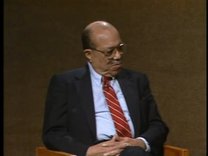
00:00:30 Dr. William Jacob Knox is a physical chemist,
00:00:59 born in New Bedford, Massachusetts, in 1905.
00:01:03 Graduating from New Bedford High School in 1921,
00:01:07 he went on to earn his B.S. in chemistry at Harvard University in 1925,
00:01:12 his M.S. in chemical engineering from MIT in 1929,
00:01:17 and a Ph.D. in physical chemistry from MIT in 1935.
00:01:23 In the 1920s and 30s,
00:01:25 Dr. Knox was an instructor in chemistry at Johnson C. Smith College and Howard University,
00:01:31 a professor of chemistry at A&T College in North Carolina,
00:01:35 and in 1942 taught as professor of chemistry at Talladega College in Alabama.
00:01:41 During World War II,
00:01:43 Dr. Knox became a research associate and later section leader
00:01:47 for corrosion studies in the Manhattan Project.
00:01:50 Working under Willard Libby,
00:01:52 he rose to become one of the premier scientists of the senior research staff.
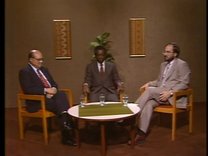
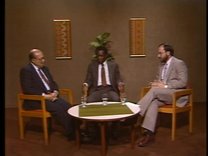
00:01:58 Joining him for this interview is his longtime friend and colleague,
00:02:02 Dr. Walter Cooper,
00:02:04 former manager of the Eastman Kodak's Office of Technological Communications,
00:02:09 and Dr. Jeffrey Sturchio,
00:02:11 associate director of the Center for the History of Chemistry.
00:02:15 This interview was produced in part with funding from the Eastman Kodak Company.
00:02:21 Dr. Knox, we know you were born in New Bedford, Massachusetts in January 1904.
00:02:27 I wonder if you could tell us a little bit about your childhood and early years there,
00:02:31 your family context, and what New Bedford was like in those times.
00:02:36 Well, I was the third of five children in my family.
00:02:43 It was a very close-knit family.
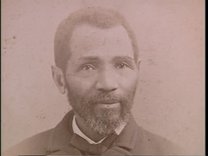
00:02:45 My grandfather was an ex-slave
00:02:48 who evidently bought his freedom around 1847 and came to New Bedford.
00:02:54 My father was born in New Bedford, Massachusetts,
00:02:57 and he graduated from high school.
00:03:01 My mother was born in Waterloo, New York,
00:03:06 and she was self-educated.
00:03:09 I had two sisters who were older than I
00:03:15 and two brothers who were younger.
00:03:17 And this family was a very close-knit family,
00:03:20 and they were very anxious to see to it that we got an education
00:03:25 because somehow or other they realized that
00:03:29 Negroes in their day and time
00:03:32 could achieve anything at all,
00:03:36 if they would achieve anything at all,
00:03:38 would have to have a solid education.
00:03:40 So they encouraged all of us to do just that.
00:03:45 We were not confined to study particular things,
00:03:48 but we were permitted to study anything
00:03:50 that we thought we might be interested in.
00:03:53 And this was the attitude of the home in which I grew up
00:03:58 and in which my brothers and sisters grew up.
00:04:01 And we all graduated from New Bedford High School.
00:04:05 I went to Harvard, entering Harvard in 1921.
00:04:13 I then taught for a few years and went back to study again
00:04:18 at the Massachusetts Institute of Technology
00:04:20 where I received a master's degree from the Department of Chemical Engineering.
00:04:24 And after teaching a year at Howard,
00:04:27 I then went back to MIT to work on a PhD,
00:04:30 which I finally received in 1935, I believe it was,
00:04:37 from the Department of Physical Chemistry.
00:04:40 In brief is the history of my family.
00:04:43 Could you tell us what New Bedford was like in those years up until 1920, 21?
00:04:48 New Bedford was a very interesting town.
00:04:50 They had a very excellent school system.
00:04:53 There was only a very small minority group population there.
00:04:58 And evidently the people who went before
00:05:02 were people who were self-educated
00:05:04 and had built a tradition
00:05:06 upon which the younger ones built
00:05:11 and realized that they had certain standards to meet.
00:05:16 Frederick Douglass spent some time there.
00:05:20 It's interesting to note that he developed some of his oratorical skills
00:05:28 in New Bedford by preaching to black audiences
00:05:32 in a church which he founded himself.
00:05:34 This indicates that the Negroes there were self-educated
00:05:40 because in order to develop that kind of oratorical skill,
00:05:46 he had to have listeners who had some education.
00:05:49 They must have been self-educated
00:05:51 because in that day and time,
00:05:54 schools were not open to them.
00:05:56 So what they learned, they learned outside of school.
00:06:00 There were only about 700 Negroes in that community at that time,
00:06:08 but the community had among its members
00:06:14 a photographer who had a studio downtown,
00:06:20 which is quite interesting for a period that early.
00:06:23 There were two black physicians.
00:06:29 There were two black lawyers.
00:06:31 There were about seven members of the police force.
00:06:35 So this was a rather advanced community.
00:06:39 This is not to say that there was not prejudice there,
00:06:42 but there was a certain tradition of independence
00:06:46 which seemed to be the guiding light of the people who lived there.
00:06:50 And this was one of the influences
00:06:53 to which my family was subjected as we grew up.
00:06:57 It was an attitude of independence that developed
00:07:00 as a result of the tradition built by our forebears.
00:07:04 New Bedford was known as a whaling community,
00:07:09 fishing community.
00:07:11 What attracted blacks from the South to migrate to New Bedford?
00:07:18 Well, it was an important station in the Underground Railway,
00:07:21 and many of them came there.
00:07:24 I have often wondered why they came there and stopped,
00:07:29 and I suspect it was due to the fact that there were laws in Massachusetts
00:07:33 which prevented Negroes from being taken back to the South if they were caught.
00:07:39 Consequently, they came there and lived,
00:07:42 and they had opportunities to work there,
00:07:46 and they built their community independently
00:07:51 on the basis of the opportunities which were theirs.
00:07:54 And the community which developed was a rather unusual one.
00:08:01 Quite amazing, I think, for the early part of the century,
00:08:07 for people to have advanced that far
00:08:10 under the conditions which prevailed in this country.
00:08:13 Bill, you majored in chemistry at Harvard.
00:08:17 Was that interest something new or associated with your entrance,
00:08:23 or did you have it from your high school years?
00:08:26 I had it from my high school years.
00:08:27 I took a course in chemistry in high school,
00:08:30 and I was quite good in mathematics and in chemistry.
00:08:36 I went to Harvard with the idea of following the career as an industrial chemist.
00:08:45 Black men in those days who followed chemistry were considered somewhat weird
00:08:51 because the claim was that there was no opportunity for them,
00:08:55 therefore it was a waste of time for them to study.
00:08:58 Also, there was a sort of a background feeling
00:09:02 that Negroes were not up to it intellectually
00:09:08 to follow the rigorous routine which was necessary
00:09:12 for the making of a chemist.
00:09:15 So you were looked upon as something of a weirdo,
00:09:20 and you were isolated,
00:09:23 and people, even members of the faculty or the student body,
00:09:27 never paid very much attention to you.
00:09:30 Thesis research on the absorption spectra of nitrogen tetroxide
00:09:33 already seems to be a different kind of research
00:09:36 than the chemistry that you were learning at Harvard just 10 or 12 years earlier.
00:09:40 Oh, yes.
00:09:41 Well, you see, actually, what happened to me in those days
00:09:46 was that when you were unwelcome in any field,
00:09:52 you would try any particular line of investigation
00:09:58 in order to broaden your experiences
00:10:00 so that your availability would be more widespread.
00:10:06 Consequently, there was no relation between what I did on my doctorate
00:10:10 with what I did on my master's degree
00:10:13 or, as a matter of fact, with what I did as an undergraduate.
00:10:17 But I was endeavoring to widen my expertise
00:10:25 so that I could expect a wider availability
00:10:30 for various jobs which might be possible.
00:10:35 At MIT, were there more new instruments than had been available?
00:10:38 Well, for example, I remember we used a Hildex spectrograph.
00:10:42 We used a couple of Hildex spectrographs and microphotometers,
00:10:47 and we had to develop a certain vacuum technique
00:10:54 in preparing pure nitrogen tetroxide,
00:10:59 which is a very difficult thing.
00:11:01 We had to devise a method whereby it could be prepared at low temperature
00:11:05 so that we wouldn't get any decomposition of the nitrogen dioxide into nitric oxide.
00:11:11 It had to be carried out in a system
00:11:17 whereby we kept oxygen flowing through the system
00:11:21 and where we carried out the synthesis in yellow light
00:11:29 because nitrogen dioxide absorbs in the visible
00:11:34 and breaks down into oxygen and nitric oxide.
00:11:37 So we wanted to get pure samples,
00:11:40 and we had to build a vacuum system
00:11:45 so that we could clean it out
00:11:47 and then set up for the preparation and storage
00:11:53 of the nitrogen tetroxide, which we were to use in our experiment.
00:11:57 You stayed at Talladega until the war came.
00:12:00 What did you decide to do when the war broke out?
00:12:03 Well, when the war broke out, I had a daughter,
00:12:08 and I didn't think that I was the arms-bearing type.
00:12:13 So I offered my services through the facilities in Talladega
00:12:21 to the federal government.
00:12:23 They were a little surprised and referred me to the governor,
00:12:27 and I called the governor's office,
00:12:29 and whoever was the governor's representative
00:12:34 told me that he was happy to receive my communication,
00:12:37 but he would let me know.
00:12:40 I never heard from him.
00:12:42 In the meantime, I had written to MIT,
00:12:44 and they put me in contact with Columbia University,
00:12:48 and I got a wire from Columbia asking me to come there for an interview.
00:12:53 I went there, and this is where I met,
00:12:57 this is where and when I met Dr. Leary.
00:13:05 He looked over my credentials and said,
00:13:10 well, I think that you can help us here.
00:13:14 He said, can you be back in two weeks?
00:13:16 And I said, I certainly can.
00:13:19 You see, it was not the Civil Rights Movement
00:13:23 that opened up things for black chemists and chemical engineers.
00:13:27 It was actually the war, and opportunities became available.
00:13:32 I returned to New York City,
00:13:36 and I went to work on the Manhattan Project.
00:13:40 We were interested in trying to find
00:13:44 what metals would have to be used and set aside
00:13:48 for the development of the atomic bomb.
00:13:51 There were corrosion studies to be carried out.
00:13:55 We had to find out how to stabilize the metal
00:14:00 which would be used in the diffusion process.
00:14:03 It had to be stabilized against the process gas,
00:14:06 which was uranium hexafluoride.
00:14:10 Our problem was to find out how to stabilize the gas,
00:14:15 how to stabilize the metal,
00:14:18 and how to measure the consumption of process gas
00:14:24 after the metal had been stabilized.
00:14:26 We had to use fluorine to do this,
00:14:28 and this was a fascinating area of research
00:14:33 because fluorine was a very uncommon chemical at that time.
00:14:38 No one knew exactly how to handle it,
00:14:42 so we had to develop the techniques of handling fluorine.
00:14:46 It was a very fascinating, very demanding,
00:14:52 but very exciting period of my life.
00:14:55 It was during this period that I first became aware
00:15:03 of the opportunity of what it was like
00:15:05 to be in an active scientific community.
00:15:08 It was a very thrilling experience for me
00:15:11 because it was the first chance I'd ever had
00:15:14 to work in that kind of community.
00:15:16 Even as a student, I never had this opportunity
00:15:19 of working in this kind of community,
00:15:23 and I worked hard at this.
00:15:27 There was a fellow named Walter J. Moore,
00:15:33 who was head of the corrosion section at that time.
00:15:39 He left, and he went to take a job, I think,
00:15:45 at Roman Haas or some other place,
00:15:48 and this left his position vacant.
00:15:51 He left it vacant for a couple of months.
00:15:58 During that period, he asked me to write a report,
00:16:01 and I did it.
00:16:03 After two months had gone, he called me in
00:16:06 and asked me if I would take charge of that section.
00:16:10 There were about a dozen people in the section,
00:16:12 all white, except myself.
00:16:15 I said, yes, I would.
00:16:17 So he called people into his office,
00:16:20 and he said, as of today,
00:16:23 Dr. Knox will be the head of the corrosion section,
00:16:26 and I want you all to give him your fullest cooperation.
00:16:30 That is all.
00:16:32 And that was it.
00:16:35 This is an interesting thing,
00:16:37 because this was purely based upon merit.
00:16:42 There was no paternalism in this.
00:16:45 This impressed me greatly.
00:16:48 There was no paternalism in this,
00:16:51 and it was a man who, I think,
00:16:56 just made judgments on the basis of competence.
00:17:00 And I think this was really the characteristic
00:17:05 of a really great man, a really great scientist.
00:17:08 So, Werner F. Libby had provided you
00:17:12 with an opportunity to compete.
00:17:14 That's right.
00:17:15 And that is all that you asked for and wanted.
00:17:18 That's right.
00:17:20 All you can expect.
00:17:23 And down the course of this project,
00:17:29 he said, as time went on,
00:17:35 and the project was about to come to a close,
00:17:39 he said, now, if you will stay with me.
00:17:43 He was talking to the whole group.
00:17:44 We had a whole group meeting.
00:17:46 He said, if you will stay with me until the project ends.
00:17:51 He said, I will do my best to see that you are placed
00:17:54 in positions which you would like to be placed in.
00:17:57 And I simply, on the basis of what I had seen,
00:18:02 I simply took him at his word.
00:18:04 I said, this man really means what he is saying.
00:18:09 And I waited, and about a month before the project ended,
00:18:13 he called me in, and he said, Bill,
00:18:15 he said, you remember I promised two months ago
00:18:20 that if you fell and stayed with me
00:18:22 until the end of this project,
00:18:24 I would try to get you placed in a position
00:18:27 that you would like to have.
00:18:28 He said, I'm calling you in today
00:18:30 to make good on that promise.
00:18:33 And as a result, I went to Eastman Kodak Company.
00:18:36 I really took the first job that was offered to me.
00:18:39 I found out later that this was not necessary,
00:18:42 but see, a fellow in my position,
00:18:44 having never been able to get a job anywhere,
00:18:49 was not so sure that there would be any other offers.
00:18:52 So I came to Rochester,
00:18:54 and I was interviewed by Kenneth Meese.
00:19:01 And he said to his subordinates,
00:19:08 he said, take Dr. Knox around this laboratory
00:19:12 and find out where he wants to work.
00:19:15 So there was no question after that
00:19:18 that he was going to offer you a job.
00:19:20 This was a director from the top.
00:19:25 A fellow named Carl Tong was working on this problem
00:19:28 when I was there, and they moved Carl Tong
00:19:32 to let him off the hook and put me on this program,
00:19:36 which was a rather difficult program,
00:19:39 because here you were trying to replace
00:19:42 in a photographic emulsion,
00:19:44 a substance around which the photographic emulsion
00:19:47 had been built.
00:19:49 To take it out without changing anything else
00:19:51 and putting in something else
00:19:53 would have exactly the same properties
00:19:55 photographically and physically as sapronin
00:19:59 was a very difficult problem.
00:20:04 And imposed upon that was the fact
00:20:07 that it was difficult to get any idea
00:20:10 as to what the composition of the emulsion was,
00:20:13 because everything is so compartmentalized
00:20:15 at Eastman Corday Company
00:20:17 that that information is not available to you.
00:20:21 That was referred to, as I recall,
00:20:23 as the silver curtain.
00:20:24 That's right.
00:20:25 Emulsion information was kept behind a silver curtain.
00:20:28 So we had to work in the dark,
00:20:30 and we worked around this,
00:20:34 and actually we made friends with people in production
00:20:37 so that we could get certain information
00:20:39 that might be useful to us.
00:20:41 We got this information on the basis of our promise
00:20:45 never to tell anybody where we got the information from.
00:20:48 You had to be very resourceful.
00:20:51 But we got it,
00:20:54 and it was sometimes difficult
00:20:56 to have our samples tested for photographic properties,
00:21:00 so we devised the method of sending
00:21:03 an atrocious number of samples to be tested,
00:21:07 and the people doing the testing would throw up their hands
00:21:10 and say, we can't test all of these things.
00:21:13 We would say, well, can't you just test two or three,
00:21:16 and we'd pick out the two or three we were interested in
00:21:19 and tell them to throw the others away.
00:21:21 So we got our tests made,
00:21:23 and we were able, eventually,
00:21:26 to find substitutes for our sap.
00:21:30 I think this resulted in,
00:21:33 we had about 21 or 22 patents.
00:21:36 What implications did that work have?
00:21:38 Well, I think that there were very advantageous implications
00:21:43 insofar as the speed of coating was concerned.
00:21:46 This came as an added value
00:21:53 to the replacement of saponin,
00:21:55 because with saponin,
00:21:57 the speed of coating was probably limited
00:22:00 to the speed which they were using at that particular time.
00:22:04 And, as a matter of fact,
00:22:06 with surfactants, the speed of coating
00:22:08 could be increased tremendously,
00:22:12 so much so that they had to then begin to study
00:22:18 ways and means by which,
00:22:20 by means of which they could more rapidly
00:22:22 set the gelatin and dry it.
00:22:25 That enabled Kodak to keep up with the growing demand
00:22:27 for photographic papers.
00:22:28 That's right.
00:22:31 So it really did have direct implications for the business,
00:22:34 unlike some research projects.
00:22:36 That's right.
00:22:37 Not only as far as paper is concerned,
00:22:39 but also as far as film is concerned.
00:22:42 Well, you were at Kodak then for 25 years.
00:22:46 That's right.
00:22:47 1945 to 1970.
00:22:49 And also in those 25 years,
00:22:51 you were very active in a variety of civic organizations.
00:22:54 The social problems in the community,
00:22:57 it was a matter of survival.
00:22:59 I mean, how do you survive without a place to live in?
00:23:02 That is, you're in a situation where
00:23:04 you can't live in the community,
00:23:06 and you can't leave,
00:23:07 because if you leave,
00:23:08 they won't hire any other black.
00:23:11 So you're in between a rock and a hard place.
00:23:15 So you have to really enter into the business
00:23:20 of trying to bring the community to the point
00:23:24 where blacks can live,
00:23:27 and live decently,
00:23:29 and carry on their professional activities.
00:23:33 And this is how I got into this work,
00:23:38 trying to find a decent place for myself and my family.
00:23:43 There's a tendency for people to have a stereotype
00:23:46 that scientists and engineers are only technical people,
00:23:49 that they aren't involved in social life,
00:23:51 in the broader world,
00:23:53 that they aren't involved in their communities,
00:23:55 that they don't have a responsibility
00:23:56 to be involved in their communities.
00:23:58 And I think the example of your work in Rochester,
00:24:02 in these many organizations,
00:24:04 and for a very important cause,
00:24:06 helps to break down that stereotype.
00:24:08 And it's not just for black professionals,
00:24:10 it's for all professionals.
00:24:12 Well, this is a new world,
00:24:13 and actually if you look at the changes in curriculum
00:24:16 in engineering schools,
00:24:19 they have introduced courses in humanities
00:24:24 and in the social sciences.
00:24:27 Because quite often,
00:24:30 captains of industry are drawn from the ranks
00:24:34 of engineers and scientists.
00:24:36 And they have to have some kind of a social background,
00:24:41 some acquaintance with the humanities,
00:24:44 in order to be able to function effectively,
00:24:46 as leaders of industry.
00:24:48 Because frequently,
00:24:50 the reputation of a corporation
00:24:53 depends upon its reputation for good citizenship
00:24:57 in the community in which it operates.
00:24:59 And the people who run those organizations
00:25:02 have to have the type of background,
00:25:05 the type of insight,
00:25:06 and the type of leadership,
00:25:08 which will enable them to keep social problems
00:25:13 from festering,
00:25:15 festering so that they become harmful
00:25:18 to progress in the community.
00:25:20 These corporations today
00:25:23 are in productive difficulties.
00:25:28 They're in productive difficulties
00:25:30 because they've got to have more efficient people
00:25:34 working for them.
00:25:36 And efficiency doesn't come with one's name
00:25:38 or the color of one's skin.
00:25:40 What advice would you give to a young person nowadays?
00:25:45 A young person today,
00:25:47 who does not have this attitude
00:25:49 that education is not the way out,
00:25:53 is a lost ball in tall weeds,
00:25:57 education is still the way out,
00:26:00 but he has to pay a price.
00:26:02 He has to pay a price to get an education.
00:26:05 Even a bank robber
00:26:08 has to case the joint before he's successful.
00:26:13 In order to get anywhere in life,
00:26:15 you have to have the tools with which to do it.
00:26:18 You have to know what the score is.
00:26:20 And these people who think that
00:26:23 life is just a bowl of cherries are mistaken.
00:26:28 This is going to be a much more competitive world
00:26:31 than it was in our day.
00:26:34 It's a much more competitive world
00:26:36 than it was in our day,
00:26:38 as far as the whole population is concerned.
00:26:41 I don't believe anymore
00:26:43 it's going to be a matter of who you know.
00:26:45 I think it's going to be a matter of what you know.
00:26:48 So my advice to these young folk
00:26:51 who are now growing up
00:26:53 is to take advantage of the accessibility
00:26:55 to education that is yours,
00:26:58 that is theirs,
00:27:00 and to go on to do the best they can.
00:27:05 You have to adopt some healthy attitude
00:27:08 toward excellence of performance.
00:27:11 Well, we've come a long way
00:27:13 from New Bedford, Massachusetts in 1904,
00:27:15 but it's been a very interesting conversation,
00:27:18 and I'd like to thank you very much for taking part.
00:27:20 I'm glad to be here.
00:27:22 And, Walt, thank you, too,
00:27:23 for helping me with the interview,
00:27:25 and we enjoyed it very much.
| Property | Value |
|---|---|
| Creator of work | |
| Format | |
| Genre | |
| Medium | |
| Extent |
|
| Language | |
| Subject | |
| Rights | In Copyright |
| Rights holder |
|
| Credit line |
|
Institutional location
| Department | |
|---|---|
| Collection |
Related Items
Cite as
American Chemical Society. “Reflections by an Eminent Chemist: William J. Knox.” Dvds, 1990. American Chemical Society Audiovisual Collection. Science History Institute. Philadelphia. https://digital.sciencehistory.org/works/e341hri.
This citation is automatically generated and may contain errors.