
Symposium on Arnold O. Beckman and Beckman Instruments (tape 1)
- 1987-Nov

These captions and transcript were generated by a computer and may contain errors. If there are significant errors that should be corrected, please let us know by emailing digital@sciencehistory.org.
Transcript
00:00:00 I think we'd rather have her here than anybody else.
00:00:15 Hey, he won this one.
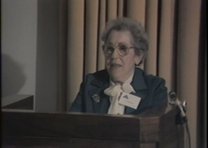
00:02:33 First of all, I want to thank John Haas very much for his hosting of this gathering of the very special friends of Chalk that we have here today.
00:02:45 Especially, we're pleased to acknowledge the help that we've gotten from the chemical community in general,
00:02:53 and of course, from our major co-sponsors, the American Chemical Society, which is represented here by Ernest Eliel,
00:03:02 the chairman of the board, and by Stan Proctor, who's the chairman of the American Institute of Chemical Engineers.
00:03:13 Stan is, well, right here.
00:03:19 And since Stan, I gather, will not be able to be with us tonight, I wonder if you have anything you'd like to relay a message to Stan.
00:03:28 Thank you, Charles.
00:03:30 I'm very pleased to be with you today on this day of celebration.
00:03:35 And I'm glad to bring you greetings from the American Institute of Chemical Engineers.
00:03:42 I'd like to make two observations with regard to this celebration in this city.
00:03:47 The first of which is that 79 years ago, in 1908, the American Institute of Chemical Engineers was formed in Philadelphia.
00:03:58 And the second observation I'd like to make, and we discussed it during the cocktail hour,
00:04:02 is that in 1922, Dr. Beckman, recognizing the opportunities existing in the new field of chemical engineering,
00:04:11 received his degree in chemical engineering from the University of Illinois.
00:04:15 So I just simply want to say thank you very much for the opportunity to be here,
00:04:20 and I wish much success to the Beckman Center for the History of Chemistry. Thank you.
00:04:26 I want to assure you I'm not slighting my old friend Ernest Elio, because he will have a chance to talk to you this evening.
00:04:38 I'm very proud of the fact that the very first appointment I ever had to make as a chairman of a department was Ernest Elio.
00:04:46 And I take great pleasure and pride in the fact that we picked a winner in Ernest Elio.
00:04:53 But you'll hear from him tonight.
00:04:55 I'm sure we're all pleased with the role that CHOC has assumed and with the extra impetus that Arnold Beckman has given to our endeavor.
00:05:06 The programs at CHOC have met with wide acceptance around the chemical community.
00:05:12 The efforts to bring the message of the contributions of chemistry and the philosophy of chemistry,
00:05:23 its intellectual as well as practical contributions to society through all kinds of activities,
00:05:33 our CHOC news, our oral histories, there's all kinds of activities that are going on,
00:05:41 has been very well received, and I believe it's a very important contribution to the broader society
00:05:51 to understand better what chemistry has done and what chemistry can do to make this a better world.
00:05:59 So we think that message is an important one.
00:06:03 We have a big challenge to our little endeavor here at Penn.
00:06:08 Arnold's faculty has done a marvelous job of getting this group organized.
00:06:14 We've been scattered for the first, was it four years now, four and a half, almost five years.
00:06:21 Oh, six, one on six.
00:06:23 Well, that shows my age.
00:06:26 Five or six years that we've been in business, we've been scattered all over the campus here
00:06:31 in attics and basements and one thing and another,
00:06:34 and with the very great help of Arnold Beckman, we're now going to be moving into the new building
00:06:40 that's just a little less than a block in that direction.
00:06:44 You may see it's still under construction.
00:06:46 Hopefully, in the spring, we'll be moving in, Arnold,
00:06:49 and we'll be able to see the results of your help to our endeavor in a very fine facility
00:06:57 that will be used until we get to the point where we may build our own facility for this endeavor.
00:07:04 But certainly, we are very pleased with the way things have developed.
00:07:10 We have here two of the, I guess, the most important founding fathers of the Center for the History of Chemistry.
00:07:19 John Haas has been one that's been with us right from the very beginning, and John is another.
00:07:25 John is a distinguished alum of the University of Pennsylvania.
00:07:28 He was a long-time trustee of the University of Pennsylvania.
00:07:33 He's a former chairman and CEO of the Rohrer Group.
00:07:38 He's a chairman of the Beckman Center's campaign for financial support, a steering committee of that.
00:07:48 He's a former chairman of the Pharmaceutical Manufacturing Association.
00:07:52 I'd like to call on John Heckman to say, hopefully,
00:07:55 John is over here at the number one table, of course.
00:07:59 We want to put him out first.
00:08:02 Wherever Arnold Beckman sits today is the number one table.
00:08:09 It's interesting that Charlie mentioned this.
00:08:12 I'm chairman of the, I guess it's officially called the Campaign Steering Committee for the capital campaign that we are mounting.
00:08:24 I guess I first got to know Charlie at a University of Pennsylvania capital campaign program some years ago,
00:08:32 which, incidentally, was for a good bit more money than we're talking about here.
00:08:37 It lasted a good bit longer, I think, than this campaign is today.
00:08:41 We got to become fast friends and, I think, sort of a mutual admiration society here.
00:08:50 Charlie, come back.
00:08:54 As Charlie said, I've been in the pharmaceutical industry for many years, in fact, all of my working life.
00:09:05 One of the things that one notices quite prominently over the years is the need for an improved public understanding of science and technology.
00:09:22 And in fact, the pharmaceutical industry, the birth of science and technology, of which I was engaged.
00:09:31 You have to think for a minute about the lack of public understanding in terms of the grand name versus generic name.
00:09:39 Pharmaceutical argument, things of that sort.
00:09:42 You begin to see the kinds of problems that the entire science and technology area has.
00:09:52 Specifically, I think that the average person nowadays thinks of science and technology almost as equating with environmental pollution,
00:10:07 rather than with the advancement of our standard of living, for example.
00:10:13 And I think that that's one of the great problems we have as an industry and one of the reasons why I have been so enthusiastic about the Center for the History of Chemistry,
00:10:24 which today we are renaming the Beckman Center for the History of Chemistry.
00:10:33 As I think you probably all know, we are mounting a capital campaign for the center for five million dollars.
00:10:47 Thanks in large measure to the vision, generosity, and the encouragement of Ronald Beckman,
00:10:58 who is, as you know, a noted California industrialist, inventor, academic, an engineer, philanthropist,
00:11:08 and whose name is enshrined forever in the name of Smith, Klein, and Beckman.
00:11:14 And I'm the honorary president of the non-existent Smith, Klein Alumni Society.
00:11:20 But I still have this august position.
00:11:27 Very late one night at a convention at a Greenbrier, after a good many drinks over the bar,
00:11:33 the then chief executive officer of Smith, Klein decided that maybe I could handle this.
00:11:41 And then when the company changed from Smith, Klein & French to Smith, Klein & Beckman,
00:11:46 you know, I was able to roll with the punches too.
00:11:50 I let Smith, Klein & Beckman, just to give you an idea of the time frame I'm talking about,
00:11:56 I let Smith, Klein & Beckman handle all this in 1952.
00:12:01 That's a long time ago.
00:12:04 It's a big challenge for us to raise $5 million,
00:12:10 even in the face of Arnold Beckman's generosity in challenging us for the first $2 million.
00:12:21 But we have, I think, had a really imaginative response in the efforts of the American Chemical Society,
00:12:31 which has agreed to join with us and we with them in making our campaign a part of the ACS capital campaign.
00:12:44 And so we think that with the Beckman match being a high-priority item in the ACS campaign,
00:12:55 that we should have no problem at all in leading Dr. Beckman's challenge and matching his kit.
00:13:03 We're well on our way and we're going to be looking to philanthropic leaders in the industry in the months ahead
00:13:11 in order to make our pitch, our ask, as they say in fundraising circles,
00:13:18 for help in the ACS campaign for chemistry so that we can meet our $5 million goal.
00:13:25 I have addressed a number of letters to chief executive officers of pharmaceutical companies,
00:13:33 and I think universally we've gotten a strong and favorable reception.
00:13:38 In one case, we got a definite commitment.
00:13:44 In other cases, we have said, hey, wait a minute, we are just in the process of working this out with the ACS campaign,
00:13:51 and we'll be back to you as soon as we have that all ironed out in terms of coordinating.
00:14:01 The $2 million for our $5 million goal has really started us off with a bang.
00:14:09 Dr. Beckman has encouraged us to aim high, raise our sights,
00:14:15 and the campaign is really off and rolling and is making excellent progress.
00:14:23 I don't want to appear to be over-optimistic, but I don't see how,
00:14:33 unless we meet with unforeseen time delays, which we are somewhat concerned,
00:14:41 I don't see how we can fail to meet, accept, and rise to the occasion I imagine Dr. Beckman is getting.
00:14:58 Now I'd like to introduce Dr. Arnold Beckman and hope he'll say a few words.
00:15:04 I have mixed emotions. First of all, I feel like an imposter.
00:15:11 Being amongst so many chemists, it's been so many years since I've lived in a test tube.
00:15:16 I'm trying to call myself a chemist. I do have a certificate.
00:15:22 I'm not a chemist, but a chemical engineer.
00:15:25 Well, it doesn't really say that. What it says is that I satisfied the academic requirements.
00:15:37 I have very many fond memories of Philadelphia.
00:15:41 Some of this may be in your history, some may not be, Arnold.
00:15:45 When I first came out with the Ph.D. here, I had a problem.
00:15:51 It had to sell for $195.
00:15:54 At the time, you could buy a bottle of Lipman's paper for about five cents.
00:15:58 Those of you who worry about your competitors' prices, you know,
00:16:01 for $195 versus a few cents for Lipman's paper, it could have been sold.
00:16:06 What happened was the American Chemical Society had its annual meeting in San Francisco
00:16:11 in the late summer of 35, and I put the instrument up their shoulder
00:16:15 to a chemical chemistry professor.
00:16:18 He said, you can sell this for $195.
00:16:21 At that time, this is 1935, you're all too young.
00:16:25 But this is, you've heard of the Depression.
00:16:27 This is the bottom of the Depression.
00:16:28 That was at least a month or two months' salary of an analytical chemist at that time.
00:16:33 For a chemist to go out and ask his boss to spend $195 for something that did nothing but measure acidity,
00:16:40 it was pretty much a toss-up whether or not this thing could be sold.
00:16:45 Well, the professors, they hedged.
00:16:46 They said, we don't know.
00:16:48 You should go back and talk to the operator's supply house, the dealers.
00:16:51 They have a much better idea.
00:16:53 And so Mr. Beckman and I got on the train.
00:16:55 I met the young president, Jane.
00:16:57 Came across the country.
00:16:58 Stopped in Denver.
00:16:59 Denver, Clark County, Chicago.
00:17:01 Son of a scientist, Ph.D.
00:17:04 On to New York.
00:17:13 Well, most of the dealers were pretty pessimistic.
00:17:16 They didn't think it would sell.
00:17:17 The price was just too high.
00:17:19 But the son of the sales manager at Arthur H. Thomas, Ed Patterson, he was a young fellow.
00:17:26 His enthusiasm had not been grunted by much period of time.
00:17:30 So he thought we might sell it at $1,500 or $1,600 over a 10-year period before we started into the market.
00:17:39 Well, fortunately, this was a depression.
00:17:42 We thought, well, good.
00:17:44 So we went ahead, which is all.
00:17:47 We had no initial capital.
00:17:49 So we sold a meter of jute and go out and buy some parts for the next three or four meters.
00:17:54 And the thing just gradually built up.
00:17:56 Well, as I say, as a market researcher, that's a pretty lousy job.
00:18:03 Instead of selling 600 and saturating the market, we made several hundred thousand.
00:18:08 And now over the years, we can't see any end of the market.
00:18:12 We're still coming up with new models and new direction.
00:18:15 So I'm so thankful to Ed Patterson and Philadelphia for giving me the encouragement enough to get started.
00:18:24 You might have another experience here.
00:18:28 That would be Dr. Sumner.
00:18:30 He was talking about, if you study things enough, people begin to believe, even though they may not be true.
00:18:36 In between the matches and Dr. Durand, I spent a couple of years with Western Electric Engineering.
00:18:43 That's what's now known as Bell Telephone.
00:18:47 Not doing chemical work, but working on an application of probability theory to sampling and inspection.
00:18:53 You take a sample of a certain size, what's the reliability of that property?
00:18:58 It's probably to the whole universe.
00:19:01 Well, I was sent down here to inspect solar joints and relay contacts on the penny factory screen.
00:19:09 That's what penny factory had just been put in.
00:19:11 I thought, well, that's a odd name. I never heard it before.
00:19:15 I think it was the William Penn Hotel.
00:19:18 I'm not too sure.
00:19:19 It was a hotel about a block or two away from a street where they had the Sideshow Barker's office.
00:19:26 They had their snake oils and this thing like that.
00:19:28 I was wandering down there one night.
00:19:30 Here was a fella playing the banjo.
00:19:33 Excellent banjo player.
00:19:34 I happened to have the light.
00:19:36 That's why I stayed and listened to him.
00:19:38 I played and played.
00:19:39 Finally got a big crowd running.
00:19:41 Then the barker came around.
00:19:43 With his snake oil.
00:19:45 He gave a tremendous pitch on the purchase of this snake oil.
00:19:48 It cured dandruff, indrum, toenails, gout, anything you might have.
00:19:52 Only a dollar a bottle.
00:19:54 Wasn't a single kicker.
00:19:56 This fella must have looked pretty low.
00:19:59 After all the expenditure he'd given this banjo player.
00:20:02 Not a single kicker.
00:20:03 He sat down and he broke out into a big smile and said,
00:20:06 Friends, you don't know how happy you've made me.
00:20:09 Show me. You've just got gullible push over.
00:20:11 You don't know me.
00:20:12 I can tell you anything.
00:20:14 But you don't have to take my word for it.
00:20:16 You can read it on the label yourself.
00:20:18 Laughter.
00:20:28 Well, thank you all very much.
00:20:30 Applause.
00:20:42 Good afternoon.
00:20:43 I'd like to welcome you all to this symposium.
00:20:46 Today is, of course, a very special day of celebration for us.
00:20:50 That we're celebrating the transformation of the Center for History of Chemistry
00:20:54 into the Arnold and Mabel Beckman Center for History of Chemistry.
00:20:59 Among our distinguished roster of speakers is Arnold Beckman himself
00:21:04 who will be telling us some things about his own experience.
00:21:09 We're especially delighted that this symposium this afternoon
00:21:13 is going to be chaired by a distinguished member of the chemical community.
00:21:18 Dr. Franklin Long is Professor Emeritus of Science and Society
00:21:23 and of Chemistry at Cornell University.
00:21:26 He is a physical chemist by training, a Berkeley PhD.
00:21:31 He did important work in the kinetics of solution reactions.
00:21:36 And, of course, more recently he's been known to us for many years
00:21:40 as a very active participant in the important dialogue about arms control.
00:21:46 Armed participant in and commentator on the scientific scene
00:21:52 and we're very delighted that he's with us.
00:21:54 He is a member of the Beckman Center's advisory board.
00:21:58 And, Frank, thank you.
00:22:04 It is a great day and I'm very pleased indeed to be here.
00:22:08 It is a day of celebration to have this new program.
00:22:13 This is a very new program, this program of history of science.
00:22:17 It was founded only in 1982 and it's had a lot of good fortunes.
00:22:23 One of them was that it was rather promptly sponsored
00:22:26 and given a home by the University of Pennsylvania,
00:22:29 or maybe I should say a series of homes.
00:22:32 But that's been very important.
00:22:36 It was equally fortunate in attracting an exceedingly able,
00:22:40 vigorous and effective head who you've just heard from, Arnold Thackeray.
00:22:45 And it's true that it was recognized by chemists very broadly and quickly
00:22:51 as a very significant thing to happen,
00:22:53 to have a program that focused on the history of this science.
00:22:59 And I think historians of science have been equally pleased.
00:23:02 The program has had the strong backing of the American Chemical Society
00:23:06 and the American Institute of Chemical Engineers.
00:23:09 But in spite of all these pluses, and there were many,
00:23:13 it is, I think, fair to say that over these recent years
00:23:16 the program has not felt either secure or that its program was of the optimum size.
00:23:25 Well, suddenly and quite dramatically, as you gather, this has now changed.
00:23:29 This very imaginative man, Arnold Beckman, has seen this as something
00:23:36 that merited the support of himself and his wife, Mabel,
00:23:40 and has given this very handsome challenge grant to the program.
00:23:45 And needless to say, the sense of pleasure and gratitude to Arnold Beckman
00:23:52 is pretty substantial, and that's a lot of what we mean when we say celebration.
00:23:57 Now, we do have a very nice group of people discussing today.
00:24:01 The topic is chemical instrumentation yesterday, today and tomorrow.
00:24:07 And it's really exceedingly appropriate that the first man we will end up hearing from is Arnold Beckman.
00:24:13 But first, let me tell you just a little bit about this really remarkable person.
00:24:18 He was born in 1900. He was a chemical engineering student at Illinois,
00:24:24 taking an A.B. degree in 1922 and a master's degree in 1923.
00:24:30 He came here to work what we would now call the Bell Labs for a couple of years.
00:24:34 And for some reason, which I have not heard from him, he decided he really should go back for a Ph.D.
00:24:40 and he went back to Caltech.
00:24:42 And it was there that, as part of his own work and responding to a few of his friends,
00:24:47 he began to apply electronics to instrumentation.
00:24:52 And it really started a quite unique and clearly very successful
00:24:57 innovative developmental entrepreneurial career.
00:25:02 First came the Beckman pH meter, which was a great step forward.
00:25:07 Then came, at least to me, then came the DU spectrometer, which was equally important.
00:25:13 And it's fair to say that these two alone really changed the face of chemistry and also biology.
00:25:19 Neither has been quite the same since those two were made available.
00:25:24 And they became very, very attractive and appealing, widely used, widely sold.
00:25:30 And the Beckman Instrument Company, which really was to follow by a year or two, was effectively on its way.
00:25:38 And after this innovative and entrepreneurial and clearly successful career,
00:25:44 Arnold and Mabel Beckman have, in recent years, been being innovative in another area,
00:25:50 which is that of philanthropy.
00:25:52 They have made a set of really imaginative and insignificant gifts
00:25:58 for things that relate to science and have made a vast difference in programs.
00:26:04 I'll mention just a few.
00:26:06 There's a wonderful building for the Western Center of the National Academy of Sciences coming up in Southern California,
00:26:13 due entirely to Arnold and Mabel Becker gift.
00:26:17 There's a laser medicine unit at the Medical School of University of California, Irvine,
00:26:23 with their support and initiation.
00:26:27 There's a new biotechnology building and some endowment at Caltech,
00:26:34 which is another one of his really major imaginative gifts.
00:26:39 And then, of course, we come to what we've got.
00:26:42 Well, now, it's very gratifying, given that background,
00:26:45 that he's been willing to be the first speaker at this occasion.
00:26:50 And what it's going to be is a video program, excerpts from videotapes,
00:26:57 that I guess the center has actually taken,
00:27:00 which will give you some flavor of him and something about his impression of his programs and activities.
00:27:09 And then there will be, from him, a few comments of the videotapes.
00:27:15 So maybe we can turn to Dr. Strucci, is it, who will be doing the videotape?
00:27:27 As the Illinois chemists, as a matter of fact, they did play an important role.
00:27:30 For no other reason than Glenn and I got very well acquainted.
00:27:34 Glenn left Illinois, went to Wisconsin to get his doctor's degree,
00:27:38 and finally came back here to Southern California, working for the Sunkist Fruit Growers Exchange.
00:27:44 Whereas I went out to Caltech and finally got my degree there.
00:27:48 Well, Glenn had a job of making byproducts from lemon juice, pectin and citric acid.
00:27:55 And he had the problem of measuring the hydrogen ion concentration.
00:27:59 And lemon juice had been heavily dosed with sulfur dioxide.
00:28:03 That's a very difficult thing to do by conventional, by the ordinary hydrogen ion measurements.
00:28:09 And he was using, properly, a glass electrode.
00:28:12 The trouble was the glass electrode was very, very fragile at that time.
00:28:16 And he was using a galvanometer, even though it was a high-sensitivity galvanometer.
00:28:22 The current required was so great that the glass electrode had to have very, very thin walls
00:28:28 and a sizable diameter on the thing.
00:28:32 So he came in to see me one day complaining that one or the other was always breaking.
00:28:37 Either the glass electrode was breaking or the galvanometer was breaking.
00:28:40 So I suggested to him that he get rid of the galvanometer
00:28:44 and substitute a rugged, what we called a vacuum two-volt meter in those days.
00:28:48 An electronic amplifier, we called it.
00:28:51 And so I built him one.
00:28:53 This is the original Beckman pH meter, an instrument introduced 21 years ago.
00:28:58 Today, the pH meter has been dressed up and redesigned,
00:29:01 but its function is still the same to determine acidity or alkalinity.
00:29:06 Now let's join our success story reporter, Ken Peters,
00:29:10 as he chats with founder and president of Beckman Instruments, Dr. Arnold O. Beckman.
00:29:15 Well, Dr. Beckman, after seeing all of these amazing operations,
00:29:18 I can't help but wonder how an organization like this ever got started.
00:29:22 Well, we got started very casually just 20 years ago, Ken.
00:29:26 I was teaching chemistry at Cal Tech
00:29:28 when an undergraduate friend of mine came in and told me his troubles.
00:29:32 He had to measure the acidity of lemon juice,
00:29:35 and he had difficulty with the equipment which was then available.
00:29:38 So I built an electronic amplifier for him to help him out of his troubles.
00:29:43 He came back in two or three months and wanted to know
00:29:45 whether I wouldn't build him another one because someone else was always using the first one.
00:29:49 I said that was enough to start a business.
00:29:51 So we built a commercial model,
00:29:54 and in the fall of 1935,
00:29:56 I took the instrument across the country to talk to dealers
00:29:59 to see whether they thought it would be a saleable item.
00:30:05 ...to change the acidity in the external solution.
00:30:09 Also in 1909, a biochemist in the Carlsberg Brewery in Copenhagen invented the pH scale.
00:30:17 As you all know, these numbers representing hydrogen ion concentration
00:30:21 are very awkward numbers.
00:30:23 Zero, then a decimal point, then a whole string of zeros, something like that.
00:30:27 So he got the idea of using the negative logarithms
00:30:30 as they concentrate to the power of 10.
00:30:33 That was in 1909.
00:30:35 These ideas lay dormant for 25 years, almost dormant.
00:30:39 A few biochemists used pH, but almost no chemists.
00:30:43 So I realized that that would simplify the construction of the instrument
00:30:47 because that gave us a linear relationship between pH and the electromotive force,
00:30:54 whereas we'd have a logarithmic ratio if we used the Nernst equation.
00:30:58 So that made the construction of the instrument easy
00:31:02 and also made the concept of acidity easy
00:31:05 because now people had just a simple scale of small positive numbers
00:31:09 from 0 to 14 instead of all these very complicated numbers.
00:31:13 Well, that was how we got started.
00:31:16 The trouble was that this instrument would have to retail for $195.
00:31:22 Now, you're all too young.
00:31:24 You all heard of the Great Depression, I'm sure,
00:31:26 but you have no comprehension of that.
00:31:29 You haven't lived through it.
00:31:31 But that was a couple of months' salary for an analytical chemist in those days.
00:31:36 To ask the chemist to ask his boss to put out that much money
00:31:39 for an instrument that did nothing but measure acidity
00:31:42 in competition with a piece of litmus paper
00:31:46 wasn't surprising.
00:31:49 So Mr. Beckman and I went up to San Francisco
00:31:52 in the end of the summer of 1935.
00:31:55 It happened that the American Chemical Society
00:31:57 was holding its annual meeting out there,
00:31:59 and I showed the instrument to some of the analytical chemistry professors.
00:32:03 Well, they very wisely refused to commit themselves,
00:32:06 said that they were not experts,
00:32:08 that we should talk to the apparatus dealers.
00:32:11 So we got on the train and went across the country then
00:32:14 and stopped at various places, Denver, Chicago,
00:32:17 New York, Philadelphia, Pittsburgh, some,
00:32:20 and talked to the dealers.
00:32:22 Most of them were pretty pessimistic.
00:32:24 But fortunately, here in Philadelphia,
00:32:27 the son of the sales manager of Arthur H. Thomas Company
00:32:31 was eager.
00:32:33 He said, you know, you might sell as many as five or six hundred of these
00:32:36 over ten years before you've saturated the market.
00:32:41 Well, fortunately, this was the Depression.
00:32:43 I had a fat salary.
00:32:45 I was an assistant professor at Caltech at that time
00:32:47 with a steady month of the income.
00:32:49 I think it was $250 a month,
00:32:51 but it came in every month.
00:32:52 That was the important thing on there.
00:32:54 So I thought this would be a way to make a few extra dollars.
00:32:58 So it started with no more planning than that.
00:33:01 I didn't realize I was ultimately going to end up in business.
00:33:04 It shows how naive I was then.
00:33:06 Still am, I swear.
00:33:08 But we started making these things.
00:33:10 One thing led to another.
00:33:13 After we were selling the pH meter in considerable quantity,
00:33:17 I realized there was a need for a photoelectric spectrophotometer.
00:33:22 Visual range spectrophotometers were widely used,
00:33:25 colorimetric and that sort,
00:33:26 but they could not be used out in the ultraviolet region.
00:33:29 Many compounds, as you well know, are colorless,
00:33:32 so you can't measure them on visual range spectrophotometers.
00:33:36 I realized we had in the circuitry of the pH meter
00:33:39 an ideal circuit to work with a vacuum-type photocell.
00:33:43 That led to the development of the spectrophotometer.
00:33:47 Well, one thing has led to another throughout my whole life here.
00:33:53 As I look back, I thought we were going to show one here.
00:33:57 Arnold, you said you had a picture of Alvere Oritz in painting.
00:34:02 It's coming in a second sequence.
00:34:04 Coming in a second sequence later on.
00:34:07 Oh, okay. I won't say it.
00:34:09 I will say it now. Do I have to talk after that?
00:34:12 I'll save it for them.
00:34:18 I could regale you here with many instances of experience we had.
00:34:23 Seeing Dr. Seaborg here.
00:34:25 Dr. Seaborg almost worked with me at Caltech.
00:34:30 Unfortunately, according to him, I just learned today here
00:34:32 that Caltech had run out of scholarships right at that time,
00:34:35 so he went up to Berkeley and said to my great detriment,
00:34:38 I'm sorry, but enjoy the relationship.
00:34:43 Well, I don't know what to say,
00:34:50 because I don't know what's coming on the next film on here.
00:34:53 Why don't we proceed forward in due course without the second film?
00:34:57 Okay, fine.
00:34:59 I'll try to think of something to say later on after seeing the other film.
00:35:02 Thank you.
00:35:15 Thank you very much, Dr. Seaborg.
00:35:18 And we will have more cake.
00:35:21 Next on the program is an old colleague of Glenn
00:35:25 that I'm really delighted to introduce him.
00:35:28 This is Glenn Seaborg, whom you've just barely heard about.
00:35:33 He and I were graduate students at Berkeley together.
00:35:37 That was many years ago.
00:35:39 There's a difference between us.
00:35:40 When I look at the extraordinary number and variety of really important things
00:35:44 that Glenn Seaborg has done in the subsequent 50 years,
00:35:48 I have a feeling he's got some inner talent
00:35:51 that's probably not even known in the books
00:35:54 that makes his use of time about three or four times as effective
00:35:57 as that for almost all of the rest of us, certainly.
00:36:00 Anyway, he's had a very impressive, useful, significant career.
00:36:05 Nobel Prize winner in chemistry.
00:36:08 Ten years as chairman of the Atomic Energy Commission.
00:36:12 Chancellor or Vice Chancellor of Berkeley for a while.
00:36:17 Important author of recent books on arms control and government affairs.
00:36:22 A remarkable and fine person indeed.
00:36:26 His topic is instrumentation and nuclear research,
00:36:29 and I'll give you Glenn Seaborg.
00:36:31 Thank you very much, Frank.
00:36:40 It was 54 years ago, Arnold,
00:36:43 when I was in my last year as an undergraduate at UCLA
00:36:49 that I drove over across town to Cal Tech
00:36:52 to see whether they might have a scholarship, a fellowship,
00:36:55 a teaching fellowship for me to do my graduate work there,
00:36:59 and I had in mind perhaps working with Arnold Fechman.
00:37:03 But they told me that they had run out of fellowships,
00:37:08 or maybe I didn't qualify.
00:37:11 I'm not quite sure what the reason was,
00:37:15 but anyway, I did wind up doing my graduate work at Cal Tech
00:37:23 and went up the next year to Berkeley,
00:37:26 where Frank was already, I guess, a second or third year,
00:37:33 a second year graduate student at that time.
00:37:36 I've been asked to speak about the early instrumentation in nuclear science,
00:37:42 and in order to help me do this,
00:37:45 I picked out a couple of dozen slides
00:37:48 from a collection of a couple of thousand slides that I had
00:37:52 to see whether I can cover this topic.
00:37:57 And I'm going to begin at the very beginning with a picture of Brentkin.
00:38:04 I think this is perhaps the beginning of nuclear science
00:38:08 with the discovery of the X-rays.
00:38:12 And here he is with some of his apparatus.
00:38:15 And here is a picture of Rutherford,
00:38:18 surely the chief nuclear physicist,
00:38:22 and Otto Hahn, the leading nuclear chemist historically in this field.
00:38:30 Here is a famous picture of Otto Hahn with Lisa Meitner
00:38:35 in their laboratory in Berlin, taken in 1913.
00:38:41 As you probably know, Otto Hahn and Lisa Meitner were a research team
00:38:47 over a period of three or four decades.
00:38:53 This is a picture of the Cavendish Laboratory,
00:38:56 where in a sense it all began, where Rutherford worked,
00:39:01 and which wasn't changed very much when I visited there about 20 years ago.
00:39:09 And in the hallways there you can see in cabinets
00:39:15 much of the early equipment of nuclear science
00:39:18 that was used in those early days at Cavendish.
00:39:24 This is a picture of a balance for the weighing of radium
00:39:30 in the Curie Laboratory sometime after the turn of the century.
00:39:40 And this is a piezoelectric electrometer
00:39:46 used to measure the intensity of radioactivity in those early days.
00:39:57 And this is a picture of one of C.T.R. Wilson's first cloud chambers,
00:40:04 which of course was further developed and served as a very important instrument
00:40:10 for the detection of radioactivity.
00:40:13 In fact, as a matter of fact, I believe it was a cloud chamber that Carl Anderson used
00:40:18 in his discovery of the positron at Caltech in the early 1930s.
00:40:25 This, of course, is the crude method for reducing pressure
00:40:30 so that you could get, in the expansion of the cloud chamber,
00:40:33 the condensation of the vapors upon which the ionizing particles condensed
00:40:46 in order to give you the fact that you could see.
00:40:51 And this is an early apparatus for producing anhydrides of the radioactive substances.
00:41:08 And this is the apparatus that was used by the Joliot-Curies
00:41:14 in their discovery of artificial radioactivity.
00:41:19 They bombarded aluminum with the alpha particles from natural polonium
00:41:26 to form an isotope of phosphorus
00:41:30 and then they chemically identified this isotope of phosphorus
00:41:35 with this simple apparatus here.
00:41:37 I think that what is notable about so much of this early equipment
00:41:43 is how simple it was, but at the same time functional,
00:41:48 making it possible to make some of these extraordinary discoveries
00:41:53 as, of course, the discovery of artificial radioactivity
00:41:56 in early January of 1934 in the Paris laboratory of the Joliot-Curies would represent.
00:42:05 This is the actual apparatus that Hahn and Strassmann used
00:42:13 in the discovery of fission in December of 1938.
00:42:19 He had the presence of mind somehow,
00:42:23 which unfortunately not all of us have had,
00:42:27 of preserving his apparatus
00:42:32 and it is now in the museum,
00:42:36 the famous Museum of Science in Munich, Germany.
00:42:42 And here you have everything from the Geiger counter that was used
00:42:48 and then the various amplification circuits,
00:42:53 the crude vacuum tubes of those days
00:42:57 and the recording apparatus and so forth.
00:43:01 They made their chemical separation, as you know,
00:43:05 in an attempt to prove that a product of the bombardment of uranium with neutrons
00:43:12 was radium, which they thought it was,
00:43:14 in an attempt to prove that it wasn't barium,
00:43:17 which they were using as a carrier.
00:43:19 To their surprise, they found out that it was barium
00:43:22 and that the uranium was splitting approximately in half
00:43:25 and this constituted the discovery of fission.
00:43:28 But this is how simple the apparatus was
00:43:33 that was used in this extraordinary,
00:43:39 you might say almost, well, not almost,
00:43:42 a world-shaking discovery,
00:43:44 namely the discovery of the nuclear fission of uranium.
00:43:47 This is a letter, a copy of a letter that Lisa Meitner wrote to me
00:43:54 on January 6th, 1939,
00:43:58 which would be just exactly at the time
00:44:01 after she had been forced to leave Germany
00:44:04 and was doing the experiments with Otto Frisch
00:44:06 to confirm the nuclear fission of uranium.
00:44:11 I had written her to comment on one of her interpretations
00:44:17 of nuclear isomerism and the decay of uranium-X to uranium-X2,
00:44:24 which exists in isomeric states.
00:44:30 And this is the letter that she wrote back in German
00:44:34 commenting on my comments on her work.
00:44:41 Now, here's a picture of Hans Geiger,
00:44:44 the inventor of the Geiger counter,
00:44:46 which, of course, is one of the most important instruments
00:44:50 used in nuclear science.
00:44:55 The Geiger counter and then the modification of that
00:44:58 to put it into tubular form, the Geiger-Muller counter,
00:45:01 which, of course, all of us used in our early work in nuclear science.
00:45:09 And this is a picture of the type,
00:45:13 well, of the actual Geiger-Muller counter assembly
00:45:16 that I used in my work before World War II.
00:45:19 And the Geiger counter is here inside of this lead shield,
00:45:25 which could be shielded from cosmic rays
00:45:31 and other sources of extraneous radioactivity
00:45:34 by closing the door here.
00:45:37 And then the pulse from the Geiger counter
00:45:39 going through the simple electronic circuit amplifier here
00:45:47 and then recorded on a simple dial counter over on the left.
00:45:53 And this was the sort of system we used in all of our work in World War II.
00:46:01 This is a picture of Ernest Lawrence's first cyclotron,
00:46:08 five inches in diameter.
00:46:11 Ernest got the idea, as you know,
00:46:15 that by using a small voltage on what he called the beads,
00:46:19 this bead and this bead,
00:46:21 by superimposing a magnetic field
00:46:24 so that the particles that were accelerated from here to here
00:46:28 at the small voltage, maybe a few kilovolts,
00:46:32 would be bent by the magnetic field so that they would come back here
00:46:37 and then accelerated from this bead or semi-circle to this one
00:46:44 and get the voltage again,
00:46:46 because in the meantime the sign of the voltage had changed.
00:46:50 And then the magnetic field bent it back around
00:46:56 so that it came here and then the sign of the voltage changed in the meantime
00:46:59 and got that voltage again
00:47:01 so that he was able to develop with a machine like this
00:47:04 something like hundreds of kilovolts.
00:47:08 And this simple device is really the forerunner
00:47:15 of all the huge accelerators that are being built today.
00:47:20 The largest one, of course, being the hope for superconducting supercollider,
00:47:27 which would be something like 20 miles in diameter.
00:47:33 That we hope to build in the United States.
00:47:36 This is the 5-inch cyclotron.
00:47:38 This went into operation in January of 1931.
00:47:43 This is the old wooden building,
00:47:50 the radiation laboratory,
00:47:53 where Ernest Lawrence then began to build his other cyclotrons
00:47:59 a little later in the 30s.
00:48:02 This is a...
00:48:04 Oh, this is a picture of the...
00:48:06 I just threw this in.
00:48:07 This is a picture of the apparatus I used working in the radiation laboratory
00:48:12 although I was in the chemistry department.
00:48:14 I got my degree in chemistry.
00:48:17 I did my work in the nuclear field.
00:48:21 They were very broad-minded at Berkeley in those days,
00:48:24 in the chemistry department.
00:48:26 And this was a so-called...
00:48:28 This was a deuteron-deuteron accelerator.
00:48:30 We accelerated deuterons, the heavy hydrogen ions,
00:48:34 to strike a target of heavy hydrogen,
00:48:37 which was kept at low...
00:48:42 in liquid...
00:48:44 in solid form at low temperatures.
00:48:47 And then the reaction of deuterons on deuterons to form neutrons.
00:48:51 And we were studying...
00:48:53 David Graham, my research partner, and I
00:48:56 were studying the properties of these neutrons
00:48:58 for our thesis work.
00:49:01 This is a picture of the 27-inch cyclotron,
00:49:07 which was built by Ernest Lawrence in the 19...
00:49:12 later in the 19...
00:49:13 still in the early 1930s, about 32 or so.
00:49:17 And...
00:49:19 1933.
00:49:20 1933.
00:49:22 And then in 1937,
00:49:25 he built the 37-inch cyclotron.
00:49:30 I began some of my work
00:49:33 on the 27-inch cyclotron in 1936
00:49:37 and on the...
00:49:39 and 37...
00:49:40 and on the 37-inch cyclotron in 1937
00:49:45 and...
00:49:47 1938.
00:49:49 This is a picture of the 16-inch cyclotron,
00:49:51 which was built not in that wooden building.
00:49:54 The 27-inch cyclotron and the 37-inch cyclotron
00:49:59 were housed in that wooden building
00:50:01 of which I showed you a picture a moment ago.
00:50:03 This was built just across the way,
00:50:06 a few hundred...
00:50:07 a few...
00:50:08 10 or 15 feet across the way
00:50:10 in a new building called the Crocker Laboratory,
00:50:13 where they built a cyclotron
00:50:16 that could accelerate deuterons to energies
00:50:19 of 16 million electron volts.
00:50:23 The 27-inch cyclotron accelerated deuterons
00:50:25 to 5.5 million electron volts,
00:50:28 and the 37-inch cyclotron accelerated deuterons
00:50:32 to 8 million electron volts.
00:50:34 But he was striving ever for higher voltages,
00:50:37 higher energies,
00:50:38 and this went up to...
00:50:42 16 million electron volts.
00:50:44 And here is Ernest and his brother John Lawrence,
00:50:47 who...
00:50:48 John Lawrence is really the father of nuclear medicine.
00:50:52 He came out to Berkeley in 1937
00:50:55 and founded the Donner Laboratory
00:50:58 and led the work there with neutrons
00:51:04 and artificially produced radioactive substances
00:51:06 that are...
00:51:07 that became so...
00:51:10 made such vital contributions to nuclear medicine.
00:51:15 Now, one of our main influence
00:51:18 that we used in our work
00:51:20 on detection of radioactivity
00:51:22 was the Lorentzen quartz fiber electroscope.
00:51:26 Now, Arnold will...
00:51:27 this will strike a responsive note
00:51:30 in his memory
00:51:31 because it was one of his colleagues,
00:51:33 Lorentzen,
00:51:34 at Caltech.
00:51:35 It's interesting how much of this
00:51:37 originated at Caltech.
00:51:39 Invented this electroscope,
00:51:40 which just took over the field.
00:51:42 We all used the Lorentzen quartz fiber electroscope.
00:51:46 All it was was a quartz fiber
00:51:49 that was charged
00:51:50 and had two arms like this.
00:51:52 And when it was charged,
00:51:55 this was repelled from that,
00:51:57 so this swung out like that.
00:51:59 And then the rate at which this thing moved back
00:52:02 was related to the radioactivity.
00:52:05 You couldn't think of anything simpler,
00:52:07 but it was just a tremendous instrument
00:52:09 for the measurement of radioactivity.
00:52:12 And we all used it.
00:52:13 And this is an example of such a...
00:52:17 an electroscope.
00:52:18 Here's the charging mechanism.
00:52:20 Here is the electroscope.
00:52:23 And the eyepiece over there
00:52:26 with the light
00:52:27 so you could watch the rate at which it discharged.
00:52:30 And then your sample was placed
00:52:32 on these shelves below,
00:52:34 either up close to measure it
00:52:36 or maybe down on a lower shelf
00:52:38 so that you could put absorbers in between
00:52:42 in order to measure
00:52:44 the rate of absorption of the radiation,
00:52:47 which, of course,
00:52:48 enabled you to determine its energy.
00:52:50 This is the electroscope
00:52:52 that Jack Livingood and I used in the 1930s
00:52:56 in all of our work,
00:52:58 which included the discovery
00:53:00 of a number of isotopes
00:53:02 so useful in nuclear medicine today,
00:53:06 iron-131,
00:53:08 cobalt-60.
00:53:11 And this is a picture
00:53:13 of Jack Livingood and I
00:53:16 at Sader Gate in Berkeley in 1938
00:53:22 on our way to mailing
00:53:24 to the physical review
00:53:27 the letter to the editor
00:53:28 announcing the discovery of iron-131.
00:53:31 We had no idea then, of course,
00:53:33 that it would be so useful
00:53:37 in the diagnosis and treatment of disease,
00:53:40 but it's now used something like
00:53:42 a couple of million times per year
00:53:45 in these functions in nuclear medicine.
00:53:49 So that's nearly...
00:53:52 that's 49 years ago.
00:53:55 And here is another type of instrument
00:53:57 that was used that Sebrey and I used,
00:53:59 a little more sophisticated
00:54:03 than a Lorentzian electroscope.
00:54:05 That was an ionization chamber
00:54:08 in which the sample was placed on top,
00:54:11 and then as the radiations went through,
00:54:13 the breakdown in the resistance there
00:54:17 led to a current
00:54:19 which was amplified by a
00:54:21 General Electric FP54 vacuum tube
00:54:25 and then read off on a galvanometer
00:54:29 with a mirror scale.
00:54:31 And this is the actual picture,
00:54:33 the FP54 and the mirror scale
00:54:40 in which we read the rate of discharge
00:54:42 by the deflection of the galvanometer.
00:54:51 And with this, Sebrey and I
00:54:54 discovered also in 1938
00:54:57 Technician 99M,
00:54:59 which is today the workhorse
00:55:02 in nuclear medicine.
00:55:04 It is used in the diagnosis
00:55:06 and treatment of more disorders
00:55:11 than any other isotope.
00:55:13 Many millions of applications
00:55:16 of Technician 99M are used per year,
00:55:22 are made per year at the present time.
00:55:25 And of course when Sebrey and I did this,
00:55:27 we had no idea that our isotope
00:55:32 would have these applications.
00:55:34 Actually, what we did in discovering
00:55:36 Technician 99M
00:55:38 was the first isomeric transition
00:55:42 in a nucleus.
00:55:44 I don't really have time to go into that.
00:55:47 This is a more advanced type
00:55:51 of a Geiger counter that we used
00:55:54 still before World War II
00:55:56 in which it was still tubular
00:55:59 but the central wire came down here
00:56:02 to a window at this point
00:56:04 so that you could put...
00:56:06 and then there was a thin window
00:56:10 made of thin mica at this end
00:56:12 and then you could put your sample here
00:56:15 and the radiation went through that window
00:56:19 and you got your discharge
00:56:21 in the Geiger counter.
00:56:22 Oh, and by the way,
00:56:23 this bell jar type Geiger counter
00:56:27 was invented by Dick Dodson
00:56:29 who was at Caltech at that time.
00:56:35 In case you don't recognize it,
00:56:38 this is a picture of me
00:56:40 at one of our Geiger counters
00:56:43 before World War II.
00:56:44 I hasten to point that out
00:56:45 because sometimes when I show this picture
00:56:48 people ask, who's that?
00:56:51 This is a...
00:56:55 Ernest Lawrence, of course, as you know,
00:56:57 won the Nobel Prize
00:56:59 for his invention of the cyclotron
00:57:02 and this is a picture
00:57:04 of the blackboard there
00:57:06 on the day that the news came
00:57:09 that he had won the Nobel Prize
00:57:12 and I will let you read that.
00:57:18 My wife, Helen, who is here today
00:57:22 in this audience
00:57:24 was Ernest Lawrence's secretary
00:57:27 at that time
00:57:29 and she had the responsibility.
00:57:34 She was in the office
00:57:36 when the word came from Stockholm
00:57:38 that he had won the Nobel Prize
00:57:40 and he was on the tennis court
00:57:43 at the Berkeley Tennis Club
00:57:46 and she put in a call there
00:57:48 to inform him
00:57:50 and she had a great trouble
00:57:52 getting the call through
00:57:53 because they said that
00:57:56 Ernest didn't like to be bothered
00:58:00 on the tennis court
00:58:03 and she insisted
00:58:08 and she was able to get through
00:58:10 and give him the news
00:58:11 that he had won the Nobel Prize in physics.
00:58:14 It was, of course, in Ernest Lawrence's office
00:58:17 that I met Helen
00:58:21 and a few years later we got married.
| Property | Value |
|---|---|
| Creator of work | |
| Format | |
| Genre | |
| Medium | |
| Extent |
|
| Language | |
| Subject | |
| Rights | In Copyright |
| Rights holder |
|
| Credit line |
|
Institutional location
| Department | |
|---|---|
| Collection |
Related Items

Cite as
Beckman Center for the History of Chemistry. “Symposium on Arnold O. Beckman and Beckman Instruments (Tape 1).” U-matic (tm), November 1987. American Chemical Society Audiovisual Collection. Science History Institute. Philadelphia. https://digital.sciencehistory.org/works/7pd0is7.
This citation is automatically generated and may contain errors.