
Chemical Hall of Fame
- Circa 1987

These captions and transcript were generated by a computer and may contain errors. If there are significant errors that should be corrected, please let us know by emailing digital@sciencehistory.org.
Transcript
00:00:00 TEMPEST IN A TEST TUBE, A SERIES OF EXPERIMENTS DESIGNED TO EXPLAIN THE MYSTERIES OF CHEMISTRY
00:00:22 AND THE LAWS THAT GOVERN, PRODUCED BY KQED SAN FRANCISCO, IN COOPERATION WITH THE CALIFORNIA
00:00:36 SECTION OF THE AMERICAN CHEMICAL SOCIETY, FOR THE EDUCATIONAL TELEVISION AND RADIO CENTER.
00:00:49 AND NOW LET'S GO TO OUR LABORATORY AND MEET DR. HARRY SELLOW.
00:00:55 Hello.
00:00:57 In previous talks, we've done a lot with experiments, not said anything about the men who developed
00:01:04 these experiments or who developed the laws and the principles behind these experiments.
00:01:10 In this talk, I would like to show you some experiments and the men who have thought first
00:01:16 along these lines.
00:01:18 Some famous men in chemistry and physics.
00:01:23 To begin with, I'd like to show you the first experiment because it will take some time
00:01:27 to progress and we can come back and look at it at a later point in the talk.
00:01:32 Here is an egg, a fine way to start a talk.
00:01:38 This egg has had the bottom shell removed so that the membrane present in the broad
00:01:44 half is exposed and has been dunked into water, that is the egg plus the exposed membrane.
00:01:49 In the top, by means of some ordinary candle wax, I stuck a straw.
00:01:55 This was prepared actually a couple of hours before this talk so that by now a liquid has
00:02:01 risen up the straw to almost over midpoint, well just about over midpoint where there
00:02:07 is a dark smear showing the fact that the liquid level is right there at the middle
00:02:13 of the straw.
00:02:16 When this experiment started, there was no liquid level visible in the straw at all.
00:02:19 It was down all in the egg, all down in the egg.
00:02:23 Since this has been going for about two hours, the liquid has risen up to this point where
00:02:27 I'm pointing.
00:02:28 We will mark that point and see just how far it can go, if any further, later in the talk.
00:02:38 I'll mark that one without trying to disturb the experiment too much.
00:02:43 There's a little tick mark right at the level of the liquid.
00:02:54 Chemistry and physics, or science in general, had its start of course generations ago, hundreds
00:02:59 of years ago, but we can track back to about the period of 1600 or thereabouts and pick
00:03:04 out some men, among many, who were instrumental in advancing science a great deal.
00:03:10 One of the first was a physicist and a chemist by the name of Sir Robert Boyle.
00:03:17 Robert Boyle studied the properties of gases.
00:03:22 Here is one kind of experiment he performed, or the principle illustrated by this experiment
00:03:27 was first, the principles were first illustrated by Robert Boyle in his experiments, we shall
00:03:32 try to do something of the same thing with modern equipment.
00:03:38 I have a jar sitting on a metal plate.
00:03:41 This plate has a hole in the center and is connected to a pump so that the air can be
00:03:45 removed from the jar.
00:03:46 In the top is a stopper to which is attached a piece of glass tubing, on the end of which
00:03:51 is a rubber balloon.
00:03:54 Now the balloon is now connected to this tank of gas so that when I open this up I can fill
00:04:00 the balloon full of compressed gas.
00:04:04 There is now, this jar is now filled with air.
00:04:07 I'll just do that, fill the balloon that is.
00:04:18 Here's the tubing connecting the gas to the rubber balloon.
00:04:24 Nothing up my sleeve.
00:04:26 There goes the balloon, being filled now.
00:04:52 The sound you heard just then was the balloon breaking in this jar.
00:04:57 The walls of the jar are pretty thick so that you don't get the loud noise of a balloon
00:05:02 breaking right out into the open air.
00:05:04 By the way, this is a bell jar, it doesn't have a glass bottom, the seal is made by putting
00:05:11 the jar on a flat metal plate and greasing the plate to provide the seal.
00:05:16 Now we'll replace the balloon, put another one in there.
00:05:26 This time, instead of blowing compressed air into the balloon while the bell jar is full
00:05:37 of air, the balloon will be inflated by withdrawing the air from the space around it.
00:05:47 In other words, a vacuum will be created around the balloon.
00:05:54 I've also cut off the air inlet to the balloon so that though it may expand a little it can't
00:06:02 expand very far, it doesn't have an air supply.
00:06:05 At the same time, connected to the top, that is connected to the piece of tubing which
00:06:11 holds the balloon, there is a T connection showing a vacuum gauge, and the vacuum gauge
00:06:16 will show the amount of vacuum which is present in the jar, or the gas pressure present in
00:06:22 the jar at any time.
00:06:25 I'll close off the valves here, make sure everything is tight, and now the pump starts.
00:06:42 Now I'll open the pump to the system.
00:06:53 So the pump is now withdrawing the air, taking the air out of the bell jar.
00:07:01 The balloon has inflated a tiny bit because there is air in it already, and since the
00:07:06 air pressure is being reduced around the balloon, the balloon will expand a little, but it cannot
00:07:10 get no more air other than what's in it.
00:07:13 Let's see what the vacuum gauge says.
00:07:14 There it is, down to about 12, 13 inches of mercury.
00:07:22 Atmospheric pressure is equivalent to a little over 30 inches of mercury, so that when we
00:07:27 get a vacuum on the gauge, which is a total vacuum, the gauge should read something a
00:07:34 little over 30, 30.4 or thereabouts.
00:07:41 Now down to 20, or up to 20 I should say, the air pressure is down.
00:07:47 The higher the gauge goes, the lower is the air pressure on the inside of the jar.
00:07:57 Notice as the vacuum gets better and better, or more and more complete, it's harder and
00:08:05 harder to get additional pumping.
00:08:08 The closer you get to the end, in a sense, the further you are away, or the harder it
00:08:14 is to get to the end.
00:08:16 Now it's 25, equivalent to 25 inches of mercury.
00:08:27 The pumping noise gets a little louder because now the pump is really laboring against a
00:08:33 partial vacuum.
00:08:42 And 26 inches, 26 and a half.
00:08:47 Let's see just how far this pump can go.
00:08:50 It probably will not reach 30 since this is not a real, really perfectly sealed system.
00:08:56 Rubber stopper, rubber to glass connections, very difficult to make a good tight seal.
00:09:02 There it is, to about 28.
00:09:07 That's about as far as it will go.
00:09:11 Now I'll shut the pump off.
00:09:23 Still just about 28, and slowly let air into the balloon.
00:09:37 This time the sound was less than it was before.
00:09:40 There was still a slight amount of sound because, I'll let all the air in now, can't hear myself.
00:09:48 There it is, zero vacuum.
00:09:51 The sound was less than it was before, there was still some sound because not all the air
00:09:56 was taken out of the jar so that sound could be transmitted.
00:10:01 The principle here then is this, sound must have some sort of medium in which to travel.
00:10:07 In this case, that is in the first case, the sound of the balloon bursting was carried
00:10:11 through the air to the sides of the balloon through the glass and out around us, around
00:10:16 to where we could hear it.
00:10:17 In the second case, since most of the air was evacuated, the sound could not be carried
00:10:22 as well.
00:10:23 If the air had been completely evacuated, all the way down to 30 and a little bit over,
00:10:27 we would not even have heard that little click.
00:10:31 This then was the sort of experiment that Robert Boyle first conducted in the study
00:10:38 of the gas laws.
00:10:39 Here is a picture of Robert Boyle, a rather handsome looking gentleman with a long flowing
00:10:49 wig.
00:10:53 It was his principles, it is his principles that are still being used in the study of
00:10:58 gases today, the effect of pressure on gases.
00:11:02 Let's go on and look at the next famous man in our little series, Sir Isaac Newton.
00:11:11 Before we talk a little bit about Newton, I would like to start this experiment, which
00:11:14 will illustrate one of the principles he first described, by this little boat.
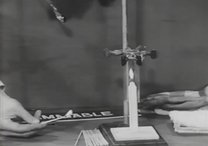
00:11:19 Here is a boat constructed out of a soap dish, a couple of pipe cleaners, an old leftover
00:11:27 aluminum cigar wrapper, and two little candle stubs placed underneath the boat.
00:11:34 Just light the little candles underneath the boat.
00:11:39 One, two.
00:11:46 This is a two candle power jet boat.
00:11:54 Now, while this little boat is warming up, I'd like to point out a few of the things
00:12:02 that Sir Isaac Newton and all his brilliant genius worked on.
00:12:06 Of course, in those days, you must remember that a scientist did not restrict himself
00:12:12 to any one field of interest.
00:12:14 All science was considered the province of the good scientists.
00:12:18 Sir Isaac Newton is a wonderful example of this type of individual.
00:12:22 Perhaps let's just jot down a few of the things he was interested in.
00:12:31 He was a good astronomer.
00:12:32 He studied a lot about the movement of the solar system and the planets therein.
00:12:38 So he was interested in astronomy.
00:12:42 Here he worked out the law of universal gravitation, by which we understand today the forces governing
00:12:48 the motion of our heavenly bodies.
00:12:51 He studied mechanics, or that part of physics having to do with the motion of various bodies,
00:13:02 applying to the motion of molecules as well.
00:13:04 This is where his interests would overlap those of chemists, who also concern themselves
00:13:10 with the motion of molecules.
00:13:12 He made fundamental discoveries in the study of light.
00:13:16 It was Sir Isaac Newton who first discovered that a beam of white light, when shined through
00:13:22 a triangular piece of glass, a prism, could be separated into its component colors.
00:13:30 He also made great and significant contributions to mathematics.
00:13:38 In fact, Sir Isaac Newton is quite often thought of as a mathematician, practically, before
00:13:42 he's thought of as a physicist or a chemist or an astronomer.
00:13:46 In mathematics, in working out these motions of bodies and the action of light, in the
00:13:52 mathematics he invented a form of calculus, which we study today.
00:13:57 Well, let's see if our little boat has gotten on yet.
00:14:02 In the cylinder, I placed a little bit of water, I should say, about a third full.
00:14:10 The back of the cylinder has a little hole punched in it, a tiny little pinhole, enough
00:14:17 to let trickles of steam escape.
00:14:20 The back end has been taped on by this light tape.
00:14:23 There it goes, it's now developing a head of steam.
00:14:25 I'll leave it at that angle so you can see the steam shooting out from the little pinhole
00:14:30 against this dark background.
00:14:31 That chalk floats, too, my doggies.
00:14:34 Get it out of there.
00:14:36 Turn this around.
00:14:40 And away goes our little jet boat.
00:14:42 The steam is really pushing it around.
00:14:44 Of course, as it moves, the flames of the candles wave a little bit so that they don't
00:14:50 get directly under the body of the...
00:14:54 It's really ejecting steam now, moving right along.
00:14:59 Let it spin itself here.
00:15:04 The principle being illustrated is this.
00:15:08 First, I should say, explained by Sir Isaac Newton.
00:15:13 The candles are causing steam to form on the inside of the little boat.
00:15:17 This steam is escaping through the hole in the back of the boat.
00:15:24 I'll get it back here where it can be seen again.
00:15:33 So that in escaping, the boat gets pushed forward.
00:15:39 Well, here's the principle.
00:15:40 First, as I say, explained by Newton.
00:15:43 As the steam is ejected in one direction, it imparts a force in the opposite direction
00:15:49 to that which is ejected, just exactly equal and opposite to the main force, to the first
00:15:56 force.
00:15:57 This is Newton's third law of motion, that every action has an equal and opposite reaction.
00:16:04 Just as in firing a bullet from a gun, the bullet, in leaving the gun, imparts a recoil
00:16:10 to the gun so that you feel the slap against the shoulder.
00:16:13 This is the principle by which a rocket, for example, would travel through space.
00:16:18 There is fuel and oxygen on the inside of a rocket.
00:16:20 The two combine to form a tremendous hot blast of gas being ejected out of the end of the
00:16:26 rocket.
00:16:28 This blast, in coming out of the rocket, would push the rocket forward.
00:16:33 Now there's a common misconception here, perhaps.
00:16:37 The steam does not have to impinge against the air or hit against the air around the
00:16:41 boat.
00:16:42 The fact that the steam is blasted out of the back of this little boat is enough.
00:16:47 That force pushes the boat forward.
00:16:51 Every action has an equal and opposite reaction.
00:16:55 Newton's third law of motion.
00:16:57 Let's just bring the boat over here once more and let it travel the full length under its
00:17:00 own steam.
00:17:01 There she goes.
00:17:05 Everything is burning.
00:17:08 Pipe cleaners are about out of water now, it's out of its fuel.
00:17:11 Well, the jet boat.
00:17:15 Let's put out the fire.
00:17:23 Here is a picture of Sir Isaac Newton about the height of his fame.
00:17:31 Very distinguished man, indeed.
00:17:37 Let's go on then and look at the third of our famous men in this talk.
00:17:43 To do the next experiment, we'll have to start the pump, so I'll just make the connection
00:17:48 here.
00:17:52 Here is a balance, right at this moment, pretty close to exact balance, on which there are
00:18:01 weights and some equipment.
00:18:03 The equipment consists of a small candle on a piece of foil, a glass chimney, and a tube
00:18:09 containing an absorbent material, which I'll explain in a moment.
00:18:14 Right now, if I just touch the balance, it will go a little bit out of balance and then
00:18:17 return to center point because it's been exactly balanced, or very nearly that.
00:18:23 It swings just about three divisions or so to either side and centers itself, perhaps
00:18:30 a little trifle heavier on the side of the weights.
00:18:34 The point is this, as the experiment progresses, one side or the other will become heavier
00:18:38 depending on how this experiment works out.
00:18:40 Let's see just how the thing does happen.
00:18:43 Now a first pump.
00:18:47 The pump is drawing air through this tube, through the absorber, and then out of the
00:18:54 chimney.
00:18:55 Air can get in on the underside of the chimney.
00:18:58 I will light the candle.
00:19:07 And put the chimney over the candle.
00:19:22 It should still be in balance, or very close to it, just like it was before.
00:19:25 It's a little, tiny, tiny bit heavy on the side of the weights.
00:19:30 Now the candle is burning in the chimney, the gases, if there are any gases being formed
00:19:35 or vapors that escape out of the chimney are sucked through the absorber and go into
00:19:41 the pump.
00:19:44 This experiment, or an experiment of this type, was first performed by a very famous
00:19:49 chemist, indeed a French chemist this time, the other two were English, Antoine Lavoisier.
00:19:57 It is Lavoisier who was given the credit for the start of modern chemistry.
00:20:03 He performed the first, most accurate experiments involving balances, much more accurate than
00:20:08 this particular one as a matter of fact.
00:20:11 At the time Lavoisier lived, there was a theory being advanced by very famous men, equal in
00:20:17 stature to Lavoisier, equal in fame.
00:20:20 There was a theory being advanced, excuse me, the candle wants to go out a little bit,
00:20:25 perhaps the suction of air is too great, let me see if I can just pinch this off a little
00:20:30 bit, there we go, there's a little bypass here which bleeds a little air into the pump
00:20:38 to make up for what the candle isn't getting, there, there it is, takes a little adjustment.
00:20:43 I was talking about Lavoisier, he first performed this kind of an experiment.
00:20:47 Now notice that the pointer already is a trifle over on the side toward the candle and away
00:20:56 from the weights.
00:20:57 It's actually on the other side of center, indicating that the side with the candle is
00:21:01 getting heavier.
00:21:02 This in spite of the fact that the candle is burning down.
00:21:08 How is it possible that the candle should be disappearing yet that side of the balance
00:21:12 is getting heavier?
00:21:13 Lavoisier was the one who explained this.
00:21:16 He pointed out, contrary to the theory of that day, that when a substance burns, it
00:21:20 gains weight, that is, picks up oxygen from the air.
00:21:25 In the case of the candle, the candle picks up oxygen, forming carbon dioxide and water.
00:21:31 That carbon dioxide and water is caught in the absorber.
00:21:35 If you didn't catch it in the absorber, it would escape out into the air and actually
00:21:40 that side of the balance would get lighter, and this was the mistake that the men made
00:21:43 in the early days.
00:21:44 They didn't watch carefully all of their weights.
00:21:47 Lavoisier did this very accurately and very carefully and pointed out this matter of combustion.
00:21:54 And now it is indeed a little heavier on that side.
00:21:57 I'll just jar the balance to see how it works here.
00:22:01 It's actually wiggling back and forth, but it is heavy on the side of the candle, indicating
00:22:07 that the candle plus its products are heavier than when they started.
00:22:11 I'll just blow the candle out, it's gone far enough, and turn the pump off.
00:22:23 Here's a picture of Lavoisier, father of modern chemistry, especially modern analytical
00:22:27 chemistry.
00:22:29 Let's go on then in time.
00:22:32 We are now to the period of about 1790, around the 1800s.
00:22:37 Lavoisier has been killed in the period after the French Revolution, actually beheaded because
00:22:44 unfortunately some people didn't realize the importance of such a man and he was guillotined.
00:22:49 It was indeed unfortunate.
00:22:52 Well, the next experiment will illustrate the observations of two scientists, actually.
00:22:58 One, a man who first performed this experiment without fully realizing what was done, and
00:23:04 the second, the man who explained it and really got the full impact of it.
00:23:08 Here is a vacuum tube in which there is a screen.
00:23:12 By means of this vacuum tube and this magnet, we will illustrate some of the properties
00:23:17 which led to the discovery of the electron.
00:23:19 To do this, I'll put the shield over the tube so that it can best be seen, and if we can
00:23:27 have the lights off, please.
00:23:29 Why?
00:23:30 There.
00:23:31 We'll see this experiment a little better.
00:23:34 I'll now cause a voltage to be imparted across that tube from one end to the other.
00:23:38 Watch what happens.
00:23:48 There is a streak of light going from this electrode to the other electrode.
00:23:58 That beam can be affected by a magnet.
00:24:02 Let's put a magnet right up against the glass and wiggle it around and see if something
00:24:06 happens to the beam.
00:24:09 I am now moving the magnet up and down.
00:24:11 The beam is also moving.
00:24:13 The magnet, of course, is on the outside of the tube.
00:24:16 Now, this means that there must be an electrical particle or particles traveling through the
00:24:22 tube because only such particles or such bits of electricity in moving would have a magnetic
00:24:30 field which could be in turn affected by a magnet.
00:24:34 If these were not electrical in nature, they would not be affected by a magnet.
00:24:37 This tube is called a Crookes tube, Sir William Crookes being the first man who observed it.
00:24:44 If we can have the lights back on again, we'll go on to the next type of tube and look
00:24:47 at this further.
00:24:51 This is a beam of electrons that we saw going across the screen, working exactly the way
00:24:57 the electrons work in the vacuum tube of your TV set.
00:25:02 Electrons running across this screen, which is made of zinc sulfide, leave a light trail.
00:25:06 That trail of light, I should say, can be seen.
00:25:09 To more properly see this or more easily see this, let me switch the electrodes to
00:25:13 the next type of Crookes tube and see if we can get a direct observation of the effect
00:25:17 of these electrons.
00:25:21 The man who first really explained this, the things that happen in a Crookes tube, and
00:25:28 the man who is credited with the discovery of the electron is an Englishman by the name
00:25:33 of Sir J.J. Thompson.
00:25:36 Here is an example of the study that Sir J.J. Thompson made when he explained the electrons
00:25:42 flowing through here.
00:25:43 There.
00:25:44 There's a little paddle wheel here running on a glass track.
00:25:48 That paddle wheel ran across the tube as if it were being bombarded by some sort of particles,
00:25:53 and indeed it was.
00:25:54 If I reverse the electrodes, I can make the paddle wheel travel in the opposite direction.
00:26:00 Still bouncing around in there.
00:26:01 See if I can get it to go all the way across the other side.
00:26:03 I now cause the beam to come from behind the paddle wheel all the way to the other end.
00:26:09 That paddle wheel shows that there are particles having weight bouncing against it, otherwise
00:26:14 it could not move.
00:26:17 Indeed an important discovery.
00:26:18 Let's go back now and look at our first experiment to see just what happened there.
00:26:23 Oh, by the way, I have here a picture of Sir J.J. Thompson, which I can show you.
00:26:35 There he is, the gentleman here with the glasses.
00:26:38 Sir J.J. Thompson.
00:26:42 Now, the experiment we started at the beginning of the talk was the experiment with the egg.
00:26:48 We made a mark on the level of liquid in the egg.
00:26:53 Here is the mark.
00:26:55 The dark region, which was formerly, the top of the dark region was formerly at the mark.
00:27:00 Now the bottom of the dark region is at the mark.
00:27:02 So the level of liquid has moved up about an inch or an inch and a half.
00:27:06 This process of liquid diffusing through the membrane of an egg is called osmosis.
00:27:12 Osmosis, O-S-M-O-S-I-S.
00:27:17 And the level of liquid rising up in the tube is due to the fact that the water in the jar
00:27:23 got up into the egg through the membrane, filled up the egg because the liquid in the
00:27:26 egg couldn't go back the other way, the egg got filled, the liquid rose in the straw.
00:27:31 The straw is put in through a hole in the top of the egg.
00:27:34 The gentleman who first observed this important physical principle, which describes the motion
00:27:38 of many liquids in the human body, was Professor Jacobus van't Hoff, a famous physical chemist.
00:27:47 Here is a picture of Professor van't Hoff, kind of a wild hair looking individual, yet
00:27:52 a very pleasant, intelligent man who inspired many students.
00:27:59 Well, who are the men that we talked about today in our Chemical Hall of Fame?
00:28:07 The famous men we discussed were van't Hoff, Boyle, Newton, Lavoisier, Thompson, and a
00:28:15 little tiny bit about Sir William Crookes.
00:28:18 Thank you.
00:28:48 This is National Educational Television.
"Chemical Hall of Fame" is one of fifty-three short educational films originally produced in 1955 for KQED San Francisco as part of the series Tempest in a Test Tube. This series of half-hour episodes illustrates basic chemistry concepts for high school students through live experiments and demonstrations by presenter Dr. Harry Sello. The experiments used in the show were designed by the American Chemical Society’s California chapter and reflect the safety standards of the time. A later, 1987 introduction with Dr. Sello has been removed from this version due to sound and image issues, but identical introductions are available in other Tempest in a Test Tube videos in this collection. A brief portion of the recording shows damage due to degradation of the tape over time. "Chemical Hall of Fame" teaches viewers how important scientists shaped chemistry and physics, and shows how their experiments explain basic scientific principles.
| Property | Value |
|---|---|
| Creator of work | |
| Place of creation | |
| Format | |
| Genre | |
| Medium | |
| Extent |
|
| Language | |
| Subject | |
| Rights | In Copyright - Rights-holder(s) Unlocatable or Unidentifiable |
| Credit line |
|
Institutional location
| Department | |
|---|---|
| Collection |
Related Items
Cite as
American Chemical Society, and KQED-TV (Television station : San Francisco, Calif.). “Chemical Hall of Fame.” Vhs, circa 1987. Tempest in a Test Tube Videocassette Collection. Science History Institute. Philadelphia. https://digital.sciencehistory.org/works/6pb6rjg.
This citation is automatically generated and may contain errors.